Bernalillo County Short-Term Rental Policy – What Homeowners Need to Know

Bernalillo County Short-Term Rental Policy – What Homeowners Need to Know

Bernalillo County Short-Term Rental Policy: What Homeowners Need to Know

Bernalillo County Assessor Tax Policy Regarding Short-Term Rentals

There's not a whole lot of detail in the major news media about this, but this is a summary of what I've been able to determine based on the information and policy that the county has put forward.

Bernalillo County has rolled out a new approach to short-term rentals (STRs), and it’s not about banning them. It’s about how they are classified—and more importantly, how they are taxed.

If you own a short-term rental, or you’re thinking about turning your home into one, this matters. A lot.


What’s the Big Change?

The county is reclassifying some short-term rentals from residential to non-residential (commercial) for property tax purposes.

Here’s the key idea:

If your property is being used like a business, it may be taxed like a business.

From the county’s own policy: classification shall be determined by the predominant use of the property

And this is the part most people miss: Pursuant to NMSA § 7-38-17.1 (1978), all property is presumed to be classified as non-residential

That flips the script. It’s not the county proving you’re commercial, you're proving you’re residential.


What Counts as a Short-Term Rental?

Bernalillo County defines a short-term rental as:

“A dwelling, or portion of a dwelling, rented for less than 30 consecutive days.”

This includes properties listed on platforms such as Airbnb and VRBO.


How the County Decides Residential vs. Commercial

This comes down to how the property is actually used.

If It Can Be Split

If you have separate spaces (example: main home + casita), they may be classified separately.

If It Can’t Be Split

The county applies a “predominant use” test and classifies the entire property based on how it’s mostly used.

Signs It May Be Considered Commercial

  • Not owner-occupied
  • Rented frequently or year-round
  • Actively marketed as a rental business
  • Managed like a business (cleaning crews, systems, etc.)
  • High guest turnover

Signs It May Stay Residential

  • It’s your primary residence
  • You rent it occasionally or seasonally
  • Limited or minimal advertising
  • Personal use outweighs rental use

There’s no single rule. It’s a total picture.


How the County Knows You Have a Short-Term Rental

This isn’t random.

The Assessor’s Office may identify STRs using:

  • City of Albuquerque STR data
  • Lodgers Tax records
  • Third-party data sources

If your property is flagged, you’ll likely receive a letter.


What You Need to Do

If contacted—or if you know you’re operating an STR—you need to respond.

Submit the Questionnaire

The county requires a Short-Term Rental Questionnaire.

This asks for:

  • Rental activity (how often it’s rented)
  • Whether you live there
  • Licensing and business use
  • Square footage used for rentals

Deadlines Matter

  • February 28: Annual questionnaire deadline
  • January 30, 2026: Deadline for updated info this year

Miss the deadline?

Your property may default to non-residential (commercial) classification.


What This Means for Your Property Taxes

If your property is classified as non-residential:

  • Your tax rate may be higher
  • Your valuation method may change
  • Your long-term holding costs could increase
  • Non-residential classification may remove the 3% cap

This is the real impact.


Can You Appeal It?

Yes. But you need proof.

If you disagree with your classification, you can file a protest within 30 days of your Notice of Valuation.

Be prepared to show:

  • Occupancy records
  • Rental history
  • Lease agreements
  • Evidence of personal use

Reality check:

In 2025, about 80% of protest cases were decided in favor of the Assessor’s Office.

This is documentation-driven. Not opinion-driven.


What This Really Means (Simple Version)

If you run a short-term rental in Bernalillo County, you may be taxed like a commercial property unless you can show it’s primarily a residence.

That’s the entire policy in one sentence.


Helpful Resources


FAQ: Bernalillo County Short-Term Rental Policy

Are short-term rentals illegal in Bernalillo County?

No. This policy is about how they are taxed, not whether they are allowed.

Will my property taxes go up if I rent my property as a short-term rental?

Possibly. If classified as non-residential, your tax rate may increase.

What if I only rent occasionally?

You may still qualify as residential, but you need to document that your primary use is living in the home.

Do I have to fill out the questionnaire?

If contacted, or if your property is identified as an STR, you should. Not responding can result in automatic reclassification.


Disclaimer

This is not legal advice. This summary is based on information available from the Bernalillo County Assessor’s Office and other public sources. You should consult a qualified real estate attorney or tax professional for guidance specific to your situation.

As with any policy change, details can evolve. Make sure you do your own research and verify how this applies to your property.

FinCEN Reporting Rules for Real Estate: What Buyers and Sellers Actually Need to Know

FinCEN Reporting Rules for Real Estate: What Buyers and Sellers Actually Need to Know

New FinCEN Reporting Rules for Real Estate: What Buyers and Sellers Actually Need to Know

If you’ve heard people talking about “new federal reporting rules” for real estate, you’re not alone. There’s been a lot of confusion — and honestly, a lot of unnecessary fear — about what the FinCEN Residential Real Estate Reporting Rule means for everyday buyers and sellers.

The goal of this article is simple: clear up the myths, explain when the rule may apply, and help you understand what information could be required during a transaction.

To make it easier, I’ve also built a step-by-step FinCEN Reporting Wizard that you can use to quickly screen a sale and see how the rule might apply. You’ll find it embedded below.

FinCEN Residential Real Estate Reporting

First — What Is the FinCEN Reporting Rule?

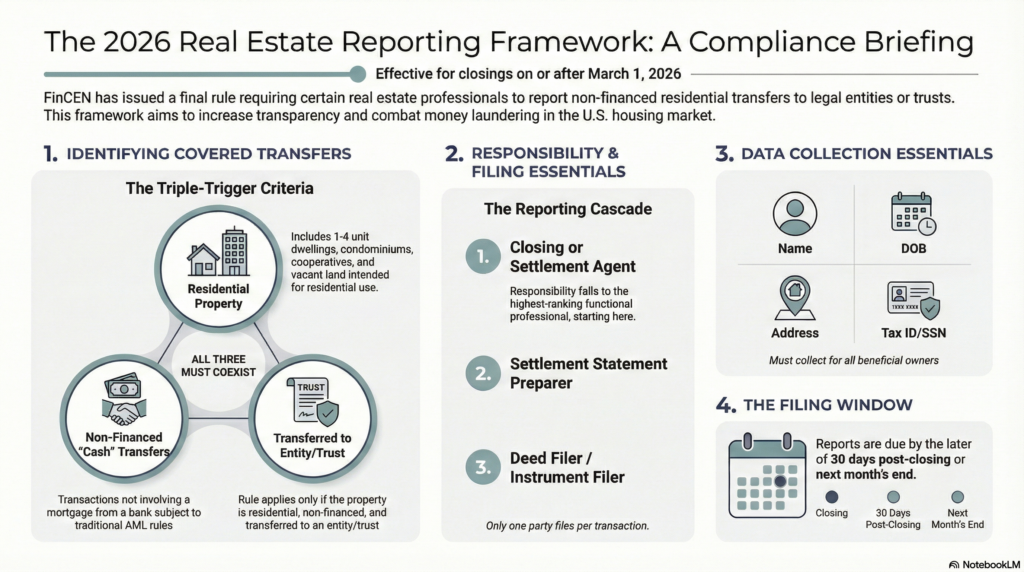
FinCEN is a federal agency focused on financial transparency and anti-money-laundering efforts. The new residential real estate reporting rule is designed to bring more visibility to certain property transfers — particularly transactions where ownership structures make it difficult to identify who is really behind the purchase.

This rule is not aimed at the average homeowner buying a house with a normal mortgage. Instead, it focuses primarily on higher-risk transaction types.


When Does FinCEN Reporting Usually Apply?

Most traditional home purchases will never trigger this rule.

In general, a transaction is more likely to fall under FinCEN reporting when it involves:

  • Non-financed or privately financed purchases (all-cash, seller financing, hard money, or private lending)
  • Buyers using legal entities such as LLCs, corporations, or certain trusts
  • Residential properties in the United States designed for 1–4 families

That doesn’t automatically mean reporting is required — but it raises the likelihood that the settlement agent will need to review the transaction more closely.


When the Rule Usually Does NOT Apply

Many everyday transactions are typically outside the scope, including:

  • Purchases financed through a regulated bank or credit union
  • Individuals buying property directly in their own names
  • Certain court-ordered or supervised transfers

That said, every transaction is unique. The final determination is made by the reporting person or settlement professional, not by a checklist alone.


What Information Might Buyers Need to Provide?

If a transaction falls into a reportable category, buyers may be asked for additional details during closing. This often includes:

  • Legal name and address of the purchasing entity or trust
  • Identification information for individuals who own or control the entity
  • Details about the person signing documents on behalf of the entity
  • Payment and funding information

For individual buyers, the requirements are generally lighter — but settlement agents may still verify identity information.


What Sellers May Be Asked For

Seller reporting requirements are typically more straightforward. Depending on the structure of ownership, sellers may need to provide:

  • Legal name and address
  • Identification type and number
  • Trustee details if the property is owned in a trust

These requests usually come from the title company or settlement professional handling the closing.


Why This Rule Exists

Real estate has historically been one of the few major asset classes where ownership structures could sometimes obscure who was behind a purchase. The FinCEN rule aims to bring consistency to reporting and reduce the risk of financial crimes — while still allowing normal transactions to move forward smoothly.

The key takeaway is this: the rule is not designed to slow down legitimate buyers and sellers. It simply adds another layer of transparency in certain situations.


Use the FinCEN Reporting Wizard

Because the rule can feel complicated, I built an interactive screening tool to help break it down into plain language.

Use the FinCEN Reporting Wizard below to see how a specific transaction may be categorized.


Final Thoughts

New regulations always bring questions, and this one is no different. The most important thing to remember is that most traditional home purchases will not be affected. For transactions that do fall within the rule, the process is usually handled behind the scenes by settlement professionals.

If you’re unsure how a specific situation fits, start with the wizard, then talk with your real estate professional, attorney, or title company for guidance.

Clarity beats confusion — and understanding the process ahead of time makes closing day much smoother for everyone involved.

Housing Is on the Agenda in 2026 – Here’s What New Mexico Lawmakers Are Proposing

Housing Is on the Agenda in 2026 – Here’s What New Mexico Lawmakers Are Proposing

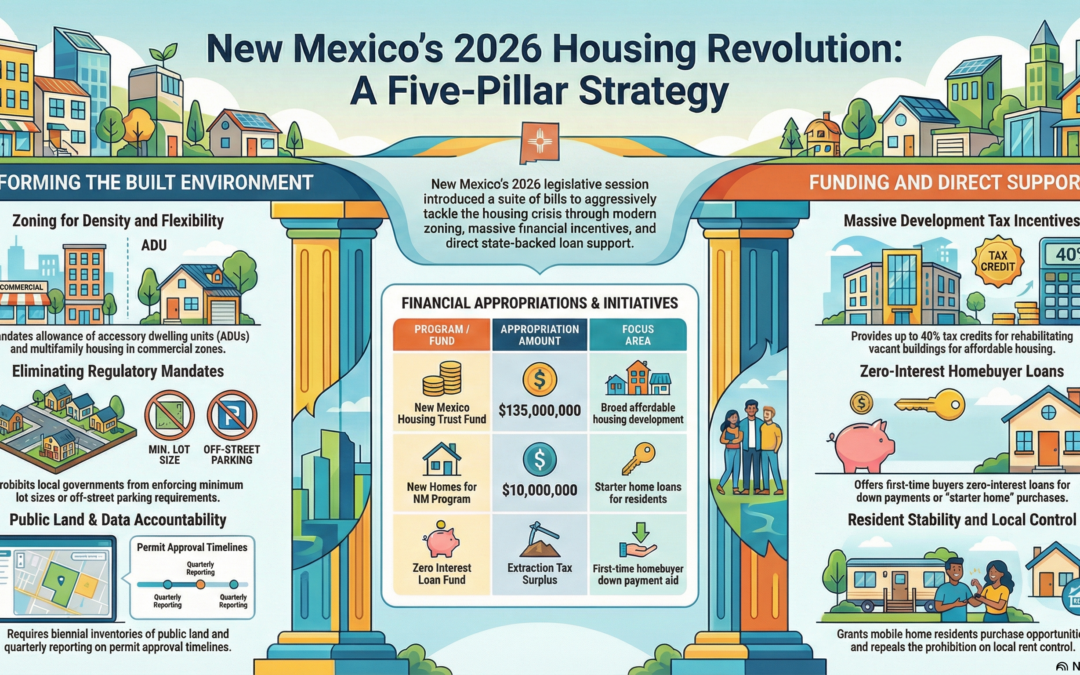
housing-related proposals for New Mexico’s 2026 sessionNew Mexico’s 2026 Housing Proposals: What’s on the Table, and Why It Matters

As New Mexico approaches the 2026 legislative session, housing is clearly one of the Legislature’s top priorities.
Lawmakers have introduced a large and diverse set of housing-related bills, resolutions, and memorials, addressing everything from zoning and construction costs to homeownership, homelessness, taxes, insurance, energy, and infrastructure.

It’s important to start with a clear caveat: these are proposals, not laws. Many of them will change. Some will not advance. Others may pass in amended or scaled-back forms. And notably, many of these ideas are not new—versions of them have been introduced, debated, or stalled in prior sessions.

Still, the sheer volume and breadth of housing proposals this year signal something meaningful: housing affordability and availability are firmly on the Legislature’s agenda in 2026.

I reviewed every housing-related proposal I could find so far and compiled a worksheet summarizing what each one does, how it works, and how it is funded. What follows is a high-level look at the major themes behind these proposals and their potential implications—without yet weighing in on which are most effective or which may be more performative than impactful.

I compiled the source material for this article from the New Mexico Legislature’s website and used ChatGPT to help summarize and organize the proposals discussed here.

I’ve also put together a Google Docs worksheet that includes links to every proposal mentioned here, along with more detailed summaries of each bill.

Zoning and Housing Supply: Potentially High Impact, Repeatedly Contested

Several proposals focus on changing zoning and land-use rules, which determine what kinds of housing can be built and where.

  • HB 17, which would require local governments to allow accessory dwelling units (ADUs) and more multifamily housing in commercial areas and near transit
  • HB 138, which would eliminate minimum lot size requirements in residential zones
  • SB 131, a sweeping zoning reform bill that would legalize apartments in commercial zones, allow duplexes and ADUs statewide, and remove height and parking mandates
  • SB 128, which targets underused public land by requiring inventories and, in many cases, the sale of long-vacant public property in metropolitan areas

These proposals are widely seen by housing researchers as necessary conditions for increasing housing supply over time. They don’t directly fund construction, but they remove legal barriers that prevent smaller, denser, and more affordable housing types from being built.

None of these ideas are new to New Mexico. Similar zoning reform efforts have surfaced in past sessions and often stalled due to local opposition or implementation concerns. Their return in 2026 suggests persistence—but not yet success.

If any category of proposals has the greatest potential to meaningfully affect housing availability, it’s this one. It’s also the category most likely to face political resistance and uneven local implementation.

Funding, Tax Credits, and Cost Reduction: Familiar Tools with Mixed Track Records

Another large set of proposals focuses on funding housing directly or lowering the cost of building it.

  • HB 139, which would appropriate $135 million to the New Mexico Housing Trust Fund
  • HB 77, creating a tax credit to rehabilitate abandoned buildings and vacant lots into affordable housing
  • SB 92, reducing construction costs by creating a gross receipts tax deduction for affordable multifamily housing
  • SB 119, establishing a demolition fund to remove condemned residential properties
  • SB 58, extending property tax exemptions for redevelopment projects
  • HB 140, funding oversight of Affordable Housing Act programs

These are well-worn policy tools. In some cases, they can help affordable housing projects move forward. In others, their impact is limited by scale, administrative complexity, or local barriers that remain unchanged.

Some of these proposals could be meaningful—especially if paired with zoning reforms like HB 17, HB 138, or SB 131.
Others may have modest or indirect effects, particularly if they are not large enough to influence market behavior.

Homeownership, Tenants, and Housing Stability: Who Gets Access

A separate group of proposals focuses less on total housing supply and more on who benefits from existing housing.

  • HB 168 and HB 176, creating zero-interest loan programs for first-time homebuyers
  • SB 114, restricting hedge funds and corporations from buying single-family homes
  • HB 192, temporarily prohibiting foreign corporations from purchasing single-family homes as investment rentals
  • HB 167, giving mobile home park residents a right to purchase their park before it is sold
  • SB 138, repealing the state ban on rent control and restoring local authority
  • HB 190, funding eviction prevention and housing assistance for LGBTQ+ people experiencing homelessness

Some of these proposals may meaningfully help specific households or communities. Others are likely to have limited impact on overall affordability or supply, even if they are politically popular.

Buyer assistance can help individuals but does little to lower prices without increased supply. Ownership restrictions often sound bold but may be constrained by exemptions and enforcement realities.

This is an area where several proposals risk being more performative than impactful, though that assessment ultimately depends on details and implementation.

Housing-Adjacent Costs: Taxes, Insurance, Energy, and Infrastructure

Many proposals this session address costs that strongly affect housing affordability even though they don’t directly create housing.

  • HB 103, HB 148, SB 149, and HJR 8 addressing property tax rules and accountability
  • SB 154, requiring wildfire insurance to cover related flood damage
  • SB 161, addressing wildfire mitigation and utility liability
  • SB 55, expanding the solar tax credit
  • HB 183, funding drinking water testing and filtration
  • HB 110, increasing transparency around housing permits
  • SB 127, restructuring state homelessness governance
  • HM 20 and SM 10, requesting studies related to renewable energy permitting and portable solar

These proposals are largely indirect in their housing effects. Some could reduce long-term costs or improve housing stability. Others may have little measurable impact but still respond to real constituent concerns.

A Realistic Takeaway

It would be easy to frame this legislative moment as a breakthrough—or, alternatively, to dismiss much of it as political theater. The reality is more complicated.

  • Some proposals—particularly zoning and land-use reforms like HB 17HB 138SB 131, and SB 128—have real potential to affect housing availability if enacted and implemented well; however, they face property rights questions.
  • Some funding and tax proposals may help at the margins but are unlikely to solve structural shortages on their own.
  • Some proposals will likely have minimal impact on housing affordability and function more as political signaling than solutions.

What is clear is that housing is a top-tier issue for the New Mexico Legislature in 2026, and lawmakers are engaging with it from many angles—even if not all approaches are equally effective.

Attention alone doesn’t solve a housing crisis. But without sustained attention, solutions are impossible.

For now, this is a snapshot of what’s on the table—and a reminder that intent, repetition, and outcomes are very different things.

Tego


Albuquerque Real Estate Market Forecast 2026

Albuquerque Real Estate Market Forecast 2026

Albuquerque Real Estate Market Forecast 2026

If you follow housing news, 2026 is going to be loud. You’ll see big political promises about housing. You’ll see nonstop media stories about affordability. And you’ll definitely see more “housing crash” headlines - because fear gets clicks.

But Albuquerque isn’t a headline market. It’s a real-life market. Real payments. Real inventory. Real neighborhoods. So here’s my Albuquerque real estate market forecast for 2026, with the noise stripped out and the local reality put back in.

Albuquerque Real Estate Market 2026 Forecast

Tego Venturi - The ABQ Housing Stats Guy

Quick Forecast: Albuquerque Housing Market 2026

Here’s my base-case Albuquerque housing market forecast 2026:

  • Home prices: up roughly 2% to 4% overall (not evenly across every neighborhood and price point)
  • Sales: slightly higher than 2025 (~10,000 homes sold), but still below years like 2018 and 2019, where we had ~13,000 sales.
  • Inventory: improves slightly but remains tight in the most desirable segments (lower price points in popular areas). No flood of inventory coming
  • Market behavior: more negotiation, more concessions, and more “price it right or it sits” listings

If mortgage rates improve faster than expected, demand improves faster. If rates stay stubborn, the market stays slow-but-stable.


"Affordability" Will Be the Word of the Year

If I had to pick one theme for 2026, it’s affordability. Not just housing affordability - everything affordability. Housing, insurance, groceries, cars, interest rates, wages. It’s the filter people will use for almost every big financial decision.

Expect big announcements from the political world on affordability. Expect bold proposals. Expect lots of headlines. Some of that will help at the margin. Most will be noise.

Local takeaway: Albuquerque affordability probably won’t “snap back.” It’s more likely to catch up slowly through a combination of moderate price appreciation, deal structures like rate buydowns, and wages climbing faster than prices and inflation.


Doom Headlines Will Keep Coming (Because Clicks Pay the Bills)

Let’s say it plainly: doomers are going to doom. “Crash” headlines get clicks. So those stories won’t go away in 2026.

Most of them have a kernel of truth, but the actual story will say something different or toned down, be missing the full context, or overhype the real impact on the market.

When you read past the headline, you’ll often find:

  • cherry-picked timeframes
  • cherry-picked metros
  • missing or ignored details that matter
  • a national story presented as it applies to your street

Rule for 2026: National headlines are entertainment. Local stats are decision tools.


Are We Through the Correction Phase? It Looks Like It

The surge in sales activity and price growth started in 2020. The pullback started in late 2022. Since then, we’ve had three years of slower sales and moderate appreciation.

That looks like a market that already went through its “correction” phase. Are we perfectly at the low point in the cycle? Nobody nails that timing. But based on the rhythm we’ve been in, it looks like we’re closer to the low than the high.


2026 May Feel Like a “Great Housing Reset”

You’re going to hear phrases like “reset,” “normalization,” and “return to balance.”

That’s a decent description of what 2026 could be:

  • fewer panic decisions
  • more normal contingencies
  • more price discovery
  • more realistic expectations on both sides

Not boring like “dead market.” Boring like “functional market.”


Mortgage Rates Are Still the Steering Wheel

If you want one dial to watch for 2026, it’s mortgage rates.

Rates don’t need to be “low” for a market to function. They need to be:

  • predictable
  • accepted
  • reflected in pricing and deal structure

If (a big if) rates drift down and stabilize, sales volume improves. If rates stay choppy, buyers stay cautious.

Either way, 2026 is likely to stay negotiable, and that matters more than people realize.


New Construction Will Stay Steady (and It Will Shape Resale)

I expect new home construction in the Albuquerque area to continue at a steady pace in 2026. Not overbuilt. Not a flood. Just consistent.

Why that matters for Albuquerque resale sellers:

  • builders can offer incentives (especially rate buydowns)
  • buyers compare resale to new construction more than ever
  • resale homes must compete on price, condition, and presentation

In this kind of market, “price it right from day one” becomes a real strategy, not a slogan.


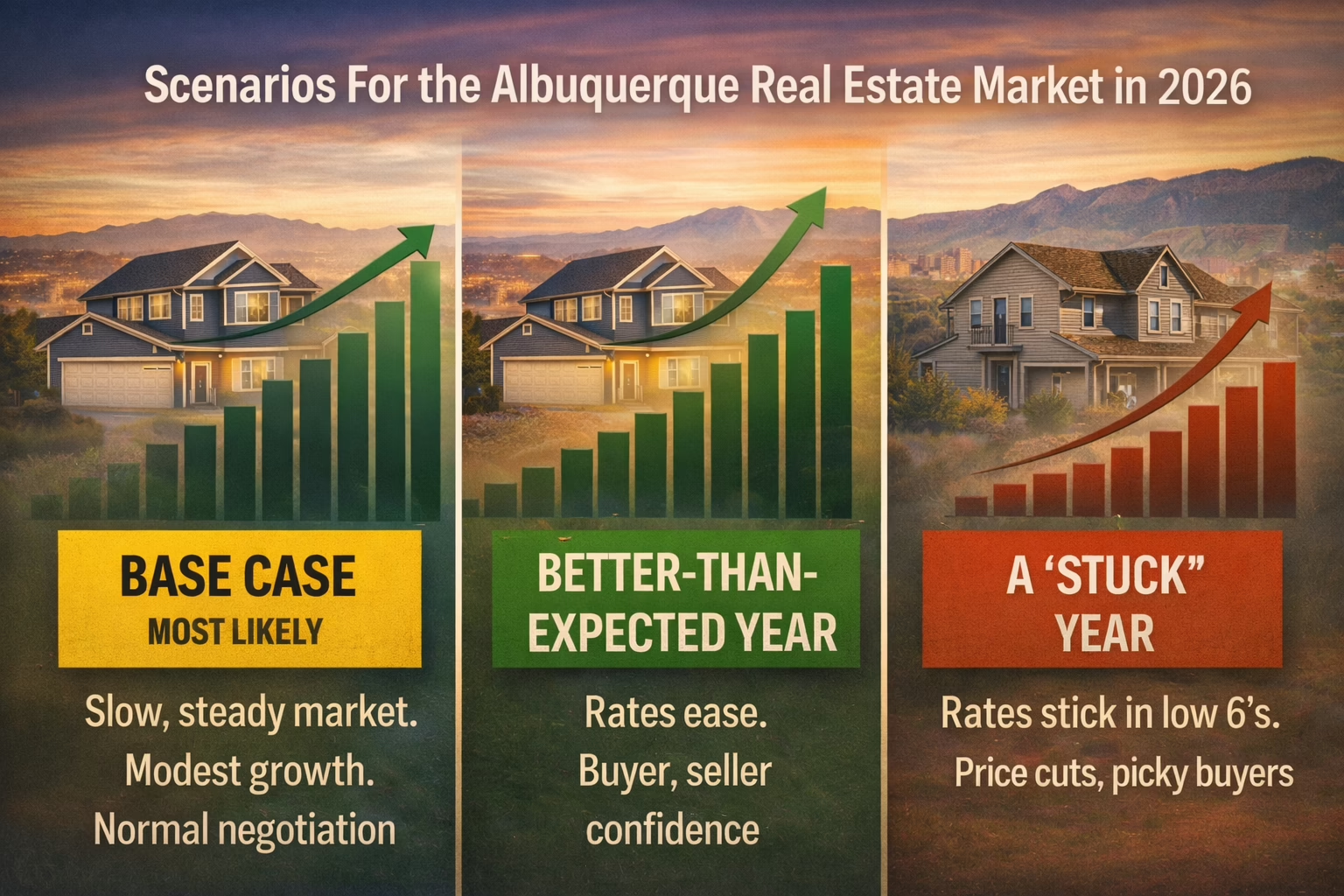
Three Scenarios for the Albuquerque Real Estate Market in 2026Three Scenarios for the Albuquerque Real Estate Market in 2026

Scenario 1: Base Case (Most Likely)

A slow, steady market with modest price growth. Negotiation stays normal. Homes that are priced right for condition and location and show well still sell in a reasonable timeframe.

Scenario 2: Better-Than-Expected Year

Rates ease and confidence returns. More buyers show up, and sellers, since most buyers are also sellers. Competition increases on the best listings. Sales (transactions) rise faster than prices.

Scenario 3: A “Stuck” Year

Rates stay in the low 6's, and buyers stay picky. Price reductions stay elevated. Overpriced and outdated homes sit longer. The market still functions - it just takes more realism. Not a "crash" just slow and steady sales and flat appreciation.


What Buyers Should Do in 2026

If you’re buying in Albuquerque in 2026, here’s how you win without getting emotional:

  1. Get financing dialed in early.
    Pre-approval, budget, and cash reserves. Understand the power of a rate buydown on your monthly payment. Don’t wing it.
  2. Shop the payment, not just the rate.
    Price, insurance, taxes, and HOA fees can matter as much as the interest rate.
  3. Negotiate like you have some leverage. 
    Concessions, repairs, closing costs, rate buydowns - if it’s been sitting, ask. But... that is a very case-by-case situation.
  4. Be picky, but don’t freeze.
    You’ll have more choices than in peak years, but the "right one" can still move quickly.
  5. Ignore the media noise.
    Owning a home is a long-term life decision, not a reaction to a scary (or hype) headline.


What Sellers Should Do in 2026

If you’re selling in 2026, assume buyers will be informed and cautious. They will compare everything.

Here’s the playbook:

  1. Spend time on pricing strategy.
    In a negotiable market, “let’s try it” becomes “let’s chase it.”
  2. Have a concessions strategy.
    Even if you don’t love it, buyers are seeing incentives elsewhere.
  3. Condition is leverage.
    Clean, staged, updated where it counts. Great photos. Easy showings.
  4. Consider a pre-list inspection.
    It reduces surprises and gives you control over the story.
  5. Don’t over-improve.
    Spend where you’ll get paid back. Not where your taste gets validated.
  6. Assume buyers compare you to new builds.
    Even with a better location, you’re competing with incentives and new-home shine.


FAQs: Albuquerque Real Estate Market Forecast 2026

Will Albuquerque home prices drop in 2026?

Prices can soften in certain neighborhoods or price ranges, but my base-case forecast is modest growth overall, not a broad decline. Most signs point to normalization, not collapse.

Is Albuquerque a buyer’s market in 2026?

It’s more accurate to call it a negotiable market. Buyers have more leverage than in the frenzy years. Sellers still win when the home is priced right and shows well.

Is 2026 a good time to buy a house in Albuquerque?

If the payment works, and you’re buying with a long-term plan, 2026 can be the year to make the move. The “perfect year” rarely shows up on schedule.

What is the biggest housing trend in 2026?

Affordability. Not just sale prices - monthly payments, mortgage rate, insurance, taxes, income, and the deal structure are all needed to make homes work.

What should I watch locally to know what’s really happening?

Look at 30–90 days of activity in your exact price range and preferred location: active inventory, days on market, price reductions, and new pendings versus new listings. That tells you more than any national headline.


Bottom Line

If you want the cleanest summary of my Albuquerque real estate market forecast 2026, it’s this:

2026 looks like a steadier, more functional market, very similar to 2025. Affordability will dominate the conversation. Doom headlines will keep coming. But locally, strategy will matter more than drama.

If you want a neighborhood-specific breakdown (or your price range), reach out, and I’ll pull the local stats and tell you what’s happening where you actually live or want to live.

Contact us here or explore more Albuquerque market updates on the site.

Albuquerque Real Estate Trends: November 2025 Market Update (Slow but Steady)

Albuquerque Real Estate Trends: November 2025 Market Update (Slow but Steady)

Albuquerque Real Estate Trends: November 2025 Market Update (Slow but Steady)

November 2025 was one of the slowest months we’ve seen in a while for Albuquerque home sales. Closings dropped, prices stayed basically flat, and inventory inched up but remains below pre-2020 levels. Here’s what the data really says and what it means if you’re thinking about buying or selling in 2026.

  • Closed sales in November fell to 638, down about 12% from November 2024 and almost 200 fewer than in October.
  • Prices are flat to slightly up for 2025 overall: median at $355,000 across all home sales in November, 1.4% lower than November 2024.
  • We expect annual appreciation to be ~2–3% higher year-over-year for the full year.
  • Inventory sits around 2,086 homes, up ~5% from last year but still slightly below 2019 levels at this time of year.
  • Days on Market has drifted back toward a “normal” pace at about 49 days, similar to 2018–2019.
  • National forecasts call for a ~14% jump in home sales next year, which could mean roughly 1,400 more closings in the Albuquerque area if that plays out locally. :

Market Snapshot – November 2025

November was sluggish. Only 638 single-family homes (attached and detached) closed in the Albuquerque area, about 190 fewer than in October and roughly 12% below November 2024’s 728 closings. Year-to-date, though, total 2025 sales are still slightly ahead of 2024, so November looks more like a soft patch than a collapse.

On the pricing side, the median sales price came in at $355,000 in November, down 1.4% compared to November a year ago and off from October’s $362,750. But when you zoom out beyond a single month, 2025 still looks like a modestly positive year for prices, with overall appreciation tracking in the 2–3% range and price-per-square-foot for November running exactly flat versus last year.

Why it matters

  • Buyers: You’re not fighting runaway price gains. A flat-to-modestly-up market gives you more room to negotiate and more time to think.
  • Sellers: You can still sell at or near the peak values achieved over the last couple of years, but you can’t count on multiple offers day one. Strategy and pricing matter again.
  • Investors: A boring market is usually a healthy market. Small, steady gains are more sustainable than boom-and-bust cycles.
Weekly Altos-style snapshot: inventory dipped seasonally into late November, buyer activity pulled back over Thanksgiving, and showings are now ticking back up as we move through December.

Foot Traffic & Buyer Demand: Holiday Dip, Normal Pattern

One of the best forward-looking indicators we watch is showing activity—how many buyers are actually out touring homes each week. In 2025, showings slid sharply at the end of November, right on cue with the Thanksgiving holiday. That same late-November drop shows up in every recent year on the chart. After the holiday, activity starts to recover into December, then takes another pause around Christmas.

Overall, 2025 has fewer buyers out shopping than some of the boom years, but the showing trend looks very similar to 2024. Fewer house hunters, yes. But not a ghost town.

Why it matters

  • If you’re selling: Expect fewer showings over the holidays. That doesn’t mean your home is “broken” - it’s just the calendar.
  • If you’re buying: This is a sneaky window of opportunity. With fewer competing buyers in November and December, you may have more negotiating room.

Inventory: Up From Last Year, Still Below 2019

Active listings for November clocked in at about 2,086 homes on the market. That’s roughly 4.9% more inventory than one year ago and about 300 fewer homes than we saw in October as sellers started to pull back heading into the holidays.

When we look at a longer weekly view back to 2019, Albuquerque has more homes on the market than in the tight-supply years from 2020 through 2024, but still fewer than in 2019, when there were about 2,150 active listings at the same time of year. Many large markets nationally have already moved above their 2019 inventory levels, but Albuquerque remains a bit undersupplied by that benchmark.

Why it matters

  • Still a supply shortage: We have more homes to choose from than during the extreme pandemic squeeze, but not a glut.
  • Pricing support: Slightly tight inventory helps keep prices from falling even when demand is soft.
  • Strategy for sellers: With fewer new listings hitting the market through January and early February, a well-prepared listing can stand out.
Long-term Albuquerque price and inventory trends: strong post-2020 appreciation followed by a shift into low single-digit annual growth and modestly higher inventory through 2024–2025.

Days on Market: Back to a “Normal” Pace

Average Days on Market (DOM) for homes that actually sold in November landed at 49 days. That’s strikingly similar to February 2020, right before the pandemic, which sat at about 45 days. It also feels a lot like the 2018–2019 market—slower than the frenzy years, but still healthy.

Remember, DOM measures how long a property sits from Active status until it goes under contract (Pending). It doesn’t include the homes that never sell, only the ones that find a buyer.

Why it matters

  • Buyers: You have time to think, inspect, and negotiate. Homes aren’t vanishing in 24 hours anymore.
  • Sellers: A realistic expectation is key. If your home takes 30–60 days to go under contract, that’s not failure - it’s the market.
  • Pricing check: If you’re well beyond the average DOM for your price bracket, it’s a signal to revisit price, condition, or marketing.

Pending Sales & New Listings: Quiet but Steady

Looking at “homes in pending” each week, we finished November with 969 pending sales, and the 90-day moving average sat around 1,021—just a hair above the same point in 2024 (about 1,002). That tells us there is steady contract activity happening behind the scenes, even if the closed sale count looked weak in November.

New listings are following their usual seasonal pattern. They dropped off sharply through late November and will likely keep easing down into January before picking up again in February and March. For several years in a row, that pattern has repeated almost like clockwork.

Why it matters

  • Buyers: You’ll see fewer fresh options over the holidays, but you can still find opportunities among existing inventory and homes returning to the market.
  • Sellers: Less competition from new listings can help your home stand out if you’re willing to list in December or January.

How Albuquerque Compares & What’s Next for 2026

Compared to some big markets—parts of Texas, Denver, and Phoenix—Albuquerque has held up better on prices, with far less downward pressure. Our median of $355,000 and average price around $410,000 still sit below many regional peers, even as we wrestle with our own affordability challenges.

Nationally, the National Association of REALTORS® is projecting about a 14% increase in home sales for next year. If that plays out here, it would mean roughly 1,400 more closed sales on top of the ~10,000 transactions expected in our market for 2025. We’ll see how that forecast lines up with reality once we get into the spring selling season.

Why it matters

  • More move-up and move-down buyers: As rates and affordability stabilize, some of the “locked-in” owners may finally make their move.
  • Pricing stability: A moderate increase in sales without a major inventory surge usually supports flat-to-modest price gains.
  • Planning window: If you’re targeting a move in 2026, now is a good time to tighten up your finances and get a strategy in place.

Buyer & Seller Q&A – November 2025 Edition

Q: Are Albuquerque home prices going up or down right now?

A: For November 2025, the median price was $355,000, down about 1.4% from last November. But looking at the full year, prices are roughly 2–3% higher than 2024, and price-per-square-foot for November is flat year-over-year. In plain English: prices are basically holding steady, not surging or crashing.

Q: Why were November 2025 home sales in Albuquerque so slow?

A: We only saw 638 closings in November, which is low for our market and notably weaker than both October and last November. The holiday calendar, fewer active buyers, and a slower national economy all play a role. The good news is pending sales and showings suggest it’s a soft patch, not a full stop.

Q: How many homes are for sale in Albuquerque right now?

A: The November reading showed about 2,086 active listings. That number moves daily, but it’s a good snapshot: slightly more homes available than last year at this time, but still a bit below 2019 levels, so we’re not in a high-inventory buyer’s market yet.

Q: Why are homes staying longer on the market?

A: Average Days on Market is now around 49 days—up from the frenzy years but similar to 2018–2019 and to pre-pandemic 2020. DOM measures how long it takes a home to go from Active to Pending. With more balanced supply and demand, it’s normal for homes to take 30–60 days to find the right buyer.

Q: Is 2025 a good time to buy a house in Albuquerque?

A: For many buyers, yes. Prices are stable, inventory is modestly higher, and you’re not fighting bidding wars on every well-priced home. Whether it’s “good” for you depends on your budget, job stability, and time horizon. If you plan to own for 5–10 years, a flat or slow-growth market like this can be a solid entry point.

Q: Is now a good time to sell my home in Albuquerque?

A: If you have a compelling reason to move, you can still sell successfully. Prices are near their highs, and inventory is not excessive, which helps well-priced, well-prepared homes stand out - especially during the winter when new listing counts are lower. If you’re flexible on timing, we’ll help you decide whether an early-spring or late-winter launch makes more sense for your specific neighborhood and price point.


About Venturi Realty Group — Data-driven Albuquerque real estate pros with 4,000+ closed transactions and active involvement in GAAR and SWMLS. We host the Albuquerque Real Estate Talk podcast and provide weekly market updates to help you make informed decisions. Call 505-448-8888 or visit WelcomeHomeABQ.com.

Albuquerque Market Updates | Search Homes | Contact Venturi Realty Group