Rent vs. Buy in Albuquerque: 2026 Reality Check and Long-Term Guide
By Venturi Realty Group
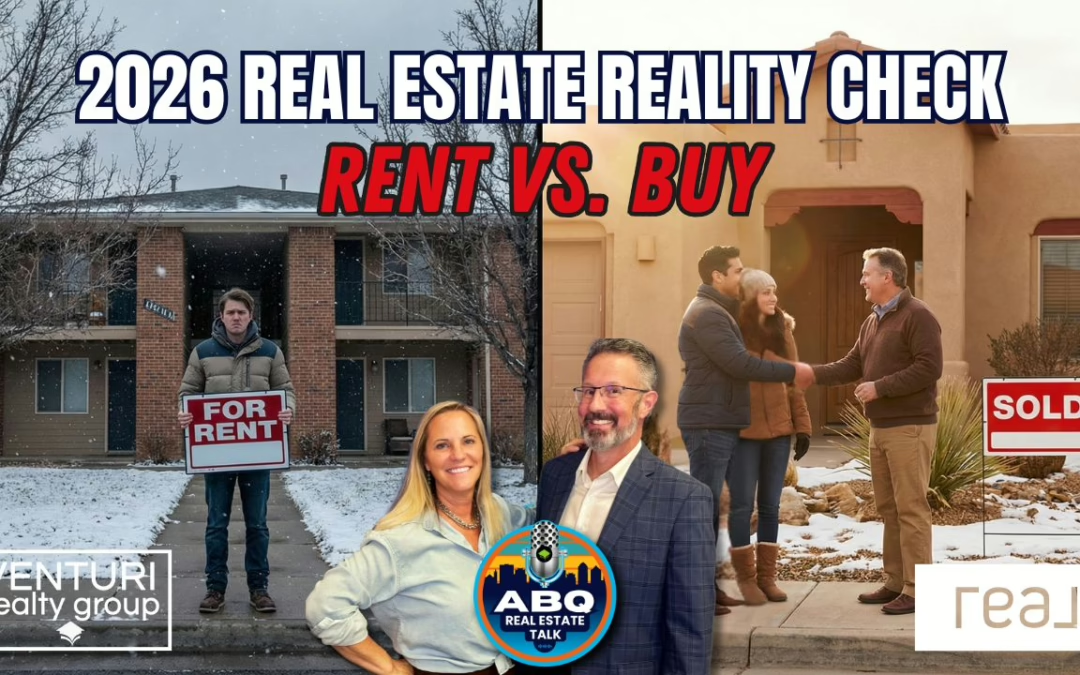
For many Albuquerque residents, the housing question isn’t simply, “Can I buy a home?” It’s, “Should I keep renting, or is it finally time to buy?” In this episode of Albuquerque Real Estate Talk, Tego Venturi, Tracy Venturi, and Leah Romero-Kayser walk through that decision the way a good reporter would: starting with the numbers, but quickly widening the lens to look at stability, risk, lifestyle, and long-term wealth building.
The conversation centers on a very real scenario: a roughly $320,000 three-bedroom, two-bath home in the Albuquerque area versus renting a similar single-family home for about $2,200 a month. In the first year, renting that property can save around $300 a month compared with the total monthly cost of owning it. That short-term savings is compelling for many people who feel squeezed by today’s prices and interest rates.
“But for most properties, it’s cheaper to rent these days.”
— Tracy Venturi
But the team doesn’t stop at the first-year math. They follow the same house out over five and ten years, layering in modest appreciation and principal paydown to show how a small down payment can grow into substantial equity over time. They contrast that with what happens if you rent the same whole period: the monthly savings can get eaten up by rising rents while the opportunity to build equity passes you by.
“Let me just preface this by saying there are no wrong answers, only real ones.”
— Leah Romero-Kayser
This guide turns their discussion into an evergreen, research-style article focused strictly on the buying versus renting decision in Albuquerque. It follows their four “reality check” questions, explores when renting is the smarter move, and explains why homeownership remains one of the most important wealth-building tools for households that are ready for its responsibilities.
Rent vs. Buy: More Than Just a Payment Calculator
When the team talks about renting versus buying, they repeatedly stress that it isn’t just a financial puzzle. Yes, there is a breakeven point where the long-term economics of owning usually surpass renting. But between now and that point, you live in the home every day. How it feels, how much control you have, and how likely you are to be forced to move can matter just as much as the spreadsheet.
Livability and Making a Home Your Own
Tracy frames one of the most underrated differences in a single word: livability. Owning a home means you can make it truly yours — painting, remodeling, adding storage, creating a home office, or building the dog run you’ve always wanted. Those changes don’t just add comfort; over time, smart updates can also add value to the property.
By contrast, renters live within a landlord’s rules. Many leases restrict painting, structural changes, or even installing things like ceiling fans or pet enclosures. That can make it harder to adapt your home to life changes like remote work, a new baby, or caring for an aging parent.
“When you are a renter, you’re helping whoever owns that property with their wealth building and, and their equity.”
— Tego Venturi
When you improve a rental, you’re often improving someone else’s long-term investment. When you improve a home you own, you’re upgrading your own asset and your daily quality of life at the same time.
Stability, Community, and the Emotional Cost of Moving
The emotional side of housing comes through strongly in Leah’s comments about stability. She notes that beyond dollars and cents, what people crave is the security of knowing that if they keep making their payment, they can stay put. A fixed-rate mortgage gives that assurance in a way that a year-to-year lease can’t.
“The sense of stability, I think also is a huge factor.”
— Leah Romero-Kayser
With rentals, even great tenants can be told they have 30 or 60 days to move because the owner wants to sell, move back in, or house a family member. The team has seen renters in Albuquerque face surprise non-renewals despite spotless payment histories. The financial cost of moving — time off work, deposits, truck rentals, and new furniture — stacks on top of the emotional and physical strain of starting over somewhere new.
Homeownership doesn’t eliminate all risk, but it dramatically lowers the odds that a third party’s decision will uproot your household. That sense of control tends to foster stronger ties to neighbors, schools, and local businesses, which in turn reinforces neighborhood stability over time.
Flexibility and Simplicity When Renting
Still, the team is careful not to paint renting as a mistake. For certain seasons of life, it is not just acceptable but absolutely rational. Renting excels when flexibility and simplicity are your top priorities.
Leah points out that if you are “checking out” Albuquerque for a year or two, you may not be ready to commit to a particular neighborhood, commute, or school district. A lease lets you leave at the end of the term with little friction. If you’re early in a career that may take you to different cities, renting can keep your options open.
“They really prefer hands off and simplicity. They’re probably better being a renter.”
— Tracy Venturi
Tracy describes clients who know themselves well: they aren’t handy, their schedules are packed, and they don’t want to think about roofs, water heaters, or contractors. For them, being able to call the landlord when something breaks is worth giving up the equity upside.
“I just want easy, simple. I wanna write somebody a check every month and not have to think about it. And that, that’s a perfectly fine answer.”
— Tego Venturi
The takeaway from this section is clear: the right answer to “rent or buy?” depends on how you weigh control, stability, and long-term wealth against flexibility and day-to-day simplicity.
The Surprising Math Behind Equity Building
One of the most misunderstood parts of the rent-versus-buy debate is how quickly equity can build—even when home price growth is modest and the down payment is relatively small.
The following example mirrors the exact scenario discussed in the episode and uses conservative assumptions designed to avoid overstating the case for ownership.
Baseline Scenario
- Home price: $320,000
- Down payment: $16,000 (5%)
- Loan amount: $304,000
- Interest rate & term: 6.25% / 30 years
- Monthly principal & interest: $1,871.78
- Home value growth assumption: 3% annually (below the long-term U.S. average)
Even at this conservative growth rate, equity accumulates from two sources at the same time:
loan paydown and home value appreciation.
Importantly, the original down payment is excluded from the equity totals below.
Loan Paydown (Forced Savings)
- 5 years: $20,255 principal paid
- 10 years: $47,917 principal paid
- 20 years: $137,294 principal paid
Home Value Growth at 3%
- 5 years: $370,968 (+$50,968)
- 10 years: $430,053 (+$110,053)
- 20 years: $577,956 (+$257,956)
Net Equity Created (Down Payment Excluded)
- After 5 years: approximately $71,000
- After 10 years: approximately $158,000
- After 20 years: approximately $395,000
This is the part of the math many renters never see.
While renting may be cheaper on a monthly basis in the early years, ownership quietly converts monthly payments into long-term wealth through compounding appreciation and automatic loan paydown.
“People focus on what they’re saving this month—but forget what they’re not building over time.”
None of this means buying is always the right choice.
But it does explain why the rent-versus-buy decision cannot be evaluated using a one-year snapshot.
The real financial story unfolds over five, ten, and twenty years—not at lease renewal.
Is It Cheaper to Rent or Buy in Albuquerque?
From a purely monthly payment standpoint, the team acknowledges a reality many Albuquerque renters have already felt: right now, renting can often look cheaper than buying the same home. Between higher prices and interest rates, the first-year owner’s payment on a median-priced starter home may be several hundred dollars more than rent on a similar property.
“Okay. So, for renting is it’s, it’s cheaper per month, at least …”
— Tego Venturi
Using their example of a roughly $320,000 three-bedroom, two-bath home versus a similar single-family rental around $2,200 a month, Tego calculates that the renter effectively “saves” about $300 each month in year one. For anyone rebuilding after a financial setback or facing other big expenses, that cushion can be meaningful.
But their analysis doesn’t end there. They extend the comparison well beyond the first year using conservative assumptions and standard 30-year fixed-rate financing. With each mortgage payment, the homeowner gradually pays down principal, and even modest appreciation adds to equity. Over time, those two forces compound in ways that are easy to overlook when comparing only monthly payments.
Using the same baseline scenario discussed in the episode—a $320,000 home with a 5% down payment ($16,000) and a $304,000 loan at 6.25%—the long-term math becomes clearer. Assuming a conservative 3% annual home value growth rate, the homeowner creates approximately $71,000 in net equity after five years, about $158,000 after ten years, and roughly $395,000 after twenty years. These figures exclude the original down payment and reflect only appreciation and principal paydown.
In this scenario, loan paydown alone accounts for $20,255 in principal reduction by year five, $47,917 by year ten, and $137,294 by year twenty. At the same time, the home’s market value increases by approximately $50,968 over five years, $110,053 over ten years, and $257,956 over twenty years—all using growth assumptions below the long-term national average.
National research has consistently backed up this broader pattern. Over many decades, surveys such as the Federal Reserve’s Survey of Consumer Finances have shown that typical homeowners hold significantly higher net worths than renters, largely because home equity becomes a foundational long-term asset. The team’s Albuquerque-based example simply illustrates how that dynamic can play out for one household deciding whether to keep renting or buy a starter home.
How Homeownership Builds Wealth Over Time
From an analytical standpoint, homeownership builds wealth in three primary ways:
- Principal paydown as “forced savings.” Each mortgage payment includes principal and interest. The interest is the cost of borrowing, but the principal directly increases your equity. Unlike rent, which is gone once paid, a portion of every mortgage check effectively becomes a deposit back into your own balance sheet. Leah and Tego describe this as a built-in savings plan that continues month after month, whether or not you’re the type to set aside money separately.
- Long-term price appreciation. Housing markets move in cycles, but over long spans, home values in most U.S. metro areas have tended to rise faster than general inflation. The team uses a modest appreciation rate in their example to avoid overpromising. Even at that conservative pace, the owner in their scenario sees tens of thousands of dollars in additional wealth over each five-year block simply because the property itself is worth more.
- More predictable housing costs. With a fixed-rate mortgage, the principal and interest portion of your payment stays essentially the same for 30 years. Property taxes and insurance can move, but the core cost is locked in. Renters, by contrast, face renewals in which landlords adjust prices to match market conditions; over decades, that often means steady rent inflation without any offsetting equity gain.
“For renting … you’re saving that a month. However, over time people forget this.”
— Tego Venturi
The implication is not that buying is always superior, but that short-term savings from renting can obscure large, compounding benefits of ownership over time. For households planning to stay in the Albuquerque area for many years, ignoring that long-term picture can be costly.
The Four-Question Reality Check: Should You Keep Renting or Buy?
To move beyond rules of thumb, Leah introduces what she calls a “Reality Quiz Check”: four questions designed to help individuals decide which side of the rent-versus-buy line they belong on right now. Rather than pushing everyone toward ownership, the framework recognizes that timing and personal circumstances matter.
“Three year rule. Do you expect to stay in Albuquerque or the greater Albuquerque area for at least the next three years?”
— Leah Romero-Kayser
1. The Three-Year Rule: How Long Will You Stay?
The first question is about time horizon. In the past, the rule of thumb was that if you expected to stay put for at least two years, buying often made sense. The team now describes it as closer to a three-year rule once you account for transaction costs, market variability, and the time it takes for appreciation and principal paydown to outweigh upfront expenses.
If you know you will be in the Albuquerque area for five years or more, the case for buying grows stronger, especially if you might keep the property as a rental when you eventually move. On the other hand, if your plan is to be here only briefly, they suggest that continuing to rent will usually be safer unless you’re intentionally buying a long-term investment property.
2. Income Stability: Are You Ready for a Fixed Payment?
The second question looks at income. Lenders generally want to see at least two years of stable, documentable income in the same line of work, whether you’re a W-2 employee or self-employed. If your earnings are still highly variable or very new, you may not yet qualify for the loan you want, even if you feel confident about your future prospects.
At the same time, the team points out that once you do qualify and buy, a fixed-rate mortgage can actually increase your financial stability by shielding you from unpredictable rent increases. In an environment where wages and rents don’t always move in sync, that predictability can be an asset in its own right.
3. The HVAC “Oh-No” Test: Do You Have a Maintenance Plan?
The third question is deliberately blunt. Leah calls it the “HVAC oh-no test” and phrases it this way:
“If your heater or AC failed tomorrow, could you handle the repair without going into crisis?”
— Leah Romero-Kayser
Tracy, drawing on real repair bills she’s seen, adds that many full system replacements are substantial expenses.
“That’s not … 12 to $16,000. Obviously this cost depends on a lot of things.”
— Tracy Venturi
As renters, people call the landlord when the heater fails or the toilet stops working; as owners, they are the ones writing the check or finding the plumber.
To help clients think realistically, Tego uses a rule of thumb of roughly 1% of the home’s value per year set aside for maintenance. On a $300,000 home, that’s about $3,000 annually. Some homes, especially those with wells or septic systems, may require more. The team also reminds would-be buyers that home warranties and new construction can moderate early-years risk, but they don’t eliminate the need for reserves.
4. The Control Factor: How Much Freedom Do You Need?
The final question is about control and future flexibility inside the home. Homeowners decide whether to welcome an aging parent, host long-term guests, convert a garage into a studio, or paint a room bright green. Renters, by design, operate within another person’s rules and may have to ask permission for even minor changes.
For some clients, that control is non-negotiable: they want the ability to adapt their property as life changes. For others, especially those leading “nomadic” lifestyles or working remotely, the priority is the freedom to move with minimal friction.
The team is explicit that choosing flexibility is not a failure. It is a legitimate preference. The key is to make that choice knowingly, understanding what you gain and what you give up in long-term wealth and stability.
Down Payments, Assistance, and the Myth of 20%
One reason many renters assume homeownership is out of reach is the persistent myth that you need a 20% down payment. The conversation cuts through that misconception. They note that many Albuquerque buyers purchase with far less down by using mainstream loan programs such as FHA, VA for qualified veterans, and low-down-payment conventional loans.
Layered on top of that, New Mexico offers state-level down payment and closing cost assistance programs that can help bridge the gap between what a renter has saved and what they need to close. These programs change over time, but the underlying message is durable: if you have steady income and manageable debts, you may not need nearly as much cash as you think to move from renting to owning.
When Renting Wins vs. When Buying Wins
When Renting May Be the Better Move (For Now)
- You expect to move within two to three years. If you’re on a temporary assignment, still deciding whether Albuquerque is home, or likely to relocate soon, the three-year rule suggests that renting is usually safer than buying a place and hoping to break even quickly.
- Your income or credit is still stabilizing. If you are just starting in a new role, recently self-employed, or working through past credit issues, it may be wiser to rent while you build reserves and a stronger application for future financing.
- You truly value simplicity and low responsibility. For people who, in Tego’s words, “just want easy, simple” and don’t want to think about maintenance or long-term commitment, continuing to rent can be the choice that best matches their values.
When Buying Often Comes Out Ahead
- You plan to stay in the area at least five years. Over that timeframe, the combination of principal paydown and even modest appreciation tends to make owning financially compelling compared with paying ever-rising rents to a landlord.
- You want stability and a sense of home. If avoiding surprise moves, putting down roots in a neighborhood, and having more control over your space are priorities, homeownership can deliver benefits that go far beyond the monthly payment.
- You’re prepared for maintenance and responsibility. If you can budget for repairs, either through savings or warranties, and you like the idea of improving your property over time, the long-term wealth-building advantages of owning can be significant.
In the end, the team returns to Leah’s framing: there are no wrong answers, only real ones. For some Albuquerque residents, renting will remain the right choice for now, either by necessity or by preference. For others, especially those with a longer time horizon and a desire for stability, stepping into homeownership — even when it looks more expensive in year one — may be the single most important financial decision they make.
Whichever side of the rent-versus-buy question you are on today, approaching it with clear numbers, an honest view of your lifestyle, and a long-term mindset will put you in a far better position than any quick online calculator alone.
Rent vs. Buy in Albuquerque: Frequently Asked Questions
This guide covers a lot of ground, but most readers considering renting versus buying in Albuquerque tend to ask the same core questions. Below are clear, straightforward answers based on the scenarios and analysis discussed throughout this article.
Is it cheaper to rent or buy in Albuquerque right now?
On a month-to-month basis, renting is often cheaper than buying a comparable home in Albuquerque—especially in the first year. Higher home prices and interest rates can make ownership cost several hundred dollars more per month upfront. This comparison can change over time when equity building through loan paydown and home appreciation is considered.
How long do I need to stay in a home for buying to make sense?
A common rule of thumb discussed in this guide is the three-year rule. If you expect to stay in Albuquerque—or at least in the same home—for three years or more, buying may begin to make financial sense. Staying five years or longer often strengthens the case for ownership.
Why does buying build wealth while renting does not?
Homeownership builds wealth primarily through principal paydown and appreciation. Each mortgage payment reduces the loan balance and increases equity over time, while rising home values add net worth. Rent payments do not build ownership or equity for the renter.
How much equity can a homeowner realistically build over time?
Using conservative assumptions—a $320,000 home, 5% down, a 30-year loan at 6.25%, and 3% annual home value growth—a homeowner can build approximately $71,000 in net equity after five years, about $158,000 after ten years, and roughly $395,000 after twenty years. These figures exclude the original down payment.
Is renting ever the better choice?
Yes. Renting can be the smarter option if you expect to move within two to three years, have unstable or hard-to-document income, or strongly value flexibility and low responsibility. Renting can also make sense as a short-term strategy while building savings or improving credit.
Do I really need 20% down to buy a home?
No. Many buyers purchase homes with far less than 20% down using programs such as FHA, VA (for qualified veterans), or low-down-payment conventional loans. In New Mexico, state-level assistance programs may also help cover down payment and closing costs.
What are the biggest risks of buying a home?
The primary risks include unexpected maintenance costs, job or income instability, and the possibility of needing to sell sooner than planned. Buyers should be prepared for repairs and maintain financial reserves to handle surprises.
What factors matter more than interest rates when deciding to buy?
While interest rates affect monthly payments, factors such as how long you plan to stay, income stability, savings, lifestyle preferences, and desire for housing stability often matter more. Rates can change, but time horizon and personal readiness are harder to adjust later.
How can I tell if I’m personally ready to buy or should keep renting?
The best approach is to evaluate your time horizon, income stability, emergency savings, comfort with maintenance costs, and lifestyle priorities. This guide outlines a four-question reality check designed to help renters determine whether buying fits their current season of life.
Where can I get help deciding whether renting or buying is right for me?
A local real estate professional can help you run personalized rent-versus-buy scenarios based on your finances, goals, and preferred neighborhoods. Tailored numbers often provide more clarity than generic online calculators.
Have questions about Albuquerque real estate?
If you are thinking about buying or selling, or just want to understand how the current market affects your plans, our team is here to be a resource.
Call or text: (505) 448-8888
Email: info@welcomehomeabq.com
Website: WelcomeHomeABQ.com
Venturi Realty Group of Real Broker, LLC