What $1 Million Really Buys in the Albuquerque Luxury Home Market

What $1 Million Really Buys in the Albuquerque Luxury Home Market

ABQ Luxury Homes: What $1 Million Really Buys in the Albuquerque Area

By Venturi Realty Group

Albuquerque Real Estate Talk – Episode 567, January 2026 Luxury Market Segment

In this episode of Albuquerque Real Estate Talk, Tego and Tracy Venturi zoom in on one thing: true luxury homes in and around Albuquerque, and what a million dollars actually buys here versus in other markets. They start by defining “luxury” the way analysts do—by looking at the top slice of real, closed sales—not just list prices or online estimates.

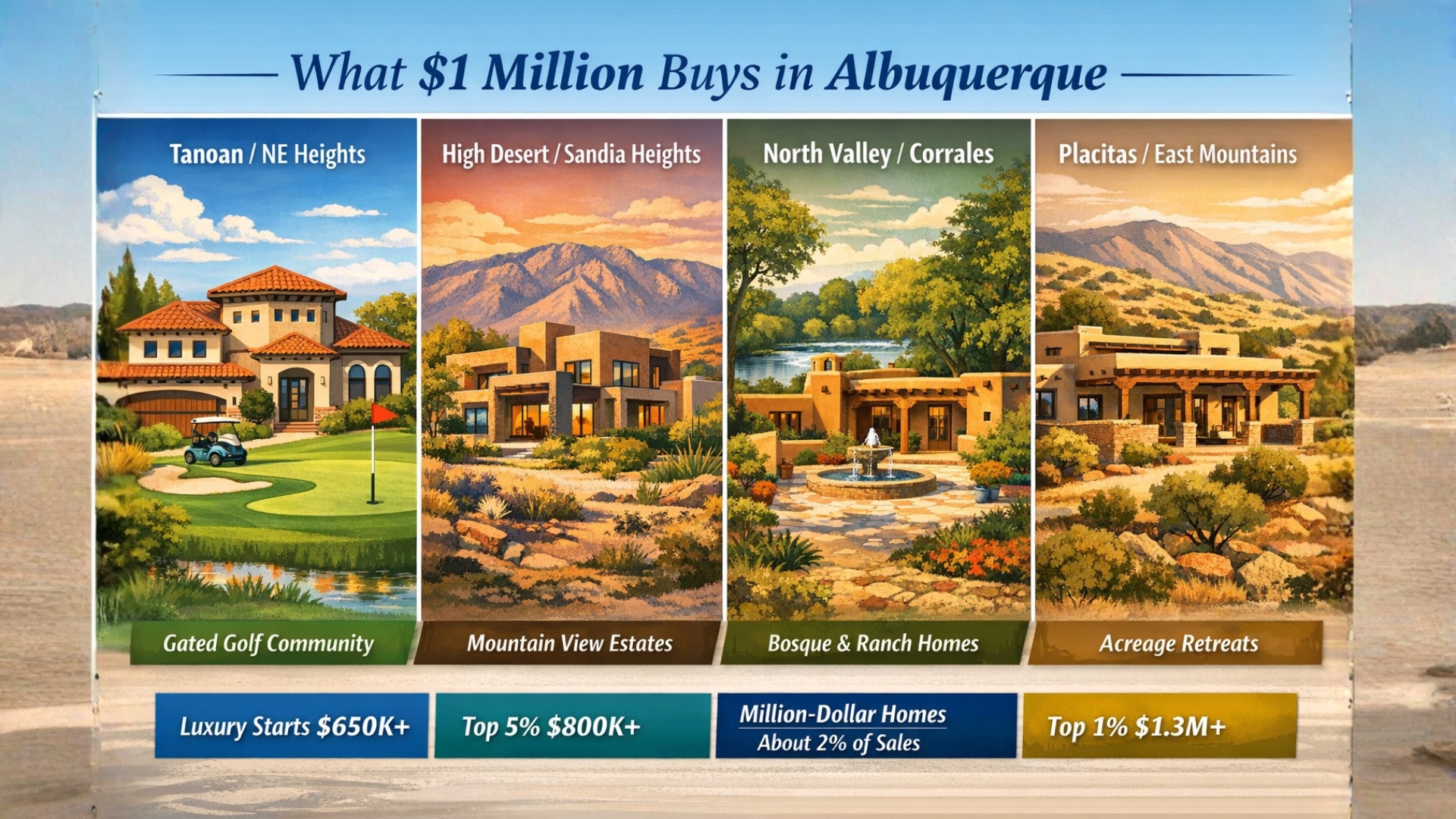
Using 2025 sales data, Tego explains that luxury in our market begins roughly at the top 10% of homes sold by price, which puts the threshold around $650,000. The top 5% cluster closer to $800,000, and homes at $1 million and above make up only about 2% of all sales. The top 1%—roughly 100 homes sold in 2025—start around $1.3 million. That narrow slice is where you find Albuquerque’s most exclusive properties, from gated golf-course estates and North Valley compounds to dramatic East Mountain and Placitas view homes.

“We’re talking big variety all over luxury house, the metro Albuquerque area.”

Tracy brings the perspective of a luxury-certified broker—someone who had to qualify by consistently selling homes above the locally defined luxury price point. From that vantage point, she and Tego walk listeners through luxury pockets across the metro: the Far Northeast Heights and High Desert, Corrales and the North Valley, Rio Rancho estates, Los Lunas near the Facebook data center, classic neighborhoods near UNM and Old Town, and acreage properties in the East Mountains.

“So there’s a general rule that luxury is considered the top 10% of homes sold by price in a market.”
— Tego Venturi

How Albuquerque Defines Luxury: From Top 10% to Top 1%

Instead of picking an arbitrary number, Tego grounds the definition of “luxury” in actual sales. Looking at the homes that closed in 2025, the top 10% of sales by price fall at about $650,000 and above. That’s the starting line for luxury in the Albuquerque area, not a national rule of thumb pulled from a different market.

From there, the numbers narrow quickly. The top 5% of homes sold come in closer to $800,000. A million-dollar purchase falls into a rarified group of sales—roughly 2% of all homes that closed last year. Push higher to $1.3 million and above and you’ve entered the top 1%, a tiny pool of roughly 100 sales spread across the metro’s most sought-after locations.

“A million and above, it’s about 2% of all the homes that sold.”

Tracy and Tego also emphasize that price alone doesn’t tell the full luxury story. A nearly million-dollar home on smaller acreage with ultra-high-end finishes can be just as “luxury” as a larger home on more land that’s more modestly finished. Neighborhood character, architecture, lot size, and lifestyle amenities—country club access, walkability, or dramatic views—are all part of what makes a property feel and live like luxury.

Even so, the data paints a clear pattern: the densest clusters of luxury homes are in the Far Northeast Heights and the North Valley/Corrales area. But the big takeaway from the episode is that luxury is not boxed into just a couple of ZIP codes—it’s scattered “all over the city,” from foothills to river valley to surrounding communities.

“1% would be 1.3 million. So, so if a home was purchased for 1.3 million or more, that’s the top 1% of all homes that sold.”
— Tego Venturi

Key Numbers in Albuquerque’s Luxury Home Market

  • Luxury starts around $650,000 Based on 2025 closed sales, the top 10% of homes by price in the Albuquerque area begin at roughly $650,000, which is where the local luxury segment effectively starts.
  • Top 5% cluster near $800,000 Homes in roughly the top 5% of the market trend closer to $800,000, marking a higher tier of price and finish within Albuquerque luxury.
  • Million-dollar homes are about 2% of sales Properties at $1,000,000 and above represent only about 2% of all homes sold in the Albuquerque area in 2025, making them a relatively small but important slice of the market.
  • Top 1% begins near $1.3 million The cut-off for the top 1% of sales sits around $1.3 million, with approximately 100 homes at or above that price point closing in 2025.
  • Luxury is concentrated—but not confined—to key areas The Far Northeast Heights and North Valley/Corrales show the highest densities of luxury homes, yet million-dollar and near-million-dollar properties also appear in Rio Rancho, Placitas, Los Lunas, the East Mountains, and classic in-town neighborhoods.
  • Finishes and lifestyle matter as much as price Tego and Tracy note that high-end finishes, neighborhood character, and lifestyle amenities—like golf, views, or large acreage—are essential parts of how buyers experience “luxury,” beyond the raw sale price.

Neighborhood-by-Neighborhood: What $1 Million Buys Across the Metro

To make the numbers real, Tracy and Tego walk through concrete examples of recent sales around the million-dollar mark. In Tanoan in the Far Northeast Heights, they highlight a home of about 4,200 square feet that sold around $1.1 million—set in a gated country-club community where residents can opt into golf, tennis, and swimming memberships and enjoy that classic “golf-cart lifestyle.”

Still in the foothills, High Desert and the Sandia Heights area showcase a different version of luxury: estate-size lots, big sky and mountain views, dark-sky-friendly lighting, native landscaping, and strict building envelopes that preserve open space and wildlife corridors. In much of this area, you can’t fence your whole lot—courtyards and limited enclosures are used instead so deer and other wildlife can move naturally through the neighborhood.

North of town in Placitas, a million-dollar home delivers what Tracy calls a Georgia O’Keeffe or Santa Fe vibe: open rolling hills dotted with chamisa, big views, and a quieter, retreat-like feel, often on larger lots that are still close enough in to keep the drive manageable.

“We’ve got something for everybody in the Albuquerque area.”

River, Valley, and In-Town Classics

In the North Valley, they point to Lee Acres off Solar Road—one of the area’s classic neighborhoods—where a roughly 3,500-square-foot home sold in the $975,000 range after extensive updating. Older ranch-style properties there have become high-end addresses thanks to mature trees, Bosque access, and proximity to the Rio Grande. Another nearby infill project, brand-new construction around $1.2 million and about 2,500 square feet, shows how new luxury can tuck into long-established pockets of the valley.

Closer to downtown, the Old Town and Albuquerque Country Club area offers million-dollar homes with a different flavor. Tracy describes a 3,700-square-foot, U-shaped New Mexico–style ranch with a courtyard—a hacienda-like layout wrapped around an interior outdoor space. It’s a blend of historic neighborhood character and updated luxury finishes just minutes from dining, museums, and the river trail system.

In Ridgecrest near UNM and Kirtland Air Force Base, a sale just under $1 million delivered walkable access to events, sporting venues, hospitals, and major employment centers. For buyers who value in-town convenience and classic mid-century neighborhoods, that kind of location is its own luxury amenity.

“Million dollars there got ’em a 3,700 square foot updated ranch style kind of… where there’s kind of the center courtyard.”
— Tracy Venturi

Rio Rancho, Los Lunas, and the Westside Bluffs

On the west side of the river, today’s luxury isn’t limited to older, in-town neighborhoods. South Rio Rancho’s Unit 10, just west of Rust Medical Center, has become a true estate area where owners buy their own lots, hire custom builders, and end up with half-acre properties. One example the team cites: a roughly 3,168-square-foot custom home around $1.05 million, loaded with high-end finishes and contemporary features.

Farther south, Los Lunas has surprised many as an emerging luxury pocket. Right across from the Facebook data center, a home around $1.1 million stood out for its “extraordinary finishes and detail”—a lot of house for the money in an area where most nearby new homes are priced in the $300,000s to $500,000s. It’s a sharp example of how a single standout property can reset expectations for what’s possible in a submarket.

Meanwhile, above the Westside bluffs near the volcano escarpments, new construction has pushed up into modern-style homes with the “latest and greatest” finishes and features. The team highlights a roughly 3,600-square-foot new build in this area at about a million dollars, illustrating how buyers can get contemporary design and big views without leaving the city’s west side.

East Mountains and Acreage Estates

Head east over the pass and luxury takes the shape of space, privacy, and views. In Paa-Ko, buyers get access to a golf course and clubhouse on lots that are typically an acre or larger, with some as big as seven acres depending on how the land was platted. Tracy notes her own history selling land in nearby San Pedro Creek Estates, where 10-acre sites and custom homes create a true mountain-estate feel.

Even farther south along the backside of the Manzanos, a 2,500-square-foot home at roughly $1 million sat on 15 acres off what locals still remember as “South 14,” now NM-337—a winding road popular with cyclists and motorcyclists for its scenery. Here, the luxury is an expansive custom home plus a 15-acre estate, trading some convenience for land and privacy that would be unattainable at this price in many larger metros.

“What a million buys here versus many of our big markets around the country… they’re just blown away.”

By the end of the segment, the message is consistent: whether you want a gated golf-course lifestyle, an updated in-town classic, a modern Westside new build, or a 15-acre mountain retreat, the Albuquerque area offers a wide range of true luxury options. Compared with many coastal and big-city markets, fellow real estate professionals are “blown away” by just how much home—and land—local buyers can secure for around a million dollars.

Frequently Asked Questions

What price range is considered “luxury” in the Albuquerque area?

In this episode, Tego defines luxury using actual 2025 sales data. The top 10% of homes sold by price start around $650,000, which is the practical entry point for the local luxury market. The top 5% cluster closer to $800,000. Homes at $1 million and above make up about 2% of all sales, and the top 1% begins around $1.3 million.

How common are million-dollar home sales in Albuquerque?

Million-dollar transactions are relatively rare. Tego notes that properties at or above $1,000,000 account for roughly 2% of all area home sales. The very top of the market—the top 1%—starts around $1.3 million and represents only about 100 sales across the entire metro in 2025.

Which areas have the highest concentration of luxury homes?

The Far Northeast Heights and the North Valley/Corrales area show the highest concentration of luxury properties when you look at density. Tanoan, High Desert, Sandia Heights, and North Valley neighborhoods like Lee Acres and Los Ranchos all feature prominently. At the same time, Tracy and Tego emphasize that luxury homes also appear in Rio Rancho, Placitas, Los Lunas, the Westside bluffs, the East Mountains, and in-town neighborhoods near UNM and Old Town.

What does $1 million typically buy in Albuquerque compared to bigger markets?

In Albuquerque, around a million dollars can buy a 4,000-plus-square-foot home in a gated country-club community like Tanoan, a fully renovated 3,500-square-foot North Valley ranch, a new-construction modern home of roughly 3,600 square feet on the Westside bluffs, or even a custom home on 10 to 15 acres in the East Mountains. Tracy and Tego mention that colleagues from larger markets are often “blown away” by how much house—and land—local buyers can get for that price.

Are there luxury options outside the Albuquerque city limits?

Yes. The episode highlights multiple examples beyond the city proper: Placitas with its open hills and Santa Fe–style views, Rio Rancho’s Unit 10 custom estates, Los Lunas near the Facebook data center with high-end new construction, and East Mountain communities like Paa-Ko and San Pedro Creek Estates where buyers can find acre-plus and 10-acre sites. All of these areas regularly see homes in the high-end and million-dollar ranges.
Have questions about Albuquerque real estate?

If you are thinking about buying or selling, or just want to understand how the current market affects your plans, our team is here to be a resource.

Call or text: (505) 448-8888
Email: info@welcomehomeabq.com
Website: WelcomeHomeABQ.com

Venturi Realty Group of Real Broker, LLC
From Contract to Close in Albuquerque: What Really Happens Behind the Scenes

From Contract to Close in Albuquerque: What Really Happens Behind the Scenes

From Contract to Close in Albuquerque: What Really Happens Behind the Scenes

By Venturi Realty Group

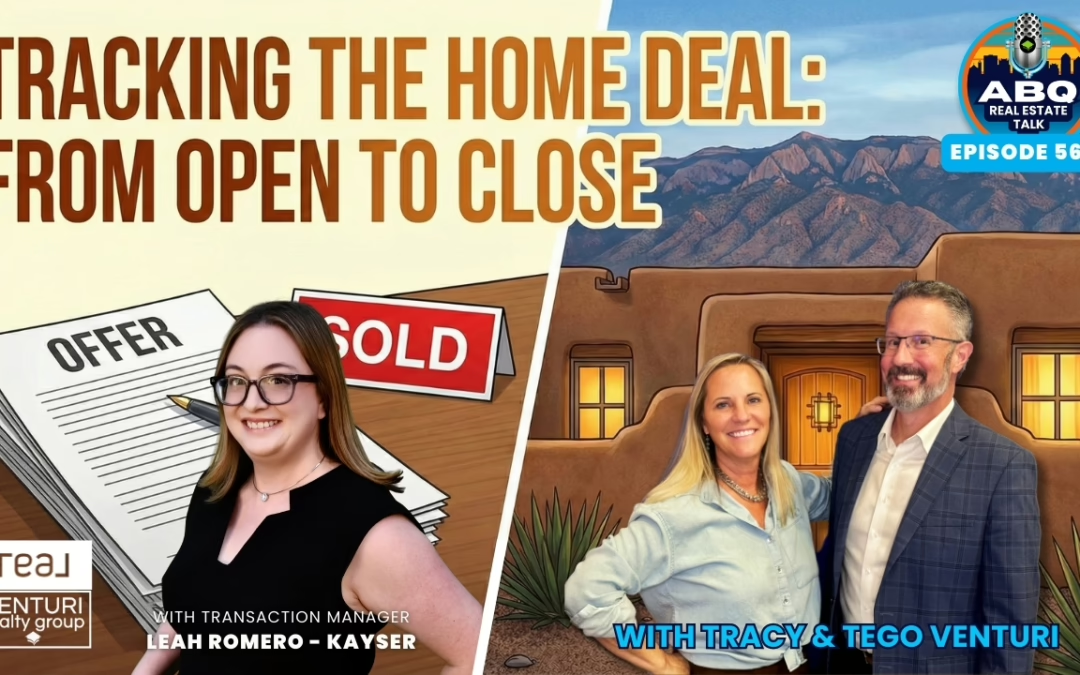
Albuquerque Real Estate Talk, Episode 566 – From Contract to Close: What’s Really Happening Behind the Scenes

Most Albuquerque buyers and sellers feel like they have “won” the moment an offer is accepted. The house hunt is over, the negotiations are done, and it feels like the hard part should be behind you. But as Tego Venturi points out, “the reality is the riskiest part of the transaction is this process from when we go under contract. You have a agreement between a buyer and a seller.” From that moment until keys change hands, the entire deal is riding on dates, deadlines, contingencies, and documents that have real consequences if they are missed.

“A real estate contract is not just paperwork—it’s a timeline with consequences.”

That’s where a dedicated transaction specialist like Leah Romero-Kayser comes in. Leah describes herself as someone who “prefer[s] to be the puppeteer, the orchestrator of all of the things,” working behind the scenes so clients can stay focused on their move instead of chasing signatures and checking calendars. She and the team track dozens of moving parts—earnest money, inspections, appraisal, title, insurance, loan approval, repair deadlines, closing, funding, and possession—often across multiple companies and professionals.

This article turns that conversation into a step-by-step guide to what actually happens from contract to close in a typical Albuquerque real estate transaction. You’ll see how contingencies protect both sides, why the “date of acceptance” matters so much, what your transaction coordinator is watching every day, and why closing, funding, and getting keys are often three separate events instead of one big moment.

What Your Transaction Coordinator Really Does Between Contract and Closing

Once a contract is signed, most of the visible work shifts from showings and negotiations to quiet, detailed coordination. Leah’s job is to keep the file moving, the parties informed, and the contract in compliance so that nothing important slips through the cracks.

As she explains it, “On a very basic level, what I like, what I’ve tried to tell people is I allow the client to stay in their emotions.” Buyers get to dream about how they’ll live in the home; sellers can focus on where they’re going next. Meanwhile, Leah and the team are tracking every obligation in the agreement so that clients and brokers don’t have to memorize the contract line by line.

“A contingency is just a condition that has to be met in order for the deal to continue to move forward.”

Managing Dates, Deadlines, and All the Moving Parts

From the moment a property goes under contract, Leah is watching a master checklist of critical dates: earnest money, proof of funds or pre-qualification, inspection periods, objection deadlines, appraisal order and delivery, title and document review periods, repair completion dates, and closing-related milestones like settlement signing, funding, and possession.

She jokes that it’s “sort of an octopus type of situation” because of how many people are involved. In a single morning, she might coordinate with a photographer, a septic company, the title office, a lender, and multiple brokers. Her job is to reduce surprises—spotting issues early enough that they can be handled with an addendum, a timeline adjustment, or a conversation rather than a last-minute crisis.

Crucially, she reminds clients that missing certain dates can change the balance of risk in the contract. Earnest money not delivered on time can quietly terminate a deal. Letting an inspection objection deadline pass can waive the buyer’s right to request repairs under that contingency. Part of Leah’s work is making sure buyers and sellers understand which dates control which rights so they can make informed decisions.

“Missing a contingency can waive rights, shift risk from one party to the other, or even quietly kill a deal.”

From Contract to Close: Key Milestones Your Transaction Coordinator Tracks

  • Date of Acceptance starts the clock Almost every other deadline in the purchase agreement—from inspections to financing and document review—is calculated from the day buyer and seller both sign and accept the contract.
  • Early performance shows good faith Earnest money, administrative fees, and pre-qualification or proof of funds are due quickly, and getting them in on time builds trust and keeps the contract from quietly terminating.
  • Three main phases of negotiation Initial contract terms, inspections and repair requests, and appraisal-related issues are the big moments where price, repairs, and risk are most likely to be renegotiated.
  • Contingencies as safety nets Financing, property condition, title, insurance, and document-review contingencies each protect buyers and sellers differently—and each has specific objection and resolution deadlines.
  • Inspection, repair, and walkthrough timing Your coordinator tracks when inspections happen, when objections are due, when repairs must be completed, and when the final walk-through needs to take place before settlement signing.
  • Closing, funding, and possession are separate steps Signing at the title company, recording the deed, releasing funds, and actually getting keys do not always happen on the same day, so your coordinator clarifies which date controls your move.
  • Two-Day Notice and extensions If one party misses a performance deadline like earnest money or proof of funds, forms such as the two-day notice can restart the clock—while other missed dates simply waive a right rather than defaulting the contract.

Step-by-Step: What Happens After Your Offer Is Accepted

Once the contract is signed and dated, the “date of acceptance” is set—and that’s when the real clock begins. Almost every other contingency deadline is measured from that date. Early on, buyers must deliver earnest money and provide proof of funds or a pre-qualification letter. Failing to meet those performance dates can quietly void the contract, even if everyone still wants the deal to happen.

From there, Leah and the lenders begin working in parallel. For financed purchases, she sends the contract to the lender, helps open the file, and confirms that the appraisal is ordered within the timeframe spelled out in the agreement—often about ten days. She then checks in regularly, explaining, “I make sure that appraisal’s been ordered. If it hasn’t, then I remind the lender that it needs to be, because contractually, that’s where we’re at.” Throughout the process, she continues to follow up about once a week until final loan approval.

“Closing is not a single moment—it’s a series of dates, each with its own consequences.”

Inspections, Repairs, and the Second Negotiation

On the property side, the inspection period is one of the most important contingencies. Buyers are allowed to perform their due diligence—hiring inspectors, reviewing reports, and walking the home again. The team often refers to the repair request as the “second negotiation,” because this is where buyers can ask for repairs, credits, or price adjustments based on what they’ve learned.

Every step has a deadline: completion of inspections, the buyer’s objection or repair request, and the period for the seller to respond and for both sides to reach a resolution. If the buyer misses the objection deadline, they haven’t defaulted on the contract, but they have given up a powerful protection. As Leah explains, “If the buyer misses that, all they’ve done is waived a right.” You can still ask for repairs, but the seller no longer has to negotiate.

In real life, things don’t always go according to plan. Inspectors get sick, reports arrive late, or a new concern pops up just before a deadline. In those situations, Tracy notes that the team may send an addendum requesting an extension—but that extension only matters if both sides agree and sign.

Title, Insurance, and Document Review

While inspections and financing are underway, the title company is preparing what’s known as a title binder—proof that the seller can legally transfer ownership and a list of any liens, encumbrances, easements, or other items that affect the property. Buyers have specific periods to receive, review, object, and resolve title-related issues, and missing those dates can waive the right to raise certain concerns later.

At the same time, buyers should be securing homeowner’s insurance and reviewing disclosures and documents such as property condition statements, HOA covenants, and any well, septic, solar, or road-access agreements that apply. There are similar phases of delivery, objection, and resolution for these materials as well. Tego encourages buyers not to feel intimidated by unfamiliar documents: “Call your realtor, call your transaction coordinator, call the title company… ask the questions. Don’t let your ego mess up the deal because you were afraid to ask.”

Closing, Funding, and When You Actually Get Keys

One of the biggest misconceptions the team addresses is the idea that “closing” is a single instant where everyone signs, money moves, and keys change hands. In reality, those steps often happen on different days. As Leah puts it, when you get to closing is when buyers and sellers go to the title company—usually in separate appointments—to sign the final loan and transfer documents and deliver any required funds by wire or cashier’s check.

But that signing is only one step. Afterward, the lender performs a final review and gives the title company permission to record the deed and release funds. The title company then electronically records the warranty deed with the county and disburses money to the proper parties. Only then is the transaction truly funded and complete.

Tego sums it up this way: there’s a settlement signing date, a recording date, a funding date, and a possession date, “and they don’t necessarily all fall on the same date.” Leah adds a practical warning: pro tip, don’t schedule your settlement signing on the last day of the month or on a Friday and expect to move in that same afternoon—some counties don’t even record on Fridays, which can push possession into the next business day.

“Don’t have your moving truck sitting outside the title company when you’re signing, because you most likely aren’t going straight to your house.”

Final Walk-Through and Last Checks Before the Finish Line

As the file moves into its final stretch, Leah confirms that any agreed-upon repairs are completed by the deadline set in the contract—often a specified number of days before closing. Her job is to know exactly what that date is and make sure everything is done on time.

Once repairs are finished, she coordinates a final walk-through for the buyer before settlement signing. Tracy describes it simply as a time “to walk through the house, make sure there’s nothing” unexpected now that furniture is gone and the home is nearly empty. The goal is to confirm that the property is in substantially the same condition as when the buyer first saw it, and that any promised repairs or items are complete.

By this point, a lot has happened: documents have been reviewed, contingencies satisfied or waived, money and insurance lined up, repairs checked, and final signing scheduled. For Leah and the team, a “boring” closing is the ultimate compliment—it means the planning, tracking, and communication worked exactly as intended.

“Contract to close is where good transactions are protected—and bad ones are prevented.”

Frequently Asked Questions

What does a transaction coordinator do between contract and closing?

A transaction coordinator manages the dates, deadlines, documents, and communication once a property goes under contract. They track everything from earnest money and inspection timelines to appraisal, title review, repair completion, and closing, so buyers and sellers stay in compliance without having to memorize the contract themselves.

What are contingencies in a real estate contract?

Contingencies are conditions that must be met for the deal to move forward. In a typical Albuquerque transaction, they include money and financing (earnest money, pre-qualification, final loan approval), property condition (inspections and repairs), legal ownership (title review), and documents and disclosures. Missing a contingency deadline can waive important rights, shift risk between parties, or even quietly terminate the contract.

Why is the “date of acceptance” so important?

The date of acceptance is the day both buyer and seller have signed and agreed to the contract, and it becomes the anchor date for many other deadlines. Inspection periods, objection dates, appraisal ordering, title review, and document-review timelines are typically calculated from this date, so tracking it accurately is essential.

What is the difference between closing, funding, and possession?

Closing or settlement signing is when buyers and sellers go to the title company to sign the final documents and deliver any required funds. After that, the lender gives permission to record the deed and release money, which is when the file officially funds. Possession—when the buyer actually gets keys and can move in—often happens only after recording and funding, so these events may fall on different days.

What happens at the final walk-through before closing?

The final walk-through takes place after agreed-upon repairs are completed but before settlement signing. It gives the buyer one last chance to see the home in person, confirm that repairs are done, and make sure the property is in substantially the same condition as when they went under contract.

Have questions about Albuquerque real estate?

If you are thinking about buying or selling, or just want to understand how the current market affects your plans, our team is here to be a resource.

Call or text: (505) 448-8888
Email: info@welcomehomeabq.com
Website: WelcomeHomeABQ.com

Venturi Realty Group of Real Broker, LLC

Las Cruces: Small-Town Feel in New Mexico’s Second-Biggest City (From the Vault)

Las Cruces: Small-Town Feel in New Mexico’s Second-Biggest City (From the Vault)

Las Cruces: Small-Town Feel in New Mexico’s Second-Biggest City (From the Vault)

By Venturi Realty Group

From the Vault – ABQ Real Estate Talk, Episode 525: Tego Venturi talks with Las Cruces real estate broker Kacie Henke of Real Broker, LLC about life, housing, and opportunities in New Mexico’s second-largest city.

In this “From the Vault” conversation, Tego Venturi continues his tour of New Mexico by heading south from Albuquerque to Las Cruces. He’s joined by longtime broker and second-generation real estate professional Kacie Henke, who moved from Alamogordo to attend New Mexico State University and never left. Together they unpack why Las Cruces manages to feel like a tight-knit small town even though it has over 100,000 residents and serves as a regional hub for education, agriculture, and outdoor recreation.

Henke explains that much of the city’s character comes from its community events and shared spaces. “We have lots of different festivals and local events and everybody goes to it because we don’t have a ton of big city life here and events here,” she says, noting that neighbors fully embrace local gatherings precisely because there aren’t pro sports teams or a constant stream of big-ticket entertainment competing for attention.

“It’s kind of like one of those Hallmark movies … it’s just a small town vibe.”

Even as Tego cites data showing that Las Cruces is New Mexico’s second-largest city and a more affordable alternative to Albuquerque, the episode keeps circling back to the same theme: people move there for a different pace of life. From the Organ Mountains on the horizon to the historic Mesilla Plaza and the influence of nearby El Paso and Mexico, Las Cruces offers a blend of scenery, culture, and affordability that feels distinct within the Southwest.

Las Cruces Real Estate: Affordable, Diverse, and Still Growing

When the conversation turns to the housing market, Kacie is clear: “I think compared to Albuquerque and other places, we are one of the most affordable places in New Mexico.” She notes that Alamogordo is still cheaper, but Las Cruces offers far more variety in both homes and amenities while remaining accessible for many buyers.

The city’s inventory includes a large share of new construction, a healthy resale market, and a small but real luxury segment. Henke explains that most builders in Las Cruces are actively offering incentives, not just to first-time buyers but “really anybody,” which can make a meaningful difference in monthly payments or closing costs for purchasers across price points.

“We have tons and tons of new construction … and most of the builders are offering incentives to help out.”

Tego brings in the numbers to frame that on-the-ground experience. At the time of their February 2025 conversation, he notes that the median sale price in Las Cruces was right around $300,000, roughly $50,000 less than the median in Albuquerque. He points out that based on his research, Las Cruces home prices had increased about 55% over the prior five years, with a much more moderate appreciation rate of around 2.5% in the most recent year—an indication that the market was no longer in the rapid run-up seen during the pandemic years.

Henke adds context from her own experience as both a homeowner and an agent. After the 2008 housing bust, she recalls, “houses kind of stayed stagnant and appraisers weren’t allowing houses to appreciate.” She and her husband bought a nearly new construction home that had originally sold for about $140,000, and “it took almost 10 years just to come to value again.” Only around 2020 did prices finally begin to catch up to where she felt they should be—then, like much of the country, they rose quickly. Today, that same house would be closer to $300,000, even as price growth has slowed.

For Kacie and Tego, that combination—strong but not overheated long-term appreciation, steady demand, and relative affordability compared with other Southwest markets—makes Las Cruces a compelling option for buyers who might be priced out elsewhere. At the same time, Henke is candid that the local luxury segment is small, with perhaps ten listings above roughly $800,000 at any given time, underscoring that Las Cruces remains primarily a market of approachable price points and practical homes rather than ultra-high-end estates.

Key Takeaways About Living and Buying in Las Cruces

  • Small-town feel in New Mexico’s second-largest city
    Kacie describes Las Cruces as feeling like a Hallmark movie town, where festivals and local events draw “everybody” even though the city has over 100,000 residents and is officially the state’s second-biggest city.
  • Home prices around $300,000 at the time of the conversation Tego notes that the median sale price was about $300,000—roughly $50,000 less than in Albuquerque—highlighting Las Cruces as a more affordable alternative within New Mexico.
  • Strong mix of new construction, resale, and limited luxury Henke emphasizes “tons and tons of new construction” with active builder incentives, a solid resale market, and a relatively small luxury segment starting around $800,000.
  • Builders offering incentives to help buyers Most local builders are contributing toward closing costs or rate buydowns, which can benefit first-time homebuyers and move-up buyers alike in the current rate environment.
  • Outdoor lifestyle anchored by the Organ Mountains and nearby White Sands Tego and Kacie highlight easy access to hiking and year-round outdoor activity in the Organ Mountains, plus the unique experience of White Sands National Park and its full-moon and balloon events.
  • Rich agricultural and food culture From pecan orchards and onion farms to green chile fields, vineyards, and the New Mexico State University Chile Institute, agriculture shapes both the local economy and the region’s celebrated food and wine scene.

Weather, Outdoors, and Everyday Life in Las Cruces

Asked to sum up the local climate, Kacie laughs that Las Cruces really has two main seasons: “hot and windy.” While there may be a day of snow now and then, she explains that winters are brief and mild, and the real rhythm of the year is warm, dry days and breezy springs.

She stresses that Las Cruces is not the same as Tucson or Phoenix when it comes to heat. One of her clients relocating from Tucson told her that while Tucson can hit 120 degrees and “never cools down,” Las Cruces might reach 105 degrees but cools off at night, making it possible to relax outdoors. “It is nice and it’s a dry heat,” Kacie says, adding that humidity is virtually nonexistent.

“If you want pure beauty every single day when you wake up … the sunsets and sunrises are so magical.”

For Henke, the real magic of the climate shows up at the beginning and end of each day. She says her kids often run in to tell her, “Mom, you have to go and check out this sunset. It’s so beautiful.” Being able to see the sky and the stars without tall buildings or smog is a daily reminder of why New Mexico is called the Land of Enchantment.

The outdoors are a huge draw. With the Organ Mountains rising just outside town, residents can hike and explore nearly year-round. White Sands, a short drive away, offers another world-class landscape where people sled on gypsum dunes, hold weddings and photo sessions, and attend full-moon nights when the sand glows almost like daylight. Kacie notes that during the White Sands International Balloon Festival, seeing hot air balloons lift off against the white dunes is “so majestic and really cool looking.”

History, Culture, and Festivals

Las Cruces and nearby Mesilla carry deep Old West history. Kacie points out that Billy the Kid is “kind of a big name here,” especially around the Mesilla Plaza where he once walked the streets and was arrested. She recently learned that La Posta, a popular local restaurant she recommends to many of her relocating buyers, reportedly used to be the jail where he was held—another layer of lore for a place that already feels like a step back in time.

Modern festivals add their own flavor. The area shares White Sands’ balloon celebration, and Las Cruces has hosted the Whole Enchilada Festival, where organizers once made Guinness Book–sized enchiladas alongside big softball tournaments. Kacie still hopes that festival returns. The city also embraces events like Día de los Muertos downtown and what she refers to as a burning-man-style celebration, giving residents and visitors a set of culturally rich, distinctly local traditions.

Food and agriculture are intertwined with that culture. Hatch and the surrounding valley are famous for green chile, and Kacie notes that Las Cruces leans more toward Mexican and New Mexican cuisine than Tex-Mex, despite its proximity to Texas. She jokes that when she visits family in San Antonio and asks for green chile, “they’re like, ‘Here’s some jalapeños’ or ‘Here’s some bell peppers,’ and they don’t understand what green chili is.” In southern New Mexico, by contrast, chile is everywhere—on traditional dishes, ice cream, and even in wine.

“We’ve been taught by the best as far as food goes … and ours is just heavily sprinkled with green chili or red chili on everything.”

A Borderland City With a Distinct Identity

Las Cruces sits in a unique tri-state, cross-border region with El Paso, Texas, and neighboring Mexican communities. Kacie half-jokingly calls El Paso “the redheaded stepchild of Texas” because it feels so far removed geographically from the rest of the state. In her view, El Paso is “more part of New Mexico” than of central Texas, and she notes that Las Cruces, Alamogordo, and El Paso are gradually knitting together, especially along travel and commuting corridors.

Many Las Cruces residents use El Paso’s airport, and some locals cross into Mexico to shop at mercados. While Kacie admits she’s “too much of a chicken” to go herself—her parents warned her as a college student never to go to Juárez—she has friends who visit often and enjoy the markets and culture there. For newcomers, it’s another layer of choice and experience within a short drive.

The region’s bilingual character is also striking. Kacie says that in many department stores in El Paso, “Spanish is like the number one language and then English is not,” which can surprise visitors who aren’t expecting it. She sees this as a positive, giving people in Las Cruces the chance to experience more culture than they might in many other American cities and, if they wish, to learn or practice Spanish in everyday life.

Why Las Cruces Appeals to Retirees and Relocating Buyers

As Tego works through his statewide tour—having recently featured Farmington and now Las Cruces—he keeps coming back to a theme: New Mexico offers several communities that combine outdoor access, reasonable costs, and a laid-back pace that’s especially attractive for retirement and remote work.

Las Cruces fits that mold. Kacie points out that you can cross town without heavy traffic, enjoy a mild climate with few extreme weather events, and still be within reach of destinations like Ski Apache (about an hour and a half away) for winter recreation. There “isn’t big shopping,” she concedes, but that’s part of what maintains the small-town feel many of her clients are seeking.

For those who want both natural beauty and a sense of community, her elevator pitch is simple: you get sunsets, stars, and open sky; you can hike almost any time of year; and you live in a city where “everybody knows everybody” and shows up for local events. That combination of affordability, lifestyle, and culture is what keeps her in Las Cruces and what draws in many of her buyers from around the Southwest and beyond.

Kacie’s Local Guide and How She Helps Newcomers

To make the transition easier for people considering a move, Kacie has created a guide to Las Cruces that includes her favorite restaurants, local wineries and vineyards, hiking spots, and day-trip ideas. She even describes the area as “like the cheap Napa Valley” because of its wine country combined with lower costs.

She is especially active on Instagram, where she says her handle is “Casey Las Cruces realtor” with an underscore between each word, and she invites people to connect with her there or via her YouTube channel under her name, Kacie Henke. For those ready to talk specifics, she also shares her direct phone number on the show: 940-232-5573. Whether someone is just starting to research the area or is ready to schedule showings, her goal is to help them understand what life in Las Cruces really looks like—and whether that Hallmark-style small-town city might be the right fit for their next chapter.

Frequently Asked Questions

How can Las Cruces feel like a small town if it’s New Mexico’s second-largest city?

Kacie explains that even with over 100,000 residents, Las Cruces feels like “one of those Hallmark movies” because people actually show up for festivals and local events. Without pro sports teams or constant big-city entertainment, community gatherings become the main attraction, and “everybody goes to it” and expects to see friends and neighbors there.

Is Las Cruces more affordable than Albuquerque?

Yes, at the time of Tego and Kacie’s conversation, the median sale price in Las Cruces was around $300,000—about $50,000 less than in Albuquerque. Kacie says that compared to Albuquerque and other places, Las Cruces is “one of the most affordable places in New Mexico,” with a wide range of options from new construction to resale homes and a relatively small luxury segment.

What is the weather like in Las Cruces?

Las Cruces has a dry desert climate that Kacie sums up as mostly “hot and windy.” Snow may appear briefly, but winters are generally mild. Unlike Tucson or Phoenix, where it can reach 120 degrees and stay hot, Las Cruces might hit 105 degrees but cools down at night, making evenings more comfortable. The lack of humidity and dramatic sunsets and sunrises are big parts of the appeal.

What kinds of outdoor and cultural activities are nearby?

Residents enjoy year-round hiking and outdoor recreation in and around the Organ Mountains. White Sands National Park is a short drive away and offers unique experiences like full-moon nights and the White Sands International Balloon Festival. Within the city and nearby Mesilla, there are historic sites connected to Billy the Kid, downtown festivals such as Día de los Muertos, and a calendar of culturally rooted community events.

How is the food scene in Las Cruces different from Tex-Mex?

Despite its proximity to Texas, Kacie says Las Cruces is not really Tex-Mex. She describes the local food as more influenced by Mexican and New Mexican traditions, with everything “heavily sprinkled with green chili or red chili.” She contrasts this with visits to San Antonio, where asking for green chile often results in being offered jalapeños or bell peppers instead.

Does living in Las Cruces connect you to El Paso and Mexico?

Yes. Many residents see El Paso as almost a sister city; Kacie jokes that it’s more like part of New Mexico than Texas. People commonly use El Paso’s airport for travel, and some cross into Mexico to shop at mercados. Spanish is widely spoken in the region, especially in El Paso, giving Las Cruces residents easy access to a rich, bilingual cultural environment while still living in a smaller, more relaxed community.

Las Cruces, New Mexico’s Second Largest City, has the best of both worlds. Small town charm, a vibrant local art scene, and all the luxuries of living in both city and rural!

Have questions about Albuquerque real estate?

If you are thinking about buying or selling, or just want to understand how the current market affects your plans, our team is here to be a resource.

Call or text: (505) 448-8888
Email: info@welcomehomeabq.com
Website: WelcomeHomeABQ.com

Venturi Realty Group of Real Broker, LLC

Rent vs. Buy in Albuquerque: 2026 Reality Check and Long-Term Guide

Rent vs. Buy in Albuquerque: 2026 Reality Check and Long-Term Guide

Rent vs. Buy in Albuquerque: 2026 Reality Check and Long-Term Guide

By Venturi Realty Group

For many Albuquerque residents, the housing question isn’t simply, “Can I buy a home?” It’s, “Should I keep renting, or is it finally time to buy?” In this episode of Albuquerque Real Estate Talk, Tego Venturi, Tracy Venturi, and Leah Romero-Kayser walk through that decision the way a good reporter would: starting with the numbers, but quickly widening the lens to look at stability, risk, lifestyle, and long-term wealth building.

The conversation centers on a very real scenario: a roughly $320,000 three-bedroom, two-bath home in the Albuquerque area versus renting a similar single-family home for about $2,200 a month. In the first year, renting that property can save around $300 a month compared with the total monthly cost of owning it. That short-term savings is compelling for many people who feel squeezed by today’s prices and interest rates.

“But for most properties, it’s cheaper to rent these days.”
— Tracy Venturi

But the team doesn’t stop at the first-year math. They follow the same house out over five and ten years, layering in modest appreciation and principal paydown to show how a small down payment can grow into substantial equity over time. They contrast that with what happens if you rent the same whole period: the monthly savings can get eaten up by rising rents while the opportunity to build equity passes you by.

“Let me just preface this by saying there are no wrong answers, only real ones.”
— Leah Romero-Kayser

This guide turns their discussion into an evergreen, research-style article focused strictly on the buying versus renting decision in Albuquerque. It follows their four “reality check” questions, explores when renting is the smarter move, and explains why homeownership remains one of the most important wealth-building tools for households that are ready for its responsibilities.

Rent vs. Buy: More Than Just a Payment Calculator

When the team talks about renting versus buying, they repeatedly stress that it isn’t just a financial puzzle. Yes, there is a breakeven point where the long-term economics of owning usually surpass renting. But between now and that point, you live in the home every day. How it feels, how much control you have, and how likely you are to be forced to move can matter just as much as the spreadsheet.

Livability and Making a Home Your Own

Tracy frames one of the most underrated differences in a single word: livability. Owning a home means you can make it truly yours — painting, remodeling, adding storage, creating a home office, or building the dog run you’ve always wanted. Those changes don’t just add comfort; over time, smart updates can also add value to the property.

By contrast, renters live within a landlord’s rules. Many leases restrict painting, structural changes, or even installing things like ceiling fans or pet enclosures. That can make it harder to adapt your home to life changes like remote work, a new baby, or caring for an aging parent.

“When you are a renter, you’re helping whoever owns that property with their wealth building and, and their equity.”
— Tego Venturi

When you improve a rental, you’re often improving someone else’s long-term investment. When you improve a home you own, you’re upgrading your own asset and your daily quality of life at the same time.

Stability, Community, and the Emotional Cost of Moving

The emotional side of housing comes through strongly in Leah’s comments about stability. She notes that beyond dollars and cents, what people crave is the security of knowing that if they keep making their payment, they can stay put. A fixed-rate mortgage gives that assurance in a way that a year-to-year lease can’t.

“The sense of stability, I think also is a huge factor.”
— Leah Romero-Kayser

With rentals, even great tenants can be told they have 30 or 60 days to move because the owner wants to sell, move back in, or house a family member. The team has seen renters in Albuquerque face surprise non-renewals despite spotless payment histories. The financial cost of moving — time off work, deposits, truck rentals, and new furniture — stacks on top of the emotional and physical strain of starting over somewhere new.

Homeownership doesn’t eliminate all risk, but it dramatically lowers the odds that a third party’s decision will uproot your household. That sense of control tends to foster stronger ties to neighbors, schools, and local businesses, which in turn reinforces neighborhood stability over time.

Flexibility and Simplicity When Renting

Still, the team is careful not to paint renting as a mistake. For certain seasons of life, it is not just acceptable but absolutely rational. Renting excels when flexibility and simplicity are your top priorities.

Leah points out that if you are “checking out” Albuquerque for a year or two, you may not be ready to commit to a particular neighborhood, commute, or school district. A lease lets you leave at the end of the term with little friction. If you’re early in a career that may take you to different cities, renting can keep your options open.

“They really prefer hands off and simplicity. They’re probably better being a renter.”
— Tracy Venturi

Tracy describes clients who know themselves well: they aren’t handy, their schedules are packed, and they don’t want to think about roofs, water heaters, or contractors. For them, being able to call the landlord when something breaks is worth giving up the equity upside.

“I just want easy, simple. I wanna write somebody a check every month and not have to think about it. And that, that’s a perfectly fine answer.”
— Tego Venturi

The takeaway from this section is clear: the right answer to “rent or buy?” depends on how you weigh control, stability, and long-term wealth against flexibility and day-to-day simplicity.

The Surprising Math Behind Equity Building

One of the most misunderstood parts of the rent-versus-buy debate is how quickly equity can build—even when home price growth is modest and the down payment is relatively small.
The following example mirrors the exact scenario discussed in the episode and uses conservative assumptions designed to avoid overstating the case for ownership.

Baseline Scenario

  • Home price: $320,000
  • Down payment: $16,000 (5%)
  • Loan amount: $304,000
  • Interest rate & term: 6.25% / 30 years
  • Monthly principal & interest: $1,871.78
  • Home value growth assumption: 3% annually (below the long-term U.S. average)

Even at this conservative growth rate, equity accumulates from two sources at the same time:
loan paydown and home value appreciation.
Importantly, the original down payment is excluded from the equity totals below.


Loan Paydown (Forced Savings)

  • 5 years: $20,255 principal paid
  • 10 years: $47,917 principal paid
  • 20 years: $137,294 principal paid

Home Value Growth at 3%

  • 5 years: $370,968 (+$50,968)
  • 10 years: $430,053 (+$110,053)
  • 20 years: $577,956 (+$257,956)

Net Equity Created (Down Payment Excluded)

  • After 5 years: approximately $71,000
  • After 10 years: approximately $158,000
  • After 20 years: approximately $395,000

This is the part of the math many renters never see.
While renting may be cheaper on a monthly basis in the early years, ownership quietly converts monthly payments into long-term wealth through compounding appreciation and automatic loan paydown.

“People focus on what they’re saving this month—but forget what they’re not building over time.”

None of this means buying is always the right choice.
But it does explain why the rent-versus-buy decision cannot be evaluated using a one-year snapshot.
The real financial story unfolds over five, ten, and twenty years—not at lease renewal.

Is It Cheaper to Rent or Buy in Albuquerque?

From a purely monthly payment standpoint, the team acknowledges a reality many Albuquerque renters have already felt: right now, renting can often look cheaper than buying the same home. Between higher prices and interest rates, the first-year owner’s payment on a median-priced starter home may be several hundred dollars more than rent on a similar property.

“Okay. So, for renting is it’s, it’s cheaper per month, at least …”
— Tego Venturi

Using their example of a roughly $320,000 three-bedroom, two-bath home versus a similar single-family rental around $2,200 a month, Tego calculates that the renter effectively “saves” about $300 each month in year one. For anyone rebuilding after a financial setback or facing other big expenses, that cushion can be meaningful.

But their analysis doesn’t end there. They extend the comparison well beyond the first year using conservative assumptions and standard 30-year fixed-rate financing. With each mortgage payment, the homeowner gradually pays down principal, and even modest appreciation adds to equity. Over time, those two forces compound in ways that are easy to overlook when comparing only monthly payments.

Using the same baseline scenario discussed in the episode—a $320,000 home with a 5% down payment ($16,000) and a $304,000 loan at 6.25%—the long-term math becomes clearer. Assuming a conservative 3% annual home value growth rate, the homeowner creates approximately $71,000 in net equity after five years, about $158,000 after ten years, and roughly $395,000 after twenty years. These figures exclude the original down payment and reflect only appreciation and principal paydown.

In this scenario, loan paydown alone accounts for $20,255 in principal reduction by year five, $47,917 by year ten, and $137,294 by year twenty. At the same time, the home’s market value increases by approximately $50,968 over five years, $110,053 over ten years, and $257,956 over twenty years—all using growth assumptions below the long-term national average.

National research has consistently backed up this broader pattern. Over many decades, surveys such as the Federal Reserve’s Survey of Consumer Finances have shown that typical homeowners hold significantly higher net worths than renters, largely because home equity becomes a foundational long-term asset. The team’s Albuquerque-based example simply illustrates how that dynamic can play out for one household deciding whether to keep renting or buy a starter home.

How Homeownership Builds Wealth Over Time

From an analytical standpoint, homeownership builds wealth in three primary ways:

  • Principal paydown as “forced savings.” Each mortgage payment includes principal and interest. The interest is the cost of borrowing, but the principal directly increases your equity. Unlike rent, which is gone once paid, a portion of every mortgage check effectively becomes a deposit back into your own balance sheet. Leah and Tego describe this as a built-in savings plan that continues month after month, whether or not you’re the type to set aside money separately.
  • Long-term price appreciation. Housing markets move in cycles, but over long spans, home values in most U.S. metro areas have tended to rise faster than general inflation. The team uses a modest appreciation rate in their example to avoid overpromising. Even at that conservative pace, the owner in their scenario sees tens of thousands of dollars in additional wealth over each five-year block simply because the property itself is worth more.
  • More predictable housing costs. With a fixed-rate mortgage, the principal and interest portion of your payment stays essentially the same for 30 years. Property taxes and insurance can move, but the core cost is locked in. Renters, by contrast, face renewals in which landlords adjust prices to match market conditions; over decades, that often means steady rent inflation without any offsetting equity gain.

“For renting … you’re saving that a month. However, over time people forget this.”
— Tego Venturi

The implication is not that buying is always superior, but that short-term savings from renting can obscure large, compounding benefits of ownership over time. For households planning to stay in the Albuquerque area for many years, ignoring that long-term picture can be costly.

The Four-Question Reality Check: Should You Keep Renting or Buy?

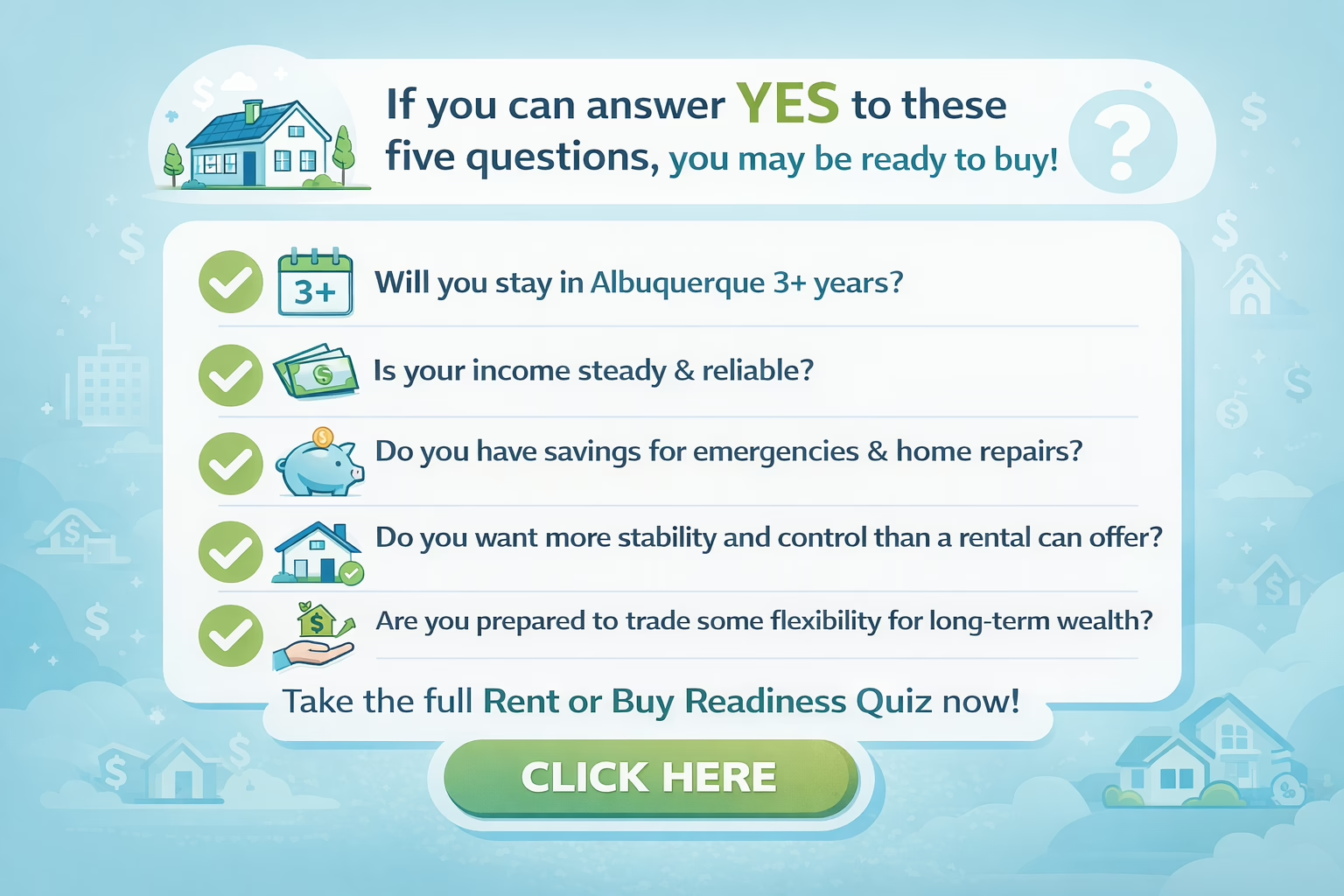
To move beyond rules of thumb, Leah introduces what she calls a “Reality Quiz Check”: four questions designed to help individuals decide which side of the rent-versus-buy line they belong on right now. Rather than pushing everyone toward ownership, the framework recognizes that timing and personal circumstances matter.

“Three year rule. Do you expect to stay in Albuquerque or the greater Albuquerque area for at least the next three years?”
— Leah Romero-Kayser

1. The Three-Year Rule: How Long Will You Stay?

The first question is about time horizon. In the past, the rule of thumb was that if you expected to stay put for at least two years, buying often made sense. The team now describes it as closer to a three-year rule once you account for transaction costs, market variability, and the time it takes for appreciation and principal paydown to outweigh upfront expenses.

If you know you will be in the Albuquerque area for five years or more, the case for buying grows stronger, especially if you might keep the property as a rental when you eventually move. On the other hand, if your plan is to be here only briefly, they suggest that continuing to rent will usually be safer unless you’re intentionally buying a long-term investment property.

2. Income Stability: Are You Ready for a Fixed Payment?

The second question looks at income. Lenders generally want to see at least two years of stable, documentable income in the same line of work, whether you’re a W-2 employee or self-employed. If your earnings are still highly variable or very new, you may not yet qualify for the loan you want, even if you feel confident about your future prospects.

At the same time, the team points out that once you do qualify and buy, a fixed-rate mortgage can actually increase your financial stability by shielding you from unpredictable rent increases. In an environment where wages and rents don’t always move in sync, that predictability can be an asset in its own right.

3. The HVAC “Oh-No” Test: Do You Have a Maintenance Plan?

The third question is deliberately blunt. Leah calls it the “HVAC oh-no test” and phrases it this way:

“If your heater or AC failed tomorrow, could you handle the repair without going into crisis?”
— Leah Romero-Kayser

Tracy, drawing on real repair bills she’s seen, adds that many full system replacements are substantial expenses.

“That’s not … 12 to $16,000. Obviously this cost depends on a lot of things.”
— Tracy Venturi

As renters, people call the landlord when the heater fails or the toilet stops working; as owners, they are the ones writing the check or finding the plumber.

To help clients think realistically, Tego uses a rule of thumb of roughly 1% of the home’s value per year set aside for maintenance. On a $300,000 home, that’s about $3,000 annually. Some homes, especially those with wells or septic systems, may require more. The team also reminds would-be buyers that home warranties and new construction can moderate early-years risk, but they don’t eliminate the need for reserves.

4. The Control Factor: How Much Freedom Do You Need?

The final question is about control and future flexibility inside the home. Homeowners decide whether to welcome an aging parent, host long-term guests, convert a garage into a studio, or paint a room bright green. Renters, by design, operate within another person’s rules and may have to ask permission for even minor changes.

For some clients, that control is non-negotiable: they want the ability to adapt their property as life changes. For others, especially those leading “nomadic” lifestyles or working remotely, the priority is the freedom to move with minimal friction.

The team is explicit that choosing flexibility is not a failure. It is a legitimate preference. The key is to make that choice knowingly, understanding what you gain and what you give up in long-term wealth and stability.

Down Payments, Assistance, and the Myth of 20%

One reason many renters assume homeownership is out of reach is the persistent myth that you need a 20% down payment. The conversation cuts through that misconception. They note that many Albuquerque buyers purchase with far less down by using mainstream loan programs such as FHA, VA for qualified veterans, and low-down-payment conventional loans.

Layered on top of that, New Mexico offers state-level down payment and closing cost assistance programs that can help bridge the gap between what a renter has saved and what they need to close. These programs change over time, but the underlying message is durable: if you have steady income and manageable debts, you may not need nearly as much cash as you think to move from renting to owning.

When Renting Wins vs. When Buying Wins

When Renting May Be the Better Move (For Now)

  • You expect to move within two to three years. If you’re on a temporary assignment, still deciding whether Albuquerque is home, or likely to relocate soon, the three-year rule suggests that renting is usually safer than buying a place and hoping to break even quickly.
  • Your income or credit is still stabilizing. If you are just starting in a new role, recently self-employed, or working through past credit issues, it may be wiser to rent while you build reserves and a stronger application for future financing.
  • You truly value simplicity and low responsibility. For people who, in Tego’s words, “just want easy, simple” and don’t want to think about maintenance or long-term commitment, continuing to rent can be the choice that best matches their values.

When Buying Often Comes Out Ahead

  • You plan to stay in the area at least five years. Over that timeframe, the combination of principal paydown and even modest appreciation tends to make owning financially compelling compared with paying ever-rising rents to a landlord.
  • You want stability and a sense of home. If avoiding surprise moves, putting down roots in a neighborhood, and having more control over your space are priorities, homeownership can deliver benefits that go far beyond the monthly payment.
  • You’re prepared for maintenance and responsibility. If you can budget for repairs, either through savings or warranties, and you like the idea of improving your property over time, the long-term wealth-building advantages of owning can be significant.

In the end, the team returns to Leah’s framing: there are no wrong answers, only real ones. For some Albuquerque residents, renting will remain the right choice for now, either by necessity or by preference. For others, especially those with a longer time horizon and a desire for stability, stepping into homeownership — even when it looks more expensive in year one — may be the single most important financial decision they make.

Whichever side of the rent-versus-buy question you are on today, approaching it with clear numbers, an honest view of your lifestyle, and a long-term mindset will put you in a far better position than any quick online calculator alone.

Rent vs. Buy in Albuquerque: Frequently Asked Questions

This guide covers a lot of ground, but most readers considering renting versus buying in Albuquerque tend to ask the same core questions. Below are clear, straightforward answers based on the scenarios and analysis discussed throughout this article.

Is it cheaper to rent or buy in Albuquerque right now?

On a month-to-month basis, renting is often cheaper than buying a comparable home in Albuquerque—especially in the first year. Higher home prices and interest rates can make ownership cost several hundred dollars more per month upfront. This comparison can change over time when equity building through loan paydown and home appreciation is considered.

How long do I need to stay in a home for buying to make sense?

A common rule of thumb discussed in this guide is the three-year rule. If you expect to stay in Albuquerque—or at least in the same home—for three years or more, buying may begin to make financial sense. Staying five years or longer often strengthens the case for ownership.

Why does buying build wealth while renting does not?

Homeownership builds wealth primarily through principal paydown and appreciation. Each mortgage payment reduces the loan balance and increases equity over time, while rising home values add net worth. Rent payments do not build ownership or equity for the renter.

How much equity can a homeowner realistically build over time?

Using conservative assumptions—a $320,000 home, 5% down, a 30-year loan at 6.25%, and 3% annual home value growth—a homeowner can build approximately $71,000 in net equity after five years, about $158,000 after ten years, and roughly $395,000 after twenty years. These figures exclude the original down payment.

Is renting ever the better choice?

Yes. Renting can be the smarter option if you expect to move within two to three years, have unstable or hard-to-document income, or strongly value flexibility and low responsibility. Renting can also make sense as a short-term strategy while building savings or improving credit.

Do I really need 20% down to buy a home?

No. Many buyers purchase homes with far less than 20% down using programs such as FHA, VA (for qualified veterans), or low-down-payment conventional loans. In New Mexico, state-level assistance programs may also help cover down payment and closing costs.

What are the biggest risks of buying a home?

The primary risks include unexpected maintenance costs, job or income instability, and the possibility of needing to sell sooner than planned. Buyers should be prepared for repairs and maintain financial reserves to handle surprises.

What factors matter more than interest rates when deciding to buy?

While interest rates affect monthly payments, factors such as how long you plan to stay, income stability, savings, lifestyle preferences, and desire for housing stability often matter more. Rates can change, but time horizon and personal readiness are harder to adjust later.

How can I tell if I’m personally ready to buy or should keep renting?

The best approach is to evaluate your time horizon, income stability, emergency savings, comfort with maintenance costs, and lifestyle priorities. This guide outlines a four-question reality check designed to help renters determine whether buying fits their current season of life.

Where can I get help deciding whether renting or buying is right for me?

A local real estate professional can help you run personalized rent-versus-buy scenarios based on your finances, goals, and preferred neighborhoods. Tailored numbers often provide more clarity than generic online calculators.

Have questions about Albuquerque real estate?

If you are thinking about buying or selling, or just want to understand how the current market affects your plans, our team is here to be a resource.

Call or text: (505) 448-8888
Email: info@welcomehomeabq.com
Website: WelcomeHomeABQ.com

Venturi Realty Group of Real Broker, LLC

ABQ Real Estate Market 2026: Housing Resolutions, Myths to Leave Behind

ABQ Real Estate Market 2026: Housing Resolutions, Myths to Leave Behind

New Year’s 2026: Housing Resolutions & Real Estate Myths – Albuquerque Real Estate Talk Ep. 564

Albuquerque Real Estate Talk Episode 564 – New Year’s 2026 special with Tracy, Tego, and Asel Venturi.

As the calendar flips to 2026, the Venturi team is kicking off the year by talking about practical housing resolutions, busting some stubborn real estate myths, and sharing what they see ahead for the Albuquerque market. From luxury properties over $1 million to first-time buyers just starting their search, this episode focuses on how real people can make smart moves in today’s “slow and steady” market.

In this conversation, Tracy and Tego break down what sellers, buyers, and current homeowners should be focusing on this year: realistic pricing, planning for concessions, understanding your true equity position, and ignoring the doom-and-gloom headlines that don’t reflect what’s actually happening on the ground in Albuquerque. They also touch on what the luxury stats are telling them, why new construction still matters, and why our market doesn’t behave like Austin, Phoenix, or Florida.

Whether you’re planning to sell, hoping to buy, or staying put and just want to make smart decisions with your home and mortgage, this New Year’s episode is designed to give you clear, local insight—without the national noise.

Albuquerque’s Luxury Market Heading Into 2026

Tracy opens the show with a deep dive into Albuquerque’s million-dollar-and-up market. Looking at properties priced at $999,000 and above over the last year, there were 1,058 total properties in that range when you combine active, pending, and closed listings. Of those, 432 actually sold at or above that million-dollar mark, showing a solid but selective luxury segment.

At the same time, not every high-end listing sailed to the closing table. Sixty-one of those luxury homes expired after an average of 204 days on the market, with an average price of about $383 per square foot. Another 10 were withdrawn, and when you remove the famously high-priced “Breaking Bad pizza house” that was listed over $2,000 per square foot, the remaining withdrawn listings averaged roughly $456 per square foot. Ninety-seven additional million-dollar listings were canceled after averaging 143 days on market at around $377 per square foot.

What These Numbers Mean for Luxury Sellers

The big takeaway for high-end sellers is that price and positioning matter more than ever. Even in the luxury tier, buyers are choosy, and many homes that started too high or didn’t show as well ended up expiring or being canceled before eventually coming back at a better price or with improvements. Unique properties—like TV-famous homes—can’t rely on hype alone to find the right buyer and still need to be priced and prepped strategically.

For anyone thinking about listing a luxury home in 2026, the data is clear: expect longer days on market, be ready to adjust if the market is giving you feedback, and work with an agent who understands both the numbers and the nuances of Albuquerque’s top 10% of the market.

Why “Expired,” “Withdrawn,” or “Canceled” Isn’t the End of the Story

Tracy also points out that a luxury listing going into “expired,” “withdrawn,” or “canceled” status doesn’t mean the home is unsellable. In many cases, sellers step back to regroup—tackling repairs, updating condition, or rethinking price and presentation based on feedback from the market. A lot of those properties later came back on the market and sold once they were better aligned with buyer expectations. Even the famous Breaking Bad “pizza house” is a reminder that in the luxury space, it still comes down to matching a unique property with the right strategy and the right buyer.

Highlights from Tego’s 2026 Albuquerque Market Forecast

  • Expect a slow-but-steady market, not a crash.
    Base-case expectations for 2026 are modest home price growth of roughly 2% to 4%, slightly higher sales than 2025, and no flood of new inventory—especially in the most desirable lower price points.
  • Affordability will be the theme of the year.
    Real decisions will center on total monthly payment and overall cost of living, with moderate price appreciation, creative deal structures like rate buydowns, and wages slowly catching up doing more heavy lifting than big price drops.
  • National “doom” headlines are entertainment, not local guidance.
    Many scary stories rely on cherry-picked metros and timeframes, so the rule for 2026 is to treat national headlines as noise and use local stats as your actual decision tool.
  • We’re likely past the “correction” and into a reset.
    After the 2020–2022 surge and the late-2022 pullback, three years of slower sales and moderate appreciation point to a market that’s closer to the low than the high and moving toward a more functional, balanced feel.
  • Mortgage rates are still the steering wheel.
    Rates don’t have to be “low” for the market to work; they need to be predictable, accepted, and built into pricing and deal structures, with 2026 staying negotiable whether rates drift down or remain stubborn.
  • New construction will quietly shape the resale market.
    Steady (not overbuilt) new-home activity means builders can offer incentives like rate buydowns, so resale sellers must compete on realistic pricing, strong condition, and standout presentation from day one.

For a deeper dive into the numbers and scenarios, read Tego Venturi’s full Albuquerque Real Estate Market Forecast 2026.

Top 2026 Resolutions for Home Sellers

1. Get Serious About Pricing From Day One

Tego’s first resolution for sellers is simple: be realistic about pricing. We’re not in 2021 or 2022 anymore, and the “let’s try a high number and see what happens” approach usually leads to price reductions and a longer time on market. Overpricing at the start often turns into “chasing the market,” which can ultimately net you less than if you had priced correctly from the beginning.

2. Plan for Concessions and Rate Buydowns

Tracy points out that even the nicest homes are seeing buyers ask for help with closing costs or other concessions. Builders have been doing this for years by offering interest rate buydowns, and resale sellers are now playing in the same arena. Buyers are focused on their monthly payment, and contributions toward a rate buydown can be more valuable than a simple price cut.

3. Offer Move-In Ready Condition

Buyers today want homes that feel well maintained and “buttoned up.” They’re more likely to ask for repairs and expect systems and finishes to be in good working order. One way to get ahead of this is with a pre-inspection: have a licensed inspector evaluate your home before you list, decide what to fix, and reduce the odds of stressful surprises during the contract period.

4. Understand Your Competition, Including New Construction

Even if your home is in an established neighborhood, your buyers are probably comparing it to new construction on the outskirts of town. New homes may not offer the same location, but they’re often move-in ready with modern systems and finishes. Sellers should honestly compare their home’s condition and features to what buyers are seeing in those new neighborhoods.

5. Start Getting Ready Months Before You List

Another seller resolution: build in more prep time than you think you need. Decluttering, maintenance, repairs, paint, and curb appeal projects almost always take longer than expected. When sellers rush to market, they tend to leave money on the table.

Smart 2026 Resolutions for Home Buyers

1. Start With Financing, Not House Hunting

For buyers, the first resolution is to “get your financing figured out.” Before you fall in love with a home online, sit down with a lender and understand your true purchasing power. That means more than just principal and interest—it includes property taxes, homeowner’s insurance, potential tax reassessments, and any HOA dues that could significantly affect your monthly payment.

2. Be Picky, But Be Ready to Move

In today’s more balanced market, buyers have room to be selective, but not to freeze. When the right home comes along, you still need to be ready to act quickly with a strong, well-structured offer. The buyers who are pre-approved and clear on their numbers are the ones who can move decisively without second-guessing.

3. Negotiate for Win-Win, Not Fire Sales

Tracy emphasizes that we are not in a distressed, desperate-seller market. Some negotiation is absolutely on the table—repairs, credits, and perhaps help with a rate buydown—but expecting $50,000 off a well-priced $350,000 home usually isn’t realistic. The goal is a fair deal that works for both sides.

4. Look Beyond the Headline Interest Rate

Buyers often focus only on the interest rate number, but Tracy and Tego encourage looking at the full picture. For example, a modest seller contribution to buy down your rate might reduce your payment more than you’d get from a simple price reduction, especially if you plan to stay in the home for several years.

5. Tune Out Doom-and-Gloom Media Noise

One of the most important buyer resolutions is to ignore sensational national housing headlines. Most viral content is built around fear, even though many markets—Albuquerque included—are seeing modest, stable appreciation rather than dramatic swings. Buying a home is a long-term life decision, not something you should decide based on this week’s social media doom scroll.

Resolutions for Current Homeowners

1. Know Your True Equity Position

Homeowners should resolve to understand their real equity—not just what a website estimate says on a good day. Automated valuation models don’t see the condition of your home or the neighboring properties. Tracy shares an example of a well-kept home sandwiched between two neglected, junk-filled yards; an algorithm might miss how much those surrounding properties affect buyer perception and value.

2. Treat Your Low Interest Rate as an Asset

If you locked in a mortgage rate around 4% or less (or even under 4.5%), that rate is an asset in today’s environment. It helps explain why many homeowners are staying put, and in some cases, FHA or VA loans may even be assumable by a future buyer. Understanding your loan terms can help you decide whether to move, stay, or leverage that loan in your next step.

3. Improve Your Home for You, Not Just the Next Buyer

The team encourages homeowners to do the projects they’ve been dreaming about—kitchen updates, fresh paint, a better garage—not just as a last-minute rush before selling. People are staying in their homes longer, and if you’re going to invest in improvements, it makes sense to enjoy them yourself before the next owner does.

4. Be Thoughtful About Refinancing and Cash-Out Offers

With rates lower than they were at the peak, many homeowners are getting emails about cash-out refinances or home equity lines of credit. Using your equity to pay off high-interest credit card debt can make sense in some situations, but Tego stresses that it’s a bigger conversation to have with a mortgage professional to ensure it truly fits your long-term plan.

Albuquerque Housing Forecast for 2026

Looking ahead, Tego describes Albuquerque as a “steady, stable, not dramatic” housing market. After several years of unusually high appreciation in 2020–2022, price growth has moderated. For 2025, the metro is on track for just over 10,000 home sales with around 2–3% price appreciation—below the long-term average but still positive. For 2026, they expect something similar: moderate sales activity, modest appreciation, and a market that feels slower than the peak years but healthier and more sustainable.

Affordability will be a major theme, both nationally and locally, as incomes, prices, and interest rates continue to rebalance. New construction is expected to continue at a steady pace, but Albuquerque builders are not overbuilding like some other Sunbelt markets. Tego believes we’ve largely moved through the “correction” phase—not in the form of price crashes, but in several years of slower, more normal appreciation.

Real Estate Myths to Leave Behind in 2025

“It’s 2008 All Over Again.”

Tracy’s favorite myth to toss out is the idea that we’re headed back to 2008. Lending standards, inventory levels, and homeowner equity positions today look nothing like the pre-crash era. While the market has cooled from the frenzy years, the underlying fundamentals are very different from the last housing crisis.

“Wall Street Is Buying All the Homes.”

Tego calls out the recurring narrative that institutional investors like BlackRock are buying everything and driving up prices. This idea has been heavily debunked, yet it keeps circulating online. In markets like Albuquerque, local buyers and sellers still overwhelmingly drive activity.

“The Market Is the Same Everywhere.”

As Asel notes, Albuquerque is not Austin, Denver, Phoenix, Southern Florida, or the hot Northeast metros. Some of those areas experienced big booms and meaningful pullbacks; others are still seeing strong appreciation. Real estate is local, and the only way to understand what’s really happening is to follow local data and talk with local experts.

“Rates Have to Drop Before I Can Do Anything.”

Another myth is that buyers and sellers should sit on the sidelines until interest rates fall to some magic number. Tracy and Tego push back on that thinking—your housing decision should be based on your life, not on waiting for a specific rate that may or may not materialize. There are already buyers closing in the mid-5% range thanks to seller-paid buydowns, and the math often works in their favor over waiting.

“Sellers Still Make All the Rules.”

This isn’t 2021’s ultra-hot seller’s market. Buyers now have more options and more leverage, especially when it comes to inspections and concessions. At the same time, it’s not a distressed buyer’s market either—2026 is shaping up to be more balanced, where fair, win-win deals are the norm.

“Renting Is Always Cheaper Than Buying.”

Finally, the team tackles the idea that renting is automatically cheaper and therefore always better. A simple monthly payment comparison might favor renting in the short term, but it ignores long-term equity building, stability, and the non-financial benefits of homeownership—like making a home your own and feeling more rooted in your community.

Thinking About a Move in 2026?

Tracy, Tego, and Asel close the episode by reminding listeners that their team is here to help with every kind of move—from first-time buyers and VA purchasers to luxury sellers and homeowners who just want a clear picture of their options. Based in the North Valley and working across the greater Albuquerque area, they’re happy to meet at your home, their office, or even a coffee shop to talk about your goals for 2026. Their “trifecta” is helping you line up the right house, the right lender, and the right real estate experts so you’re confident in every step of your plan.

Have questions about Albuquerque real estate?

If you are thinking about buying or selling, or just want to understand how the current market affects your plans, our team is here to be a resource.

Call or text: (505) 448-8888
Email: info@welcomehomeabq.com
Website: WelcomeHomeABQ.com

Venturi Realty Group of Real Broker, LLC

Albuquerque Real Estate Market Forecast 2026

Albuquerque Real Estate Market Forecast 2026

Albuquerque Real Estate Market Forecast 2026

If you follow housing news, 2026 is going to be loud. You’ll see big political promises about housing. You’ll see nonstop media stories about affordability. And you’ll definitely see more “housing crash” headlines – because fear gets clicks.

But Albuquerque isn’t a headline market. It’s a real-life market. Real payments. Real inventory. Real neighborhoods. So here’s my Albuquerque real estate market forecast for 2026, with the noise stripped out and the local reality put back in.

Albuquerque Real Estate Market 2026 Forecast

Tego Venturi – The ABQ Housing Stats Guy

Quick Forecast: Albuquerque Housing Market 2026

Here’s my base-case Albuquerque housing market forecast 2026:

  • Home prices: up roughly 2% to 4% overall (not evenly across every neighborhood and price point)
  • Sales: slightly higher than 2025 (~10,000 homes sold), but still below years like 2018 and 2019, where we had ~13,000 sales.
  • Inventory: improves slightly but remains tight in the most desirable segments (lower price points in popular areas). No flood of inventory coming
  • Market behavior: more negotiation, more concessions, and more “price it right or it sits” listings

If mortgage rates improve faster than expected, demand improves faster. If rates stay stubborn, the market stays slow-but-stable.


“Affordability” Will Be the Word of the Year

If I had to pick one theme for 2026, it’s affordability. Not just housing affordability – everything affordability. Housing, insurance, groceries, cars, interest rates, wages. It’s the filter people will use for almost every big financial decision.

Expect big announcements from the political world on affordability. Expect bold proposals. Expect lots of headlines. Some of that will help at the margin. Most will be noise.

Local takeaway: Albuquerque affordability probably won’t “snap back.” It’s more likely to catch up slowly through a combination of moderate price appreciation, deal structures like rate buydowns, and wages climbing faster than prices and inflation.


Doom Headlines Will Keep Coming (Because Clicks Pay the Bills)

Let’s say it plainly: doomers are going to doom. “Crash” headlines get clicks. So those stories won’t go away in 2026.

Most of them have a kernel of truth, but the actual story will say something different or toned down, be missing the full context, or overhype the real impact on the market.

When you read past the headline, you’ll often find:

  • cherry-picked timeframes
  • cherry-picked metros
  • missing or ignored details that matter
  • a national story presented as it applies to your street

Rule for 2026: National headlines are entertainment. Local stats are decision tools.


Are We Through the Correction Phase? It Looks Like It

The surge in sales activity and price growth started in 2020. The pullback started in late 2022. Since then, we’ve had three years of slower sales and moderate appreciation.

That looks like a market that already went through its “correction” phase. Are we perfectly at the low point in the cycle? Nobody nails that timing. But based on the rhythm we’ve been in, it looks like we’re closer to the low than the high.


2026 May Feel Like a “Great Housing Reset”

You’re going to hear phrases like “reset,” “normalization,” and “return to balance.”

That’s a decent description of what 2026 could be:

  • fewer panic decisions
  • more normal contingencies
  • more price discovery
  • more realistic expectations on both sides

Not boring like “dead market.” Boring like “functional market.”


Mortgage Rates Are Still the Steering Wheel

If you want one dial to watch for 2026, it’s mortgage rates.

Rates don’t need to be “low” for a market to function. They need to be:

  • predictable
  • accepted
  • reflected in pricing and deal structure

If (a big if) rates drift down and stabilize, sales volume improves. If rates stay choppy, buyers stay cautious.

Either way, 2026 is likely to stay negotiable, and that matters more than people realize.


New Construction Will Stay Steady (and It Will Shape Resale)

I expect new home construction in the Albuquerque area to continue at a steady pace in 2026. Not overbuilt. Not a flood. Just consistent.

Why that matters for Albuquerque resale sellers:

  • builders can offer incentives (especially rate buydowns)
  • buyers compare resale to new construction more than ever
  • resale homes must compete on price, condition, and presentation

In this kind of market, “price it right from day one” becomes a real strategy, not a slogan.


Three Scenarios for the Albuquerque Real Estate Market in 2026Three Scenarios for the Albuquerque Real Estate Market in 2026

Scenario 1: Base Case (Most Likely)

A slow, steady market with modest price growth. Negotiation stays normal. Homes that are priced right for condition and location and show well still sell in a reasonable timeframe.

Scenario 2: Better-Than-Expected Year

Rates ease and confidence returns. More buyers show up, and sellers, since most buyers are also sellers. Competition increases on the best listings. Sales (transactions) rise faster than prices.

Scenario 3: A “Stuck” Year

Rates stay in the low 6’s, and buyers stay picky. Price reductions stay elevated. Overpriced and outdated homes sit longer. The market still functions – it just takes more realism. Not a “crash” just slow and steady sales and flat appreciation.


What Buyers Should Do in 2026

If you’re buying in Albuquerque in 2026, here’s how you win without getting emotional:

  1. Get financing dialed in early.
    Pre-approval, budget, and cash reserves. Understand the power of a rate buydown on your monthly payment. Don’t wing it.
  2. Shop the payment, not just the rate.
    Price, insurance, taxes, and HOA fees can matter as much as the interest rate.
  3. Negotiate like you have some leverage. 
    Concessions, repairs, closing costs, rate buydowns – if it’s been sitting, ask. But… that is a very case-by-case situation.
  4. Be picky, but don’t freeze.
    You’ll have more choices than in peak years, but the “right one” can still move quickly.
  5. Ignore the media noise.
    Owning a home is a long-term life decision, not a reaction to a scary (or hype) headline.


What Sellers Should Do in 2026

If you’re selling in 2026, assume buyers will be informed and cautious. They will compare everything.

Here’s the playbook:

  1. Spend time on pricing strategy.
    In a negotiable market, “let’s try it” becomes “let’s chase it.”
  2. Have a concessions strategy.
    Even if you don’t love it, buyers are seeing incentives elsewhere.
  3. Condition is leverage.
    Clean, staged, updated where it counts. Great photos. Easy showings.
  4. Consider a pre-list inspection.
    It reduces surprises and gives you control over the story.
  5. Don’t over-improve.
    Spend where you’ll get paid back. Not where your taste gets validated.
  6. Assume buyers compare you to new builds.
    Even with a better location, you’re competing with incentives and new-home shine.


FAQs: Albuquerque Real Estate Market Forecast 2026

Will Albuquerque home prices drop in 2026?

Prices can soften in certain neighborhoods or price ranges, but my base-case forecast is modest growth overall, not a broad decline. Most signs point to normalization, not collapse.

Is Albuquerque a buyer’s market in 2026?

It’s more accurate to call it a negotiable market. Buyers have more leverage than in the frenzy years. Sellers still win when the home is priced right and shows well.

Is 2026 a good time to buy a house in Albuquerque?

If the payment works, and you’re buying with a long-term plan, 2026 can be the year to make the move. The “perfect year” rarely shows up on schedule.

What is the biggest housing trend in 2026?

Affordability. Not just sale prices – monthly payments, mortgage rate, insurance, taxes, income, and the deal structure are all needed to make homes work.

What should I watch locally to know what’s really happening?

Look at 30–90 days of activity in your exact price range and preferred location: active inventory, days on market, price reductions, and new pendings versus new listings. That tells you more than any national headline.


Bottom Line

If you want the cleanest summary of my Albuquerque real estate market forecast 2026, it’s this:

2026 looks like a steadier, more functional market, very similar to 2025. Affordability will dominate the conversation. Doom headlines will keep coming. But locally, strategy will matter more than drama.

If you want a neighborhood-specific breakdown (or your price range), reach out, and I’ll pull the local stats and tell you what’s happening where you actually live or want to live.

Contact us here or explore more Albuquerque market updates on the site.