
Quick Take
This blog covers two main questions: what to know about the 2026 Albuquerque Parade of Homes, and whether renting your house instead of selling it is actually a smart move.
- What stands out in this year’s Parade of Homes?
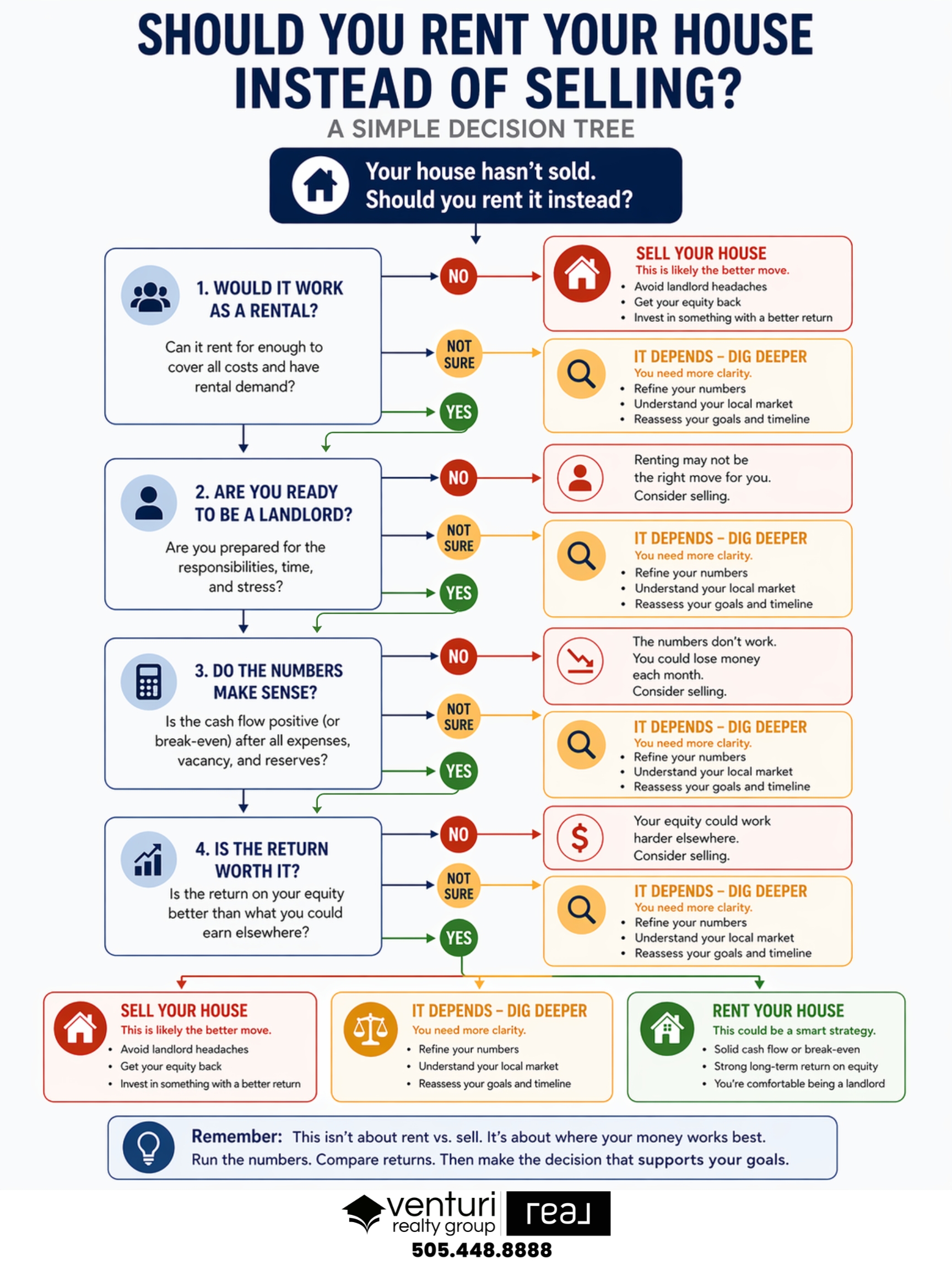
- How do you know if a house works as a rental?
- When does renting make more sense than selling?
Albuquerque Parade of Homes 2026 and the “Accidental Landlord” Question: Should You Rent Your House Instead of Selling?
Albuquerque Real Estate Talk, Episode 578: Parade of Homes + “Accidental Landlords” (Rent vs. Sell)
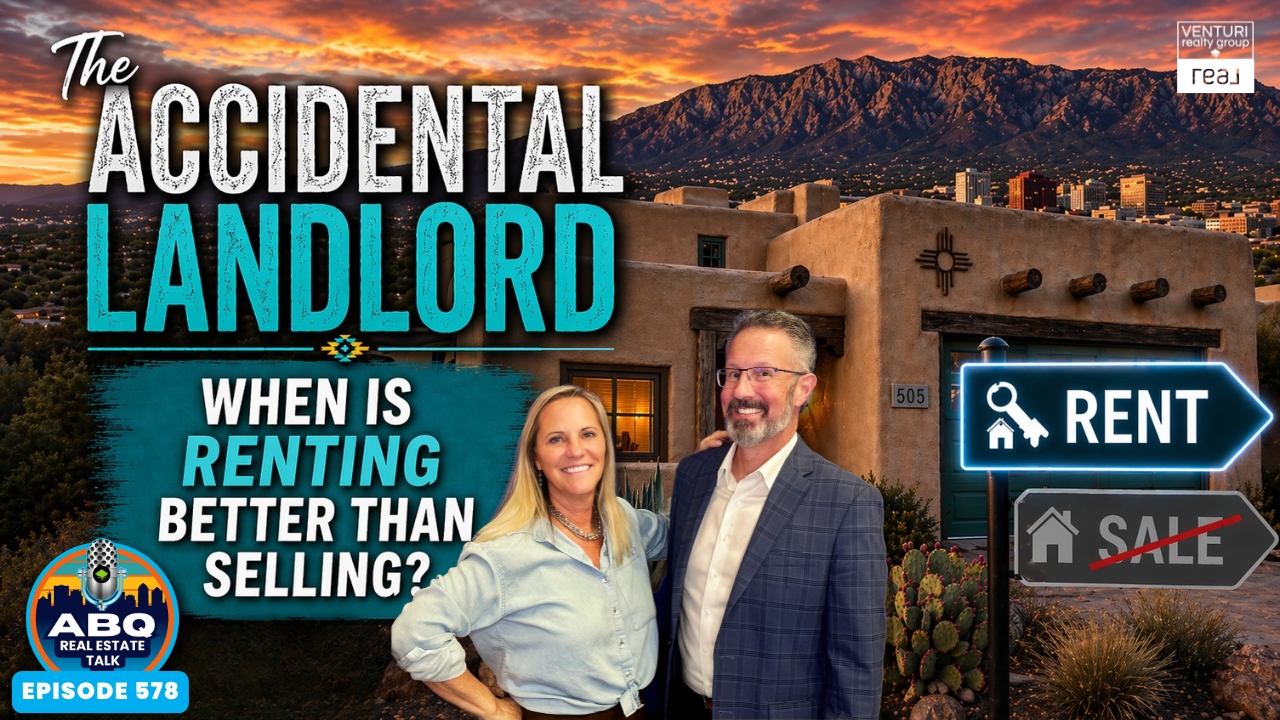
Episode 578 of Albuquerque Real Estate Talk covers two timely topics for local homeowners: the 2026 Parade of Homes and the growing question of whether a seller who cannot get their number should rent the property instead of selling it. Tego and Tracy Venturi open with a tour of this year’s Parade, including the featured community of Mesa del Sol, then shift into a practical conversation about what really happens when a homeowner becomes an “accidental landlord.”
The heart of the episode is not just whether a house can rent, but whether renting is actually the right strategy. The Venturis walk through the kind of analysis many sellers skip: rental value, insurance changes, maintenance reserves, vacancy, tenant turnover costs, equity, appreciation, and whether the owner truly wants the responsibilities that come with landlord life. It is a grounded Albuquerque conversation about real numbers, real tradeoffs, and real expectations.
"Renting should be a strategy if that's what you want to do, but it shouldn't be a backup plan."
There is also a local market angle throughout the show. The team discusses current Albuquerque activity, military relocation patterns tied to Kirtland Air Force Base, and the way some owners intentionally keep homes as rentals for long-term wealth building while others make the decision reactively out of frustration with the sales market.
Accidental Landlords in Albuquerque: The Real Math Behind Renting Instead of Selling
Tego frames the issue clearly: sometimes a homeowner puts a property on the market, cannot get the price they want, and decides to rent it instead. Sometimes the house never even hits the market because the seller sees the numbers and chooses to hold it. Other times, especially with military relocation, keeping the home as a rental is a deliberate long-term wealth-building strategy rather than a fallback.
That distinction matters because the numbers are more involved than many sellers expect. The episode walks through home value, available equity, likely rent, insurance changes, management fees, routine maintenance, vacancy, turnover costs, and the owner’s own tolerance for being a landlord. Tego points out that if a seller has significant equity, that capital has an opportunity cost too: is it better left in the property, or would it work harder elsewhere?
“You've got to figure at least 10% to whatever the rental income is,” Tego says when discussing property management, while Tracy adds that some owners may pay even more depending on how many rentals they have.
"You have to do the analysis. You can't do it by accident."
The upside is real. Tracy describes the long-term benefit as wealth building through appreciation and mortgage paydown. Tego expands that into four parts: cash flow, appreciation, principal reduction, and possible tax advantages. Their point is not that renting is bad. In fact, they own rentals themselves and manage some personally while using a property manager for others. Their point is that holding a home as a rental can be smart when it is intentional and fully analyzed.
The show also ends on a practical note for today’s sellers: modern tools can help owners pressure-test the decision. Tego explains how a homeowner can plug rental income, mortgage costs, taxes, insurance, HOA fees, vacancy assumptions, maintenance reserves, and appreciation into a large language model to model different outcomes. That does not replace local advice, but it can help turn an emotional decision into a clearer one.
"Where will my equity work harder for me?"
Parade of Homes 2026: A Bigger Look at Albuquerque’s Free, Self-Guided Home Tour
The episode opens with Tracy and Tego Venturi talking about one of the best ways to understand what is happening in Albuquerque new construction right now: the 2026 Homes of Enchantment Parade of Homes. As they exp
lain, it is a chance for buyers, sellers, future builders, and even homeowners who just want design ideas to get inside real homes and see what builders are actually delivering across the Albuquerque area.
What makes the Parade especially useful is that it is not a trade-show-style event in onebuilding. It is a self-guided tour spread across multiple parts of the metro, so visitors can compare neighborhoods, builders, price points, lot locations, and floor plans in a way that feels much closer to an actual home search. The official event is free, runs April 24-26 and May 1-3, and is open daily from 11 a.m. to 5 p.m., which lines up closely with the timing discussed in the episode.
As Tracy puts it, “So a lot of the builders like to showcase what they do and the signature neighborhood.”
"Go take a look. A lot of fun."
The official Parade site currently shows 19 featured homes, ranging from more attainable new-construction options to high-end custom and semi-custom properties. That matches the broad range Tracy talks about in the episode when she says the event gives people a way to see homes from the high $400,000s up into the luxury category. In practical terms, that means the Parade is not only for luxury shoppers. It is also for buyers trying to understand what entry-level and move-up new construction looks like in today’s Albuquerque market.
The 2026 featured community is Mesa del Sol, and that focus comes through strongly in the episode. Tracy describes Mesa del Sol as a community south of the airport where visitors can explore not just homes, but a larger neighborhood concept: trails, parks, a dog park, pool, nearby businesses, and a more walkable environment than many newer subdivisions. Official Mesa del Sol materials also highlight walking and biking paths, Aperture Plaza, community amenities, and an on-site school environment that reinforces why the neighborhood stands out in the Parade conversation.
The official Parade list backs up the episode’s emphasis on Mesa del Sol with four featured homes there: one each from Twilight Homes of New Mexico, Abrazo Homes, D.R. Horton, and Richmond American Homes. That is important because it gives visitors a rare side-by-side look at how different builders approach floor plans, finishes, and pricing within the same master-planned community.
Tego highlights one of the Parade’s most practical benefits when he talks about using the official homes list and map to plan a route. That is more valuable than it sounds. A serious buyer can compare infill product in the Northeast Heights, custom homes in areas like Placitas or Sandia Park, and builder-driven neighborhood product in places like Mesa del Sol or the Northwest, all in a single weekend. For homeowners not actively buying, the event still works as a snapshot of where Albuquerque design and construction trends are headed.
That trend-watching piece matters. Tego and Tracy connect the Parade to their own real-life experience of gathering ideas when they were thinking about building. They describe looking at layout ideas, smart features, finishes, appliances, and how spaces were being used. That makes the Parade useful far beyond an immediate purchase decision. It becomes a research tool for remodeling, a benchmark for pricing expectations, and a way to understand what today’s builders think Albuquerque buyers want most.
Another strong local angle in the episode is geographic variety. Tracy mentions homes in places like Placitas, Sandia Park, Rio Rancho, the West Side, and central Albuquerque infill locations. The official Parade history explains why that spread matters: since 1991, the event has brought the public and builders together across the metro rather than limiting the experience to one corridor or one style of housing. That broad footprint makes it easier to compare lifestyle choices as much as houses themselves.
One especially interesting example from the episode is the infill development around Wyoming and Montgomery, which Tracy points out as a rare chance to see brand-new construction in the heart of the Northeast Heights. That kind of project stands out because Albuquerque buyers do not often get many new-build options in mature, centrally located parts of the city. In that sense, the Parade is not just a showcase of homes. It is also a window into where new housing opportunities are opening up across the metro.
The builder mix is another reason the Parade draws real attention. According to the official event information from the Home Builders Association of Central New Mexico, the event includes both production builders and custom builders. That means visitors can compare the efficiencies and pricing of larger-volume builders with the design flexibility, lot selection, and specialty features often found in custom or higher-end homes. For someone trying to decide whether to buy new, build from scratch, or simply borrow ideas for a future project, that side-by-side comparison is unusually helpful.
Seen that way, the Parade does more than entertain. It helps visitors answer practical questions: Which neighborhoods feel right? Which builders consistently deliver a style I like? What does my budget buy in different parts of Albuquerque? How much more do upgrades change the final number from base price? What design features are showing up again and again in 2026 homes? Those are exactly the kinds of market-education questions that Tego and Tracy are encouraging listeners to explore.
By the end of this part of the episode, the Parade of Homes is framed not as a casual weekend outing, but as a smart local research exercise. It gives buyers a clearer picture of new construction, gives sellers a better sense of their competition, and gives homeowners a firsthand look at where Albuquerque housing design is going next.
Frequently Asked Questions
Is the Albuquerque Parade of Homes free and open to the public?
Yes. In the episode, the team describes the Parade of Homes as a free event where people can walk through participating homes over two weekends. For event details and the official map, visit the official Parade website.
What makes Mesa del Sol A Desirable ABQ Neighborhood?
Mesa del Sol is discussed as the featured community in this year’s Parade. Tracy highlights its parks, trails, pool, businesses, dog park, and the local community setting, while also noting its appeal for people connected to Kirtland and other major employers.
What is the first question to ask before renting out a home instead of selling it?
The first question is whether the property really works as a rental. The hosts explain that some homes are naturally easier to rent than others, and that condition, location, layout, and maintenance demands all matter.
What costs do homeowners forget when they become landlords?
The episode identifies several commonly overlooked costs: property management, higher insurance, ongoing maintenance, capital improvements, vacancy between tenants, and turnover expenses after a renter moves out.
Is renting out a house always a good backup plan if it does not sell?
No. The main theme of the episode is that renting can be an excellent strategy, but it should be intentional. The hosts repeatedly caution against becoming a landlord just because a sale was frustrating without first doing the full analysis.
Have questions about Albuquerque real estate?
If you are thinking about buying or selling, or just want to understand how the current market affects your plans, our team is here to be a resource.
Call or text: (505) 448-8888
Email: [email protected]
Website: WelcomeHomeABQ.com
Venturi Realty Group of Real Broker, LLC