
 New Mexico’s 2026 Housing Proposals: What’s on the Table, and Why It Matters

As New Mexico approaches the 2026 legislative session, housing is clearly one of the Legislature’s top priorities.
Lawmakers have introduced a large and diverse set of housing-related bills, resolutions, and memorials, addressing everything from zoning and construction costs to homeownership, homelessness, taxes, insurance, energy, and infrastructure.
It’s important to start with a clear caveat: these are proposals, not laws. Many of them will change. Some will not advance. Others may pass in amended or scaled-back forms. And notably, many of these ideas are not new—versions of them have been introduced, debated, or stalled in prior sessions.
Still, the sheer volume and breadth of housing proposals this year signal something meaningful: housing affordability and availability are firmly on the Legislature’s agenda in 2026.
I reviewed every housing-related proposal I could find so far and compiled a worksheet summarizing what each one does, how it works, and how it is funded. What follows is a high-level look at the major themes behind these proposals and their potential implications—without yet weighing in on which are most effective or which may be more performative than impactful.
I compiled the source material for this article from the New Mexico Legislature’s website and used ChatGPT to help summarize and organize the proposals discussed here.
I’ve also put together a Google Docs worksheet that includes links to every proposal mentioned here, along with more detailed summaries of each bill.
Zoning and Housing Supply: Potentially High Impact, Repeatedly Contested
Several proposals focus on changing zoning and land-use rules, which determine what kinds of housing can be built and where.
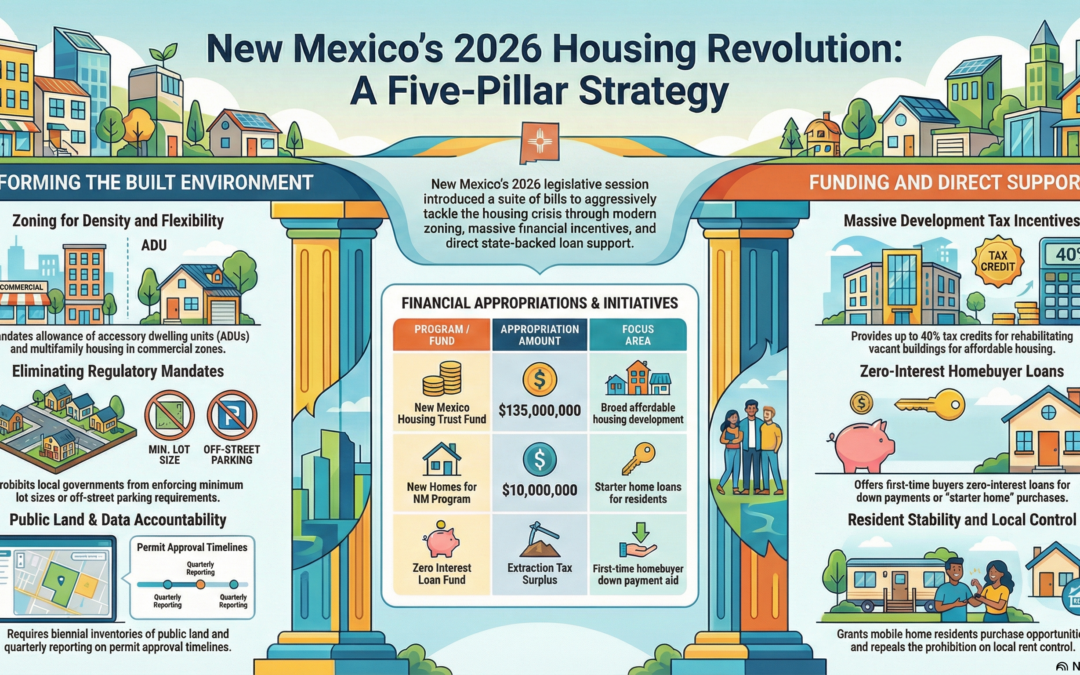
- HB 17, which would require local governments to allow accessory dwelling units (ADUs) and more multifamily housing in commercial areas and near transit
- HB 138, which would eliminate minimum lot size requirements in residential zones
- SB 131, a sweeping zoning reform bill that would legalize apartments in commercial zones, allow duplexes and ADUs statewide, and remove height and parking mandates
- SB 128, which targets underused public land by requiring inventories and, in many cases, the sale of long-vacant public property in metropolitan areas
These proposals are widely seen by housing researchers as necessary conditions for increasing housing supply over time. They don’t directly fund construction, but they remove legal barriers that prevent smaller, denser, and more affordable housing types from being built.
None of these ideas are new to New Mexico. Similar zoning reform efforts have surfaced in past sessions and often stalled due to local opposition or implementation concerns. Their return in 2026 suggests persistence—but not yet success.
If any category of proposals has the greatest potential to meaningfully affect housing availability, it’s this one. It’s also the category most likely to face political resistance and uneven local implementation.
Funding, Tax Credits, and Cost Reduction: Familiar Tools with Mixed Track Records
Another large set of proposals focuses on funding housing directly or lowering the cost of building it.
- HB 139, which would appropriate $135 million to the New Mexico Housing Trust Fund
- HB 77, creating a tax credit to rehabilitate abandoned buildings and vacant lots into affordable housing
- SB 92, reducing construction costs by creating a gross receipts tax deduction for affordable multifamily housing
- SB 119, establishing a demolition fund to remove condemned residential properties
- SB 58, extending property tax exemptions for redevelopment projects
- HB 140, funding oversight of Affordable Housing Act programs
These are well-worn policy tools. In some cases, they can help affordable housing projects move forward. In others, their impact is limited by scale, administrative complexity, or local barriers that remain unchanged.
Some of these proposals could be meaningful—especially if paired with zoning reforms like HB 17, HB 138, or SB 131.
Others may have modest or indirect effects, particularly if they are not large enough to influence market behavior.
Homeownership, Tenants, and Housing Stability: Who Gets Access
A separate group of proposals focuses less on total housing supply and more on who benefits from existing housing.
- HB 168 and HB 176, creating zero-interest loan programs for first-time homebuyers
- SB 114, restricting hedge funds and corporations from buying single-family homes
- HB 192, temporarily prohibiting foreign corporations from purchasing single-family homes as investment rentals
- HB 167, giving mobile home park residents a right to purchase their park before it is sold
- SB 138, repealing the state ban on rent control and restoring local authority
- HB 190, funding eviction prevention and housing assistance for LGBTQ+ people experiencing homelessness
Some of these proposals may meaningfully help specific households or communities. Others are likely to have limited impact on overall affordability or supply, even if they are politically popular.
Buyer assistance can help individuals but does little to lower prices without increased supply. Ownership restrictions often sound bold but may be constrained by exemptions and enforcement realities.
This is an area where several proposals risk being more performative than impactful, though that assessment ultimately depends on details and implementation.
Housing-Adjacent Costs: Taxes, Insurance, Energy, and Infrastructure
Many proposals this session address costs that strongly affect housing affordability even though they don’t directly create housing.
- HB 103, HB 148, SB 149, and HJR 8 addressing property tax rules and accountability
- SB 154, requiring wildfire insurance to cover related flood damage
- SB 161, addressing wildfire mitigation and utility liability
- SB 55, expanding the solar tax credit
- HB 183, funding drinking water testing and filtration
- HB 110, increasing transparency around housing permits
- SB 127, restructuring state homelessness governance
- HM 20 and SM 10, requesting studies related to renewable energy permitting and portable solar
These proposals are largely indirect in their housing effects. Some could reduce long-term costs or improve housing stability. Others may have little measurable impact but still respond to real constituent concerns.
A Realistic Takeaway
It would be easy to frame this legislative moment as a breakthrough—or, alternatively, to dismiss much of it as political theater. The reality is more complicated.
- Some proposals—particularly zoning and land-use reforms like HB 17, HB 138, SB 131, and SB 128—have real potential to affect housing availability if enacted and implemented well; however, they face property rights questions.
- Some funding and tax proposals may help at the margins but are unlikely to solve structural shortages on their own.
- Some proposals will likely have minimal impact on housing affordability and function more as political signaling than solutions.
What is clear is that housing is a top-tier issue for the New Mexico Legislature in 2026, and lawmakers are engaging with it from many angles—even if not all approaches are equally effective.
Attention alone doesn’t solve a housing crisis. But without sustained attention, solutions are impossible.
For now, this is a snapshot of what’s on the table—and a reminder that intent, repetition, and outcomes are very different things.
Tego