

How to Speak New Mexican in Real Estate | Albuquerque Metro Guide

How to Speak New Mexican in Real Estate: Adobe, Acequias, Casitas, and an Albuquerque Metro Area Tour
By Venturi Realty Group
Albuquerque Real Estate Talk Ep. 572 | Tego Venturi and Tracy Venturi
For anyone relocating to New Mexico, house hunting can feel like learning a second language. In this episode, Tego and Tracy Venturi unpack the local real estate vocabulary that shows up in listings across Albuquerque and Northern New Mexico, then shift into a practical breakdown of how locals think about the greater Albuquerque metro area.
The conversation starts with a playful fictional property description full of words that are familiar to longtime New Mexicans but often confusing to out-of-state buyers: adobe, portal, corbels, vigas, latillas, kiva fireplace, nicho, horno, acequia, casita, bosque, and more. What sounds poetic in a listing is also highly specific to the architecture, landscape, and culture of this region.
“If you didn’t, if you were not from New Mexico and not familiar with these terms, you’d be going, I have no idea what they’re talking about.”
— Tego Venturi
“House hunting in New Mexico can feel like learning a new real estate language.”
That is exactly why this episode works so well as a guide for buyers moving to Albuquerque, Rio Rancho, Corrales, the North Valley, the South Valley, or other parts of central New Mexico. It is part glossary, part lifestyle explainer, and part local orientation tour for people trying to understand not just what these words mean, but how they connect to the places where people actually live.
Speaking “New Mexican” in a Home Search
Tego opens the episode with a made-up listing description designed to sound like a classic New Mexico home for sale. It includes nearly every phrase that can stop a relocating buyer in their tracks: a Northern New Mexico style adobe with a shady portal, carved corbels, exposed vigas, latillas, a kiva fireplace, a banco, a nicho, Saltillo tile, an horno, acequia access, a separate casita, luminarias, the Rio Grande bosque, Old Town, and Sandia views. The point is not just that these are colorful words. The point is that they describe real architectural features and real lifestyle cues that matter in this market.
“So here’s this fictional property and just stringing together all the different words that are used in New Mexico, in housing.”
— Tego Venturi
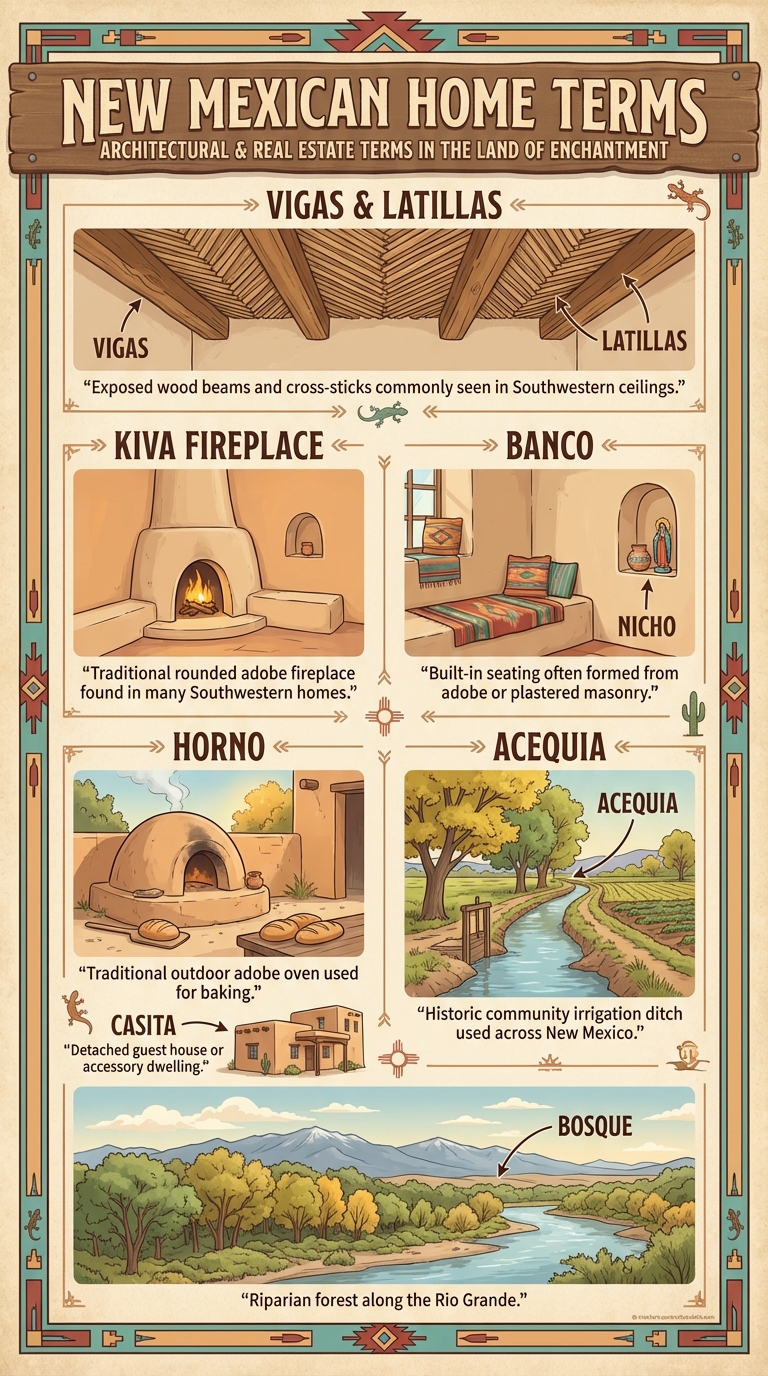
As Tracy explains, New Mexico homes often look very different from homes in other parts of the country. That difference shows up first in the roof and ceiling vocabulary. Vigas are the large structural beams. Latillas are the smaller wood pieces laid across them. Corbels are the carved supports that often appear beneath beams. These details are more than decorative shorthand. They signal the regional design language buyers see throughout Albuquerque and especially in Pueblo-style and Northern New Mexico-style homes.
The episode also breaks down interior and exterior terms that show up constantly in local listings. A kiva fireplace is the rounded beehive-style fireplace many buyers associate with Southwestern design. A banco is built-in seating, often near a fireplace or along a wall. A nicho is a recessed wall niche designed to display art, pottery, or religious santos. An horno is the outdoor adobe-style oven that looks like a rounded dome in the yard. A casita is what many buyers elsewhere would call a guest house, in-law quarters, granny flat, or ADU.
“A casita is New Mexico’s version of the guest house, and it deserves its own name.”
Another important takeaway from the episode is that these terms often describe more than architectural details—they hint at lifestyle. When a listing mentions the bosque, for example, it usually refers to the cottonwood forest that runs along the Rio Grande and the trail systems that many locals use for walking, cycling, and horseback riding. When a home advertises acequia access, it often means proximity to the historic irrigation ditches that shape much of the valley landscape and provide the peaceful, rural feel buyers associate with areas like Corrales and the North Valley.
Many of these features also reflect how climate and culture shaped New Mexico architecture over generations. Thick adobe-style walls help regulate temperature during hot summers and cool desert nights. Covered portals create shaded outdoor living areas. Courtyards, bancos, and outdoor ovens encourage gathering and outdoor cooking. Even small details like nichos or carved corbels reflect artistic traditions that have deep roots in the region’s Hispanic, Native American, and Spanish colonial heritage.
For buyers relocating from other parts of the country, understanding this vocabulary quickly changes the way listings read. Instead of sounding mysterious, these descriptions start to paint a clear picture of the home’s design, craftsmanship, and sense of place. Once buyers learn the language of New Mexico real estate, they often find it becomes one of the most charming and distinctive parts of the home search process.
Additional New Mexico Real Estate and Architecture Terms to Know
- Zaguan In historic New Mexico architecture, a zaguan is a covered passageway or entry corridor that carries you from the street, gate, or front courtyard deeper into the home or compound.
- Placita A placita is an enclosed courtyard or shared outdoor gathering space, often associated with traditional compound layouts and homes designed around privacy and sheltered outdoor living.
- Canales These are the roof spouts that extend through a parapet wall to drain water away from a flat roof, and they are one of the most recognizable details on adobe and Pueblo-style homes.
- Parapet A parapet is the low wall that rises above the roofline and creates the flat-roof silhouette many buyers immediately associate with classic Southwestern architecture.
- Brick coping In many Territorial-style and adobe buildings, brick coping is the protective brick cap along the top of a wall or parapet that helps shed water and adds a crisp architectural edge.
- Portal A portal is a covered outdoor porch or walkway supported by posts, and in New Mexico it often serves as an important shaded living space during warmer months.
- Courtyard entry This refers to a home layout where the front approach opens into a walled or partially enclosed outdoor area before you enter the main house, adding privacy and a sense of arrival.
- Adobe construction Traditionally, adobe refers to sun-dried earthen bricks, but in modern listings it may also describe the look and feel of thick-walled Southwestern construction inspired by historic building methods.
- Territorial style Territorial homes usually blend adobe-inspired massing with straighter lines, more formal symmetry, and trim details that feel a little crisper than rounded Pueblo-style architecture.
- Pueblo-style home This style generally features rounded edges, flat roofs, vigas, corbels, earth-toned finishes, and a softer handmade appearance rooted in regional New Mexico design traditions.
- Clerestory windows Clerestory windows are high-set windows placed above eye level to bring in natural light while maintaining privacy, and they are common in Southwestern homes with dramatic ceiling lines.
- Coyote fence A coyote fence is a rustic New Mexico fence made from tightly placed upright poles, often used to reinforce the traditional village, hacienda, or high-desert character of a property.
- Latilla ceiling While the episode discussed latillas with vigas, some listings also highlight a latilla ceiling specifically to emphasize the texture, craftsmanship, and wood detail overhead.
- Saltillo tile Saltillo tile refers to warm-toned clay tile flooring that gives many Southwestern homes their earthy, handmade look and pairs naturally with adobe-style finishes.
- View lot In Albuquerque real estate, a view lot often means sightlines to the Sandias, volcanoes, city lights, or bosque corridor, which can significantly shape both lifestyle appeal and pricing.
How the Venturis Explain the Albuquerque Metro Area
After decoding the housing vocabulary, the episode pivots into a broad tour of the greater Albuquerque area. The Venturis frame this section the way many relocating buyers think: not just in terms of city names, but in terms of feel. Where are the rural pockets? Where are the newer production-home areas? Where do you find horse properties, valley trails, historic homes, condos near downtown, or custom homes with views?
“We’re just focused right now on what we think of as the metro area.”
— Tracy Venturi
One of the clearest threads in this part of the episode is the river corridor. Corrales, the North Valley, and the South Valley all connect back to the acequias, ditch trails, bosque access, horses, and agricultural history that make this part of the Albuquerque area feel different from suburban tracts on the west side. Readers who want to understand why the bosque matters so much can explore the Paseo del Bosque Trail, the City of Albuquerque’s Open Space lands, and the Corrales Bosque Preserve.
Corrales gets special attention as a highly desired village with a distinct small-town feel. Tracy describes it as the horse capital of New Mexico, with riding along the ditches, local events, a growers market, and San Ysidro Church reinforcing its identity as a true village beside the city. North Valley areas share some of that river-oriented character, though the Venturis also point out that not every North Valley neighborhood feels uniformly rural.
Rio Rancho is presented differently. The conversation emphasizes variety: custom homes on larger lots in some areas, master-planned neighborhoods in others, and a strong pull for relocating buyers who start their search online. Tracy highlights the appeal of four seasons, well-rated schools, and new homes, while Tego notes that Rio Rancho and Sandoval County are no longer simply the bargain alternative they once were. For readers comparing lifestyle amenities there, the City of Rio Rancho’s parks, bike paths, open space, and trails guide is a useful companion resource.
“The metro area makes more sense when you think in terms of lifestyle: river villages, suburban west side neighborhoods, and historic core districts.”
The west side and Northwest Albuquerque come across in the episode as the more suburban side of the market, with many subdivisions, production-built homes, and fewer big lots. The South Valley is described in much more rural and agricultural terms, with ranches, small farmers, horses, and growing things along the river. Old Town and downtown form another distinct category altogether, anchored by history, older adobe homes, Victorians, Craftsman-style houses, condo pockets, and the city’s long-established cultural core. Readers who want more context on those areas can use Visit Albuquerque’s Historic Old Town guide and broader Albuquerque neighborhood guide.
The result is less of a hard-boundary map and more of a local field guide. That is what makes this episode valuable for buyers coming from out of state. It translates both the homes and the geography into plain language without stripping away what makes Albuquerque and New Mexico feel different.
Frequently Asked Questions
What are vigas and latillas in a New Mexico home?
In the episode, vigas are described as the larger structural ceiling beams that run across a room, while latillas are the smaller wooden pieces placed across them. Together they create the exposed wood ceiling look that is common in many Pueblo-style and Southwestern homes.
What is a kiva fireplace?
A kiva fireplace is the rounded, adobe-style fireplace often seen in Southwestern homes. Instead of a square brick hearth like many homes elsewhere in the country, a kiva fireplace typically has a curved, beehive-style shape that reflects traditional Pueblo architecture.
What is the difference between a banco and a nicho?
A banco is built-in seating, usually formed out of the wall or masonry near a fireplace or along a living area. A nicho, on the other hand, is a recessed niche in the wall designed to display pottery, artwork, or religious items such as santos.
What is an horno?
An horno is a traditional outdoor adobe oven that looks like a rounded dome. Historically used for baking bread and roasting food, hornos are still found in some New Mexico homes and outdoor patios as both functional cooking features and cultural design elements.
What is a casita in New Mexico real estate?
As discussed in the episode, a casita is a small separate living space on the property. In other parts of the country it might be called a guest house, in-law suite, granny flat, or accessory dwelling unit (ADU).
What does “acequia access” mean in a real estate listing?
An acequia is part of the traditional irrigation ditch system that has been used in New Mexico for centuries. When a property advertises acequia access, it often means the home is located near these historic irrigation channels, which are especially common in valley areas like Corrales and the North Valley.
What is the bosque in Albuquerque?
The bosque refers to the cottonwood forest that runs along the Rio Grande through Albuquerque and surrounding communities. Homes near the bosque often provide access to walking, biking, and horseback riding trails along the river corridor.
What is a portal?
A portal is a covered porch or outdoor walkway typically supported by wooden posts. In New Mexico homes, portals provide shaded outdoor living space and are often a central gathering area for relaxing or entertaining.
What does Territorial style mean?
Territorial-style homes blend adobe-inspired construction with straighter architectural lines and decorative trim. Compared to rounded Pueblo-style homes, Territorial homes often have sharper edges, brick coping, and a slightly more formal appearance.
Why do New Mexico homes often have flat roofs?
Flat roofs are a defining characteristic of Pueblo and adobe-inspired architecture. Historically, these roofs were practical for the dry desert climate and allowed homes to maintain their distinctive Southwestern silhouette.
Why do Albuquerque listings mention views so often?
In Albuquerque real estate, views can significantly affect a home’s appeal and value. Listings often highlight views of the Sandia Mountains, city lights, volcanoes, or the Rio Grande bosque because these natural features are a major part of the local lifestyle.
TL;DR: What This Episode Covers
This episode helps buyers understand the language of New Mexico real estate and the layout of the Albuquerque metro area. Tego and Tracy explain the local words that often appear in listings, including adobe, portal, vigas, latillas, corbels, kiva fireplace, banco, nicho, horno, acequia, casita, and bosque.
They also explain how those terms connect to real places and lifestyles across the region. The second half of the episode gives a practical overview of areas like Corrales, the North Valley, the South Valley, Rio Rancho, the West Side, Old Town, and downtown, with a focus on how each area feels to live in.
“This episode is both a New Mexico real estate glossary and a local guide to how the Albuquerque metro area fits together.”
For relocating buyers, the big takeaway is simple: understanding Albuquerque real estate means understanding both the homes and the local vocabulary that describes them. This episode is a strong introduction to both.
Have questions about Albuquerque real estate?
If you are thinking about buying or selling, or just want to understand how the current market affects your plans, our team is here to be a resource.
Call or text: (505) 448-8888
Email: info@welcomehomeabq.com
Website: WelcomeHomeABQ.com
Venturi Realty Group of Real Broker, LLC