
New Mexico homebuying guide
Title, Escrow and Title Insurance in New Mexico
Who handles the money, what the paperwork says, and which policy protects whom.
Listen To The Summary
0:00 / 1:40
The practical difference
Title refers to legal ownership rights. Closing escrow coordinates money and documents under the transaction’s instructions. Title insurance protects an insured interest against covered title risks, subject to the policy’s terms. Knowing which job you are asking about makes it easier to get a useful answer before closing.
Tego starts the original conversation by naming the people involved in a purchase: the broker, lender, title company, inspectors and others. Then he and Tracy slow down over one word—title. Their question is a good place to start when a closing statement arrives with several unfamiliar charges.
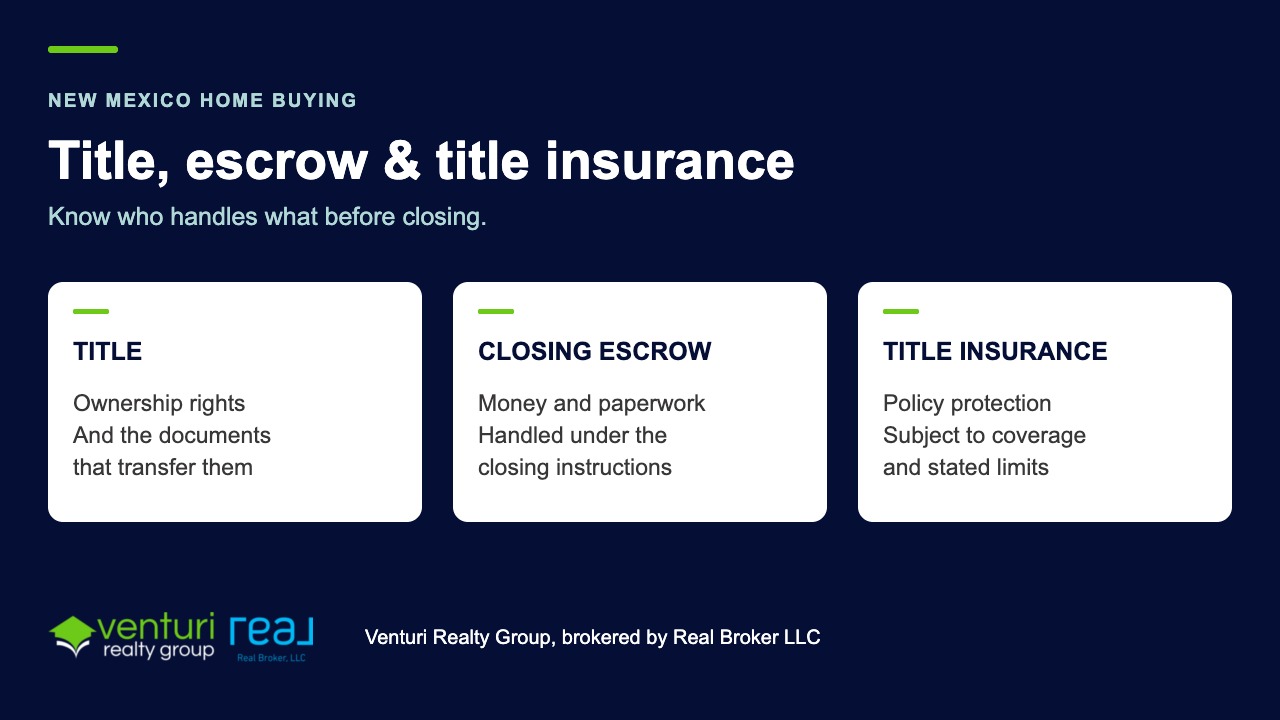
Title is the ownership right; the deed records a transfer
Tracy describes title as the legal right to own and use property. A deed is the document used to transfer ownership. They are closely related, but asking for “the title” may leave the closing team wondering which document or question you mean. What title means · 1:12 ↗ The New Mexico OSI: title insurance consumer guide explains the distinction.
Tracy also raises a familiar paperwork problem: property passed through generations without every transfer being clearly documented. Her point is practical. Before a sale, the closing team needs to establish what the records show and what documentation is required. Family transfers and title questions · 2:11 ↗
If you are selling, bring known prior policies, payoff information and relevant ownership documents into the conversation early. Your title team can identify its requirements; an attorney can advise on legal questions about ownership or authority to sign.
Use the title commitment to ask specific questions
The conversation becomes more useful when Tracy and Tego get to the title binder—the document that sets out what the title company found and what its proposed protection will address. Understanding the title binder · 3:29 ↗
New Mexico’s NM Form 6 is an offer to issue a policy, with conditions. It separates the proposed insured and property details from requirements and exceptions. Read those parts together rather than treating the commitment as an already-issued policy. See New Mexico’s promulgated title insurance forms (PDF).
| Part to review | A useful question |
|---|---|
| Schedule A | Who and what is proposed to be insured? |
| Requirements | What must happen before the policy can issue? |
| Exceptions | Which listed matters would be outside the proposed protection? |
Tracy names liens and assessments among the items that can appear in the review. Tego adds a local example: a private road crossing property in the North Valley or Corrales. Liens and financial claims · 3:52 ↗ Easements and access · 4:34 ↗
For a shared drive or another easement, ask for the referenced document and an explanation of what it means for the property and proposed coverage. A reference number alone does not answer your questions about access, maintenance or planned use. Get legal advice when the rights or obligations need interpretation.
An owner’s policy and a lender’s policy protect different interests
A brief exchange near the end of the title discussion gets to a question buyers often have: is the policy required? Tego is thinking about the lender’s requirement; Tracy points out the choice involved when there is no mortgage. The policy requirement conversation · 6:38 ↗
The distinction matters more than a quick yes or no. Most mortgage lenders require a lender’s policy to protect the amount they lend. An owner’s policy addresses the homeowner’s insured interest. Paying for one does not make it the other. The CFPB: owner’s title insurance explanation is a useful starting point.
Ask which policies are proposed, who will be insured and what amount of coverage applies. Protection depends on the issued policy’s covered risks, exceptions, exclusions and conditions. A title search and an insurance policy are valuable parts of the process; neither is a promise that every imaginable dispute is covered.
Homeowners insurance is a separate conversation. In the later segment, Tracy recommends obtaining a property-specific quote early enough to understand the cost and any availability questions. The homeowners insurance conversation · 10:34 ↗ Keep that quote alongside your title and loan questions rather than assuming all insurance charges do the same job.
Clarify which kind of escrow is being discussed
During a purchase, the closing team brings documents, charges and instructions together. Tracy describes that coordinating work in the recording. Coordinating closing paperwork · 5:35 ↗ Ask who will hold funds, what instructions govern their release and when signing, funding, recording and possession are expected for your agreement.
A mortgage escrow account serves a different purpose after the purchase. It may collect part of each monthly payment for property taxes and insurance, with the servicer paying those bills. Those expenses can change, so the escrow portion of a payment can change too. See the CFPB: mortgage escrow accounts explanation.
On an estimate or closing statement, ask whether an escrow item is a service charge, money needed for the transaction or a deposit toward future bills. For the rest of the purchase sequence, use our New Mexico homebuying guide.
Compare the written quote and verify the path for your funds
New Mexico regulates title insurance rates and authorized charges. Ask the company to identify the applicable policies, coverage amounts, endorsements and charges in an itemized quote. A meaningful comparison starts with the same proposed coverage and a clear explanation of what each line includes. The New Mexico title insurance rate rules are the primary state reference.
For covered mortgages, section C on page 2 of the Loan Estimate identifies services you can shop for. Your lender’s list and acceptance requirements matter when choosing a provider. The CFPB: choosing closing services guide explains that process. Our Albuquerque closing-cost guide can help organize the broader cash-to-close conversation.
Confirm payment instructions through a trusted, independently known phone number, especially when a message requests a last-minute change. If you suspect funds were diverted, contact your bank immediately and report the incident to IC3. See NAR: protecting closing funds for the verification steps.
Prepare for the title-commitment conversation
Choose the part of the commitment you are reading and copy two questions for your title team. This reader organizes a conversation; it does not interpret your documents or determine coverage.
Schedule A
Confirm the details with the title team.
- Who and what will be insured?
- Which policy and amount are proposed?
Watch the original November 2020 conversation
The 13:53 video was published November 28, 2020. It includes pandemic-era market commentary between the title and homeowners-insurance discussions; those numbers and forecasts are historical. This written guide uses current primary sources for the process explanations.
Questions that often come up before closing
Does a lender’s policy protect me as the homeowner?
It protects the lender’s insured interest. An owner’s policy is a separate coverage decision for your interest in the property. Ask the title team to explain both policies and your contract’s requirements.
Does a title search guarantee there will never be a claim?
No. A search may not uncover every issue. The issued insurance policy defines the protection, limits and conditions that apply.
Can I choose the title or closing company?
Discuss the choice early with your broker and lender. Many closing services can be shopped for, while the lender’s acceptance requirements and your purchase agreement still need to be addressed.
Is mortgage escrow the same as closing escrow?
Mortgage escrow generally sets money aside for later property-related bills. Closing escrow concerns the funds and instructions for the purchase itself. Ask which meaning applies to each charge or request.
Sources and update notes
Guide researched November 5, 2026. Original article publication date remains December 4, 2020; source video publication is November 28, 2020. The overview is original VRG artwork and the studio images are real archival frames.
- New Mexico OSI: title insurance
- CFPB: owner’s title insurance
- New Mexico’s promulgated title insurance forms (PDF)
- New Mexico title insurance rate rules
- CFPB: choosing closing services
- CFPB: mortgage escrow accounts
- NAR: protecting closing funds
Coverage and legal rights depend on the actual documents. Ask the title or insurance professional about the policy, and an attorney about legal interpretation.
Know who to ask before closing
If you are preparing for an Albuquerque-area purchase or sale, we can help organize the next conversations with your lender, title team and other professionals.
Venturi Realty Group, brokered by Real Broker LLC