

Why a Carpet Allowance Does Not Work Anymore When Selling an Albuquerque Home
By Venturi Realty Group
Albuquerque Real Estate Talk, Episode 589 — July 2026
For years, home sellers have used the phrase “carpet allowance” as if it were a simple fix. The carpet looks worn, the seller does not want to move furniture, and the hope is that the buyer can simply pick the flooring after closing. In this episode of Albuquerque Real Estate Talk, Tego Venturi, Tracy Venturi, and Asel Venturi explain why that old strategy can work against sellers in today’s Albuquerque real estate market.
The conversation started in a team meeting when someone said the seller wanted to offer a carpet allowance. Tracy’s reaction was immediate: “Carpet allowance is not a thing.” Her point was not that sellers cannot help buyers with costs. It was that buyers do not shop houses in theory. They respond to the photos, the showing experience, the smell, the condition, and the feeling of whether a home is truly move-in ready.
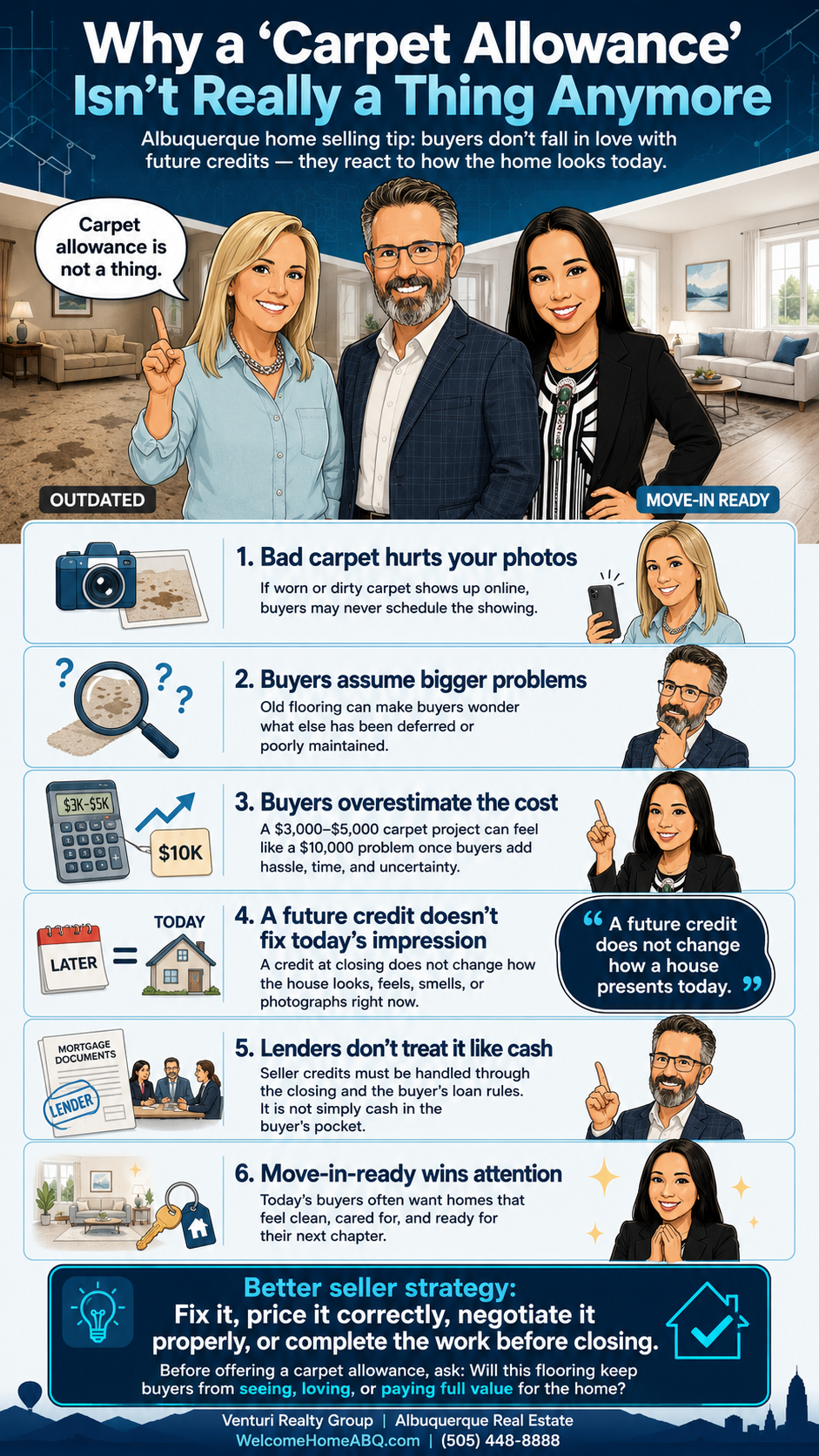
"A future credit does not change how a house presents today."
That is the real story. A flooring credit may sound practical at the kitchen table, but it does not make worn carpet look better in listing photos. It does not prevent a buyer from wondering what else has been deferred. And it does not always work cleanly with the buyer’s loan, because seller credits must be accounted for through the lender, closing disclosure, and loan program rules.
The Problem With a Carpet Allowance Starts Before the Buyer Ever Walks In
When Tracy explains why a carpet allowance fails, she starts with the most important part of modern home selling: presentation. Most buyers see a home online first. If the carpet looks dirty, stained, worn, or outdated in the listing photos, the seller may never get the showing at all.
Tracy described the typical seller logic this way: “They say, ‘Oh, we’ll just give a carpet allowance.’ What in reality sounds really reasonable, right? Gonna give them a carpet allowance.” The problem is that reasonable does not always mean effective in a competitive marketplace.
From the seller’s point of view, the allowance feels flexible. Maybe the buyer wants a different color. Maybe they would rather have wood flooring. Maybe the seller does not want to spend money on a choice the buyer may replace anyway. But from the buyer’s point of view, worn flooring can signal more than a cosmetic issue.
"If the photos show dirty or worn carpet, they'll never get in your home potentially."
That is the first risk. The second risk happens during the showing. If the carpet looks worse in person than it did online, the flooring can become the first negative impression. Tracy explained that buyers may immediately think, “Huh, I wonder what else is deferred maintenance or not taken great care of in the home.” In other words, the carpet is not just carpet. It becomes evidence.
This is why preparation matters. The National Association of REALTORS® has continued to emphasize the role of presentation, staging, and buyer expectations through resources like its Profile of Home Staging and Remodeling Impact Report. In Albuquerque, the same principle shows up in daily buyer behavior: buyers may like the price, location, and floor plan, but condition still shapes whether they write an offer.
Tego added another layer: buyers often overestimate repair costs. A carpet replacement that might cost three to five thousand dollars can feel like a ten-thousand-dollar problem to the buyer, especially when they also factor in the hassle of moving in, arranging installers, and living around the project.
As Tracy put it, “These days, Tego and Asel, people want move in ready houses, right? They don't wanna take on a project after closing. They wanna be able to move in.”
What Albuquerque Sellers Should Know Before Offering a Carpet Allowance
- Photos drive the first decision
If worn carpet shows in the listing photos, some buyers may skip the home before a seller ever gets a chance to explain the allowance.
- Condition creates assumptions
Tracy explained that buyers may see worn carpet and start wondering what else in the home has been deferred or poorly maintained.
- Buyers often inflate repair costs
Tego noted that a buyer may see a three-to-five-thousand-dollar carpet issue and mentally turn it into a much larger discount request.
- A credit does not improve presentation
A future concession may help with closing math, but it does not change how the home looks, feels, photographs, or smells today.
- Lending rules matter
Asel and Tego pointed out that seller credits must be handled through the lender, not as simple cash handed to the buyer after closing.
- The cleaner strategy is decided before listing
The team’s guidance was to replace it, price for it, negotiate it correctly, or complete the work before closing when appropriate.
Why Seller Credits Are Not the Same as Handing the Buyer Cash
The phrase “carpet allowance” can make it sound as if the seller simply gives the buyer money at closing and the buyer heads to the flooring store. In a financed transaction, that is not how it works. Asel, drawing on her lending background, made the key point: “It's not cash in your pocket right away.”
Tego explained the lender side clearly: “Any credit from a seller to a buyer must be accounted for somewhere in the closing.” Asel identified the lending term as an interested party contribution, often shortened to IPC. Conventional loan rules from Fannie Mae’s Interested Party Contributions guidance and Freddie Mac’s guide show why seller contributions are not unlimited and why they must be structured correctly. FHA guidance from HUD’s Single Family Housing Policy Handbook also treats seller contributions as part of the lending and underwriting picture.
"You can't just give somebody money."
That matters for Albuquerque sellers because the wrong wording can create confusion. A seller may think they are solving a carpet problem, while the lender may treat the proposed credit as a concession subject to the buyer’s loan type, closing costs, and program limits. If the buyer does not have enough allowable closing costs to absorb the concession, the seller may not be able to deliver the help in the way they imagined.
The Better Question: Will This Flooring Keep Buyers From Seeing the Home?
Tego reframed the issue in a way sellers can use before listing: “The question isn't, you know, can we give a carpet allowance? The question is, will this flooring keep buyers from seeing my home?” Tracy added the follow-up: will it keep them from buying it, and will it affect the final price more than the hassle and cost of replacing it?
That is the practical test. Sellers do not need to fix every cosmetic item before listing, and not every house requires brand-new flooring. But the flooring decision should be part of a larger pricing and presentation strategy, not an afterthought.
Tracy laid out the options directly: “Instead of a carpet allowance, maybe think through the actual strategy. Maybe replace the flooring before we list it so it can clearly improve the presentation or price the home to reflect the condition.” She also mentioned negotiating a seller concession toward closing costs if the lender permits it, or agreeing to complete the work before closing in the right situation.
Move-In Ready Still Matters in the 2026 Albuquerque Market
The team connected the carpet allowance conversation to a broader market reality: buyers in 2026 have more choices than they did during the tightest inventory years, and the buyers who are active are often picky. Tracy said, “They have a lot more choices in homes right now than they've had for the last few years.” Tego added, “The buyers that are out there are very picky. They want move-in-ready homes is what we're seeing.”
That does not mean every seller should remodel. It means sellers should be clear-eyed. If the carpet is going to hurt first impressions, the seller can fix it. If the seller does not want to fix it, the price needs to acknowledge the condition. If the issue is going to be negotiated, the concession must be structured with the buyer’s lender and closing costs in mind.
"Fix it, price it accordingly, or negotiate it."
The same episode also touched on a healthier local backdrop. Tego shared that Albuquerque had less than one percent of homeowners with mortgages in negative equity, New Mexico mortgage delinquency was about three percent of mortgaged homeowners, and distressed listings were less than half a percent of homes on the market. For outside context on mortgage performance, Tego referenced Intercontinental Exchange data, and sellers can review current national reporting through the ICE Mortgage Monitor data reports.
In plain English, the carpet allowance issue is not about a collapsing market or desperate sellers. It is about strategy. In a market where serious distress is still limited and move-in-ready homes attract attention, a seller who handles visible condition issues before listing may protect both buyer interest and negotiating power.
First-Time Buyers and Seller Concessions Still Have a Place
The team also discussed encouraging news for first-time buyers. Tego referenced a recent National Association of REALTORS® report showing first-time buyers had risen to 35% of all buyers, the highest share since June 2020. That trend appears in NAR’s REALTORS® Confidence Index.
Tracy connected that to local opportunity, noting that some builders and sellers were helping buyers with closing costs. Tego also mentioned New Mexico first-time buyer programs, down payment assistance, closing cost assistance, and low-down-payment options. Buyers can review statewide resources through Housing New Mexico / MFA mortgage programs.
That is where seller concessions can be powerful. A closing cost credit may help the buyer get into the home. But it should be positioned as a financing strategy, not as a magic fix for carpet that photographs poorly and weakens the buyer’s first impression.
The final takeaway for Albuquerque home sellers is simple: a carpet allowance may sound flexible, but buyers do not fall in love with allowances. They fall in love with homes that feel clean, cared for, and ready for their next chapter.
Questions Answered In This Episode
-
Why doesn’t a carpet allowance work like it used to?
Because buyers judge the home by how it looks and feels today, not by a future credit they may receive later. -
Can a seller just give a buyer cash for new carpet?
Not usually. Seller credits must be handled through the closing process and the buyer’s lender rules. -
Should sellers replace worn carpet before listing?
In many cases, yes. Fresh flooring can improve photos, showings, buyer confidence, and perceived value. -
What should sellers do instead of offering a carpet allowance?
Fix it before listing, price the home to reflect the condition, negotiate a proper seller concession, or complete the work before closing. -
Are Albuquerque buyers still looking for move-in-ready homes?
Yes. The team explains that today’s active buyers tend to be selective and often prefer homes that feel clean, cared for, and ready to move into.
Helpful Resources Mentioned in This Topic
-
National Association of REALTORS® — Profile of Home Staging
See how presentation, staging, and buyer perception affect the way homes are viewed and valued.
Read the NAR home staging report -
Fannie Mae — Interested Party Contributions
Learn how seller credits and concessions are treated in many conventional mortgage transactions.
Review Fannie Mae IPC guidance -
HUD — FHA Single Family Housing Policy Handbook
Review FHA policy guidance related to financing, underwriting, and seller contribution rules.
Visit HUD Handbook 4000.1 -
Housing New Mexico / MFA — Homebuyer Mortgage Programs
Explore New Mexico down payment assistance, closing cost assistance, and mortgage program options.
View Housing New Mexico mortgage programs
Have questions about Albuquerque real estate?
If you are thinking about buying or selling, or just want to understand how the current market affects your plans, our team is here to be a resource.
Call or text: (505) 448-8888
Email: [email protected]
Website: WelcomeHomeABQ.com
Venturi Realty Group of Real Broker, LLC