
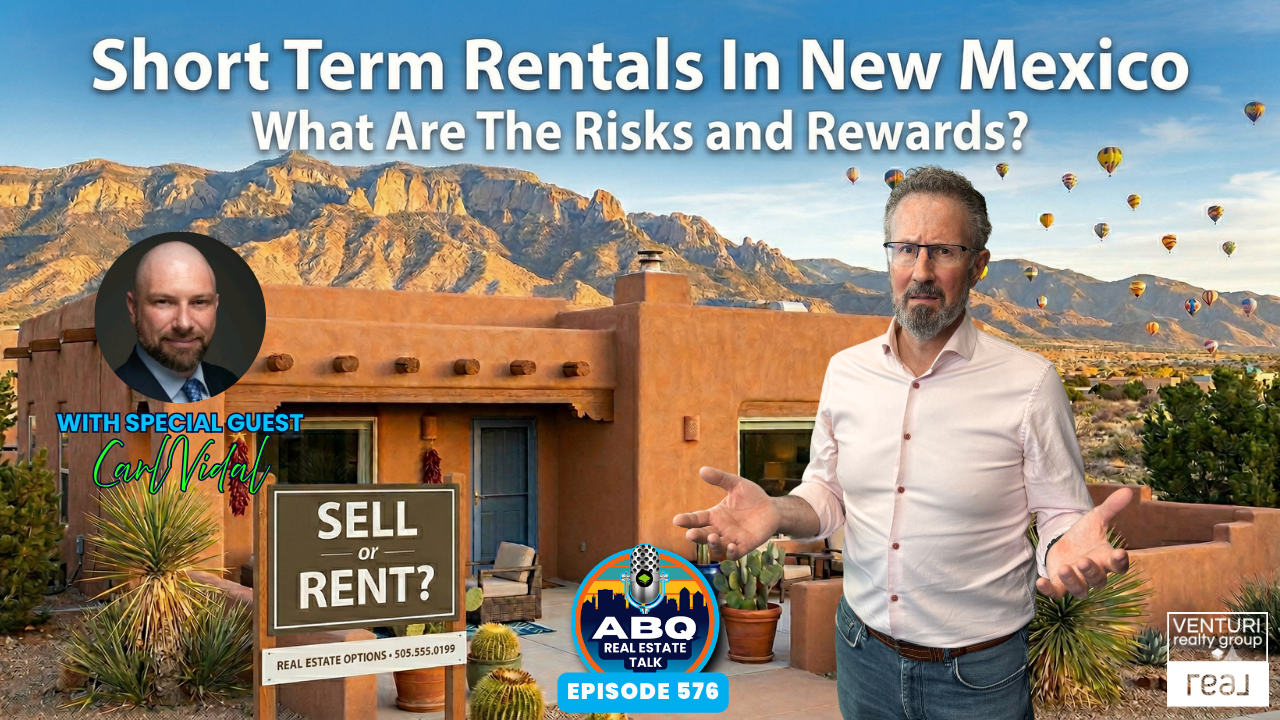
Short-Term Rentals in New Mexico: Economic Impact, Hosting Standards, and the Bernalillo County Tax Fight
By Venturi Realty Group
Albuquerque Real Estate Talk, Episode 576 | April 2026 | Featuring Tego Venturi and Carl Vidal
Short-term rentals sit at the intersection of tourism, housing policy, property rights, and small-business economics in Albuquerque and across New Mexico. In this episode, Tego Venturi sits down with Carl Vidal—an Albuquerque-based operator, Realtor, and board member connected to both the New Mexico Short-Term Rental Association and Visit Albuquerque—to unpack what short-term rentals actually do for local owners, local workers, and local communities.
The conversation stays grounded in New Mexico realities. Vidal argues that these properties are not one single category, but a wide range of owner-operated and professionally managed homes serving different needs: tourism, family travel, and even longer contractor stays tied to projects and employers that touch the Albuquerque metro, including activity around Intel in Rio Rancho and Netflix Studios Albuquerque. He also ties the guest experience directly to the local economy, from neighborhood restaurants to museums like the Indian Pueblo Cultural Center, the National Hispanic Cultural Center, and city attractions listed by Albuquerque Arts & Culture.
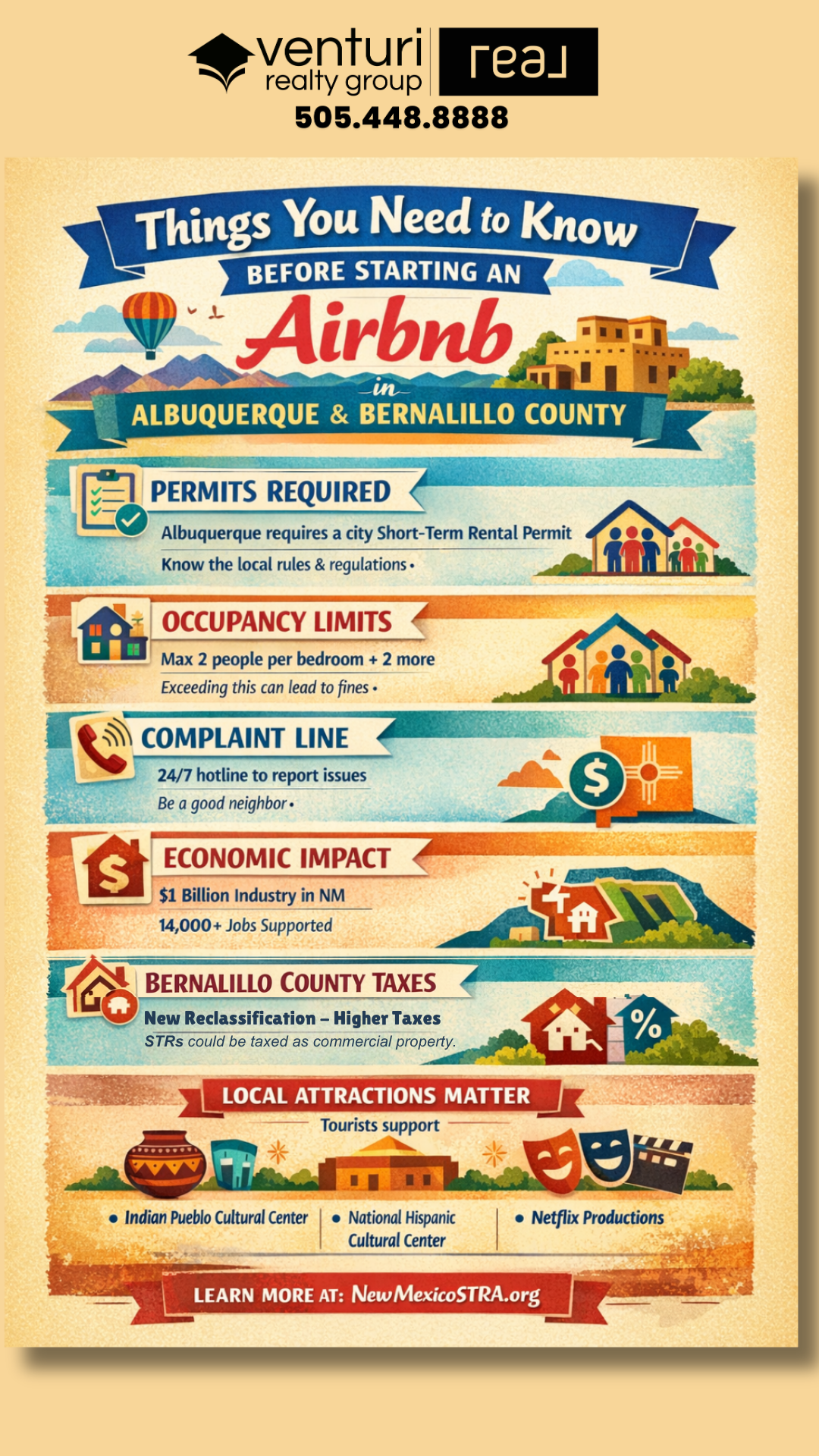
Full Quote: “This is a $1 billion industry statewide, and there’s over 14,000 employees, and that doesn’t include the homeowners. You know, there’s 14,000 homeowners, so total you’re looking at about 28,000 New Mexicans that derive their income from these short term rentals. It is a huge industry.” — Carl Vidal
“They’re all small businesses.”
Why the Short-Term Rental Debate in Albuquerque Is Bigger Than Airbnb
One of the strongest themes in this episode is that short-term rentals get flattened into a single public stereotype when the real market is far more varied. Vidal describes luxury vacation homes, contractor-focused furnished housing, part-time family homes, and owner-retained properties that are only rented for limited periods of the year. That distinction matters in Albuquerque, where the city’s short-term rental permit system, occupancy rules, and complaint enforcement structure were built specifically to address neighborhood concerns without treating every property the same.
That is where the “good neighbor” conversation becomes practical rather than theoretical. In the transcript, Vidal points to Albuquerque’s local framework limiting occupancy and giving neighbors a route to report problems. The city’s public FAQ also outlines the permit requirement, complaint pathways, and a 24-hour hotline for concerns about unpermitted or problematic properties. In other words, the local policy environment already recognizes the core issue most residents care about: not whether a house is listed online, but whether it operates responsibly inside a neighborhood.
Full Quote: “There’s certain things like you’re not allowed to have too many people at a house under City of Albuquerque law, you’re allowed two people per bedroom plus an additional two at the house… If they get three strikes, they’re out, they lose their city permit, the city can shut them down.” — Carl Vidal
“No one wants to live next to a party house.”
The discussion also pushes back on the idea that these properties only serve leisure travelers. Vidal specifically mentions contractors and other temporary workers, which makes this issue relevant not only to tourism but also to regional mobility and workforce housing. In a metro where visitors may spend time near Intel’s New Mexico operations, production facilities such as Netflix’s expanded Albuquerque hub, and Albuquerque institutions promoted by Visit Albuquerque, the short-term rental market is tied to more than weekend tourism. That local context helps explain why the episode frames short-term rentals as a New Mexico economic issue, not just a neighborhood nuisance issue.
Hyper-Local Takeaways Albuquerque Hosts and Owners Should Know
- Albuquerque already has an STR permit system The City of Albuquerque requires permits for short-term rentals and publishes a public FAQ covering registration, compliance, and enforcement.
- Occupancy rules are part of the local framework The city’s short-term rental ordinance includes occupancy standards and enforcement language designed to reduce nuisance use in residential neighborhoods.
- There is a 24/7 complaint path for neighbors Albuquerque’s STR program includes a hotline and reporting process described by the city at its official FAQ page, which supports the “good neighbor” approach discussed in the episode.
- Tourism dollars connect directly to Albuquerque institutions Guests staying in the city often spend money at local attractions and cultural anchors such as the Indian Pueblo Cultural Center, the National Hispanic Cultural Center, and destinations listed by Visit Albuquerque.
- Bernalillo County’s tax fight is separate from city permitting The property-tax controversy comes from the county assessor side, while the day-to-day operating rules for STRs inside Albuquerque come from the city’s permit and code framework.
- New Mexico’s host advocacy network is growing Owners who want to follow policy changes or improve operations can connect with the New Mexico Short-Term Rental Association, which the episode identifies as an education and advocacy group for hosts statewide.
The Bernalillo County Tax Controversy and Why It Matters to Albuquerque Owners
The second half of the episode turns from operations to tax policy, and this is where the conversation becomes especially local. Tego and Vidal discuss the March 31, 2026 announcement from the Bernalillo County Assessor, which formalized a reclassification approach for certain short-term rentals as nonresidential property. Bernalillo County’s own release frames that move as part of a housing-guideline effort, while the podcast frames it as a major policy shift with real consequences for small owners.
Full Quote: “Some people got tax bills with a 600% increase… a lot of those tax increases were on homes that families have owned for generations, and all of a sudden they’re faced with losing a property that has been in their family for generations because the tax bill now went up 600%.” — Carl Vidal
“You’re getting a double whammy here of tax lightning on your property taxes.”
The podcast also points listeners to the unresolved legal and legislative gray area around how short-term rentals should be treated under New Mexico property-tax law. That is not just a talking point. In 2025, the New Mexico Legislature adopted House Memorial 52, a short-term rental work group memorial that requested suspension of reclassification until a broader study could be completed. The memorial text itself specifically references the need to study the regulatory framework and requests suspension of reclassification while that work is underway. That legislative backdrop directly bolsters the episode’s core point: this is not a settled issue.
What makes the Bernalillo County controversy especially important for Albuquerque-area owners is that it is not only about large commercial operators. Vidal argues in the transcript that many properties are part-time homes, military family homes, or owner-held assets that do not fit a simplistic “hotel versus house” narrative. That nuance matters in a county where the assessor’s office has published a clear reclassification position, while city-level STR operations remain governed by Albuquerque’s own permit and compliance system. The episode’s broader argument is that policymakers should distinguish between irresponsible nuisance use and responsible, locally rooted ownership.
There is also a larger economic development angle running through the conversation. If Albuquerque continues competing for visitors, project-based workers, and temporary stays tied to regional employers and attractions, short-term rentals will remain part of that ecosystem alongside hotels. Travelers coming for cultural stops like the Indian Pueblo Cultural Center, performances at the NHCC, or general trip planning through Visit Albuquerque do not experience these categories as abstract policy debates. They experience them as lodging choices inside a real local economy.
Full Quote: “I also don’t think that our government should be picking winners and losers between the hotel industry and the small business short-term rental.” — Carl Vidal
Frequently Asked Questions
What is a short-term rental in New Mexico?
In the context of this episode, a short-term rental is generally a property rented for 30 days or less. That is the threshold Carl Vidal and Tego Venturi use when discussing how these properties are treated differently from midterm and long-term rentals.
How is a short-term rental different from a midterm rental or a long-term rental?
The podcast breaks rentals into three broad categories. Long-term rentals are typically traditional leases of six months to a year or more. Midterm rentals usually fall into the month-to-month or 30-day-plus range and often serve traveling professionals or contractors. Short-term rentals are generally stays of 30 days or less and are commonly associated with platforms like Airbnb and VRBO.
Are all short-term rentals the same type of business?
No. One of the main points in the episode is that the public often lumps all short-term rentals into one category when they actually serve very different purposes. Some are luxury vacation homes, some are part-time family homes, some are used to host contractors, and some are operated by homeowners simply trying to generate supplemental income.
How big is the short-term rental industry in New Mexico?
According to Carl Vidal in the episode, short-term rentals represent a major statewide economic force. He describes the industry as generating roughly $1 billion in economic impact and supporting income for thousands of New Mexicans, including both workers and property owners.
What does that economic impact include?
Vidal explains that the impact goes beyond the property owner. It includes visitor spending at gas stations, restaurants, museums, local attractions, and other businesses that benefit when travelers, tourists, or contractors stay in New Mexico. The argument in the episode is that short-term rentals help capture outside dollars and spread them through the local economy.
Why do some guests choose short-term rentals instead of hotels?
The episode suggests that many guests prefer the flexibility, privacy, space, and residential feel of a short-term rental. In some cases, travelers are staying longer for work assignments or family reasons and want something that feels more like a home than a hotel room.
Are short-term rentals important only for tourism?
No. While tourism is a major part of the conversation, the podcast also points out that short-term rentals can serve contractors, temporary workers, and others coming to New Mexico for project-based assignments. That means the industry is tied not only to leisure travel but also to workforce mobility.
What are some of the biggest complaints people have about short-term rentals?
The most common complaints center on noise, parties, overcrowding, parking issues, and the fear that a residential neighborhood could be disrupted by poorly managed properties. Tego and Carl both acknowledge that these concerns exist and that bad actors have shaped much of the public debate.
What is the “good neighbor” idea discussed in the episode?
The “good neighbor” concept means operating a short-term rental in a way that respects the surrounding neighborhood. That includes limiting occupancy, preventing parties, responding quickly to issues, and making sure guests understand the house rules. In the podcast, Carl presents this as one of the most important responsibilities of a host.
What is the STR occupancy standard for Albuquerque?
Carl explains that under Albuquerque rules, occupancy is generally limited to two people per bedroom plus an additional two people in the house. In the example he gives, a three-bedroom property would usually be limited to eight occupants total.
Why are parties considered such a major issue for STR hosts?
Carl says the biggest risk often is not the person renting the home but the extra people they invite over. Those guests may have no financial responsibility for the property and can create noise, damage, parking problems, or neighborhood complaints. That is why he says responsible operators do not allow parties.
Can a bad short-term rental lose its right to operate?
According to the discussion, yes. Carl says Albuquerque has an enforcement structure where repeated violations can put a property’s city permit at risk. His explanation is that if a property becomes a recurring problem, the city can ultimately shut it down.
Are most short-term rentals causing neighborhood problems?
No. Carl argues that the overwhelming majority of short-term rentals do not generate major issues. His position in the podcast is that highly visible bad examples get most of the public attention, while the far larger number of uneventful, well-managed stays never make the news.
What makes a property a good candidate for a short-term rental?
The episode makes clear that not every house works well as a short-term rental. Carl says the right property, right location, right amenities, and right market positioning are all crucial. Without those factors, the revenue may not justify the labor, cost, and risk involved.
Is running a short-term rental easy money?
No. Both Tego and Carl push back on that assumption. They describe short-term rentals as labor-intensive and say many people underestimate the work required to keep a property clean, updated, competitively priced, and consistently guest-ready.
What kind of work goes into operating a short-term rental?
The podcast emphasizes guest communication, cleaning, furnishing, maintenance, marketing, pricing, screening, house rules, and rapid problem-solving. A successful host has to think like an operator, not just a property owner collecting rent.
Why do some owners decide the short-term rental business is not for them?
Tego shares that he and Tracy had short-term rentals during the pandemic but ultimately decided it was not the right business for them. The takeaway is that while the model can work well for some owners, others discover that the time, management, and constant attention required are more than they want to take on.
What advice does the episode give to someone thinking about starting an Airbnb or VRBO?
The core advice is to treat it like a real business from day one. That means understanding your market, knowing your local rules, setting strict house policies, creating a high-quality guest experience, and being honest about whether your property is actually suited for this use.
What should STR hosts focus on most?
Carl repeatedly comes back to guest experience and neighborhood responsibility. His view is that the house has to be clean, modern, well-managed, and set up to create a great stay while also protecting the surrounding neighborhood from nuisance behavior.
Why do rules matter so much for a short-term rental host?
Clear rules help define how guests are expected to use the property and help prevent avoidable problems. Carl explains that strong rules are one of the main tools a host has to protect the home, the neighbors, and the overall quality of the guest stay.
Can an owner hire a property manager instead of running everything personally?
Yes. Tego asks this directly, and Carl confirms that there are property managers who handle short-term rentals for owners. That option can make sense for people who want the income potential but do not want to manage the daily details themselves.
What is the New Mexico Short-Term Rental Association?
In the episode, Carl describes it as a statewide association of hosts formed to help members become better operators and to educate policymakers about the industry. He says it is both a professional resource and an advocacy organization.
Why does Carl believe short-term rentals should not automatically be treated like large commercial operations?
He argues that many short-term rentals are small, family-scale operations or properties used part-time by their owners. In his view, treating them all as if they are large commercial enterprises ignores how diverse the market really is and can unfairly punish ordinary homeowners.
What is the Bernalillo County tax controversy discussed in the episode?
The podcast explains that Bernalillo County has taken the position that certain short-term rentals should be treated as nonresidential or commercial for property tax purposes. Carl argues that this is a major shift from how these properties have historically been treated in New Mexico.
Why is that tax change such a big deal to owners?
According to Carl, the change can mean both losing the benefits tied to residential classification and being taxed at a higher rate. In the episode, he describes this as a double financial hit that can dramatically increase annual tax burdens.
Does the episode say this issue affects only big investors?
No. A major point Carl makes is that these tax changes can hit small owners, families, inherited properties, and homeowners using the property only part of the year. The argument is that this is not simply a fight involving large-scale investors.
Why is the STR issue so complicated?
Carl talks about scenarios like snowbirds, part-time residents, and even military families who may leave New Mexico temporarily but want to keep their home and return later. In those cases, the house may be rented for periods of time, but that does not necessarily fit the public image of a full-time commercial lodging business.
What role did the New Mexico Legislature play?
The episode says lawmakers recognized the issue and moved to study it through a memorial, with the idea that broader legislative review should happen before county-level reclassification efforts move forward. That supports the podcast’s argument that the matter is not fully resolved.
Why does Carl think policymakers should be careful here?
His concern is that tax policy can end up picking winners and losers between hotels and small-scale short-term rental owners. He argues that overly aggressive reclassification could push small operators out of the market before the state has fully decided what the long-term policy should be.
Will taxing short-term rentals at a higher rate solve the housing crisis?
No. The conversation suggests that short-term rentals are part of a much bigger housing conversation and that using them as a single explanation for housing shortages oversimplifies the problem.
What is the biggest takeaway from this podcast about short-term rentals for a new host?
The biggest takeaway is that starting a short-term rental is not just about listing a home online. It means entering a regulated, competitive, and politically debated business where success depends on the right property, strong operations, responsible hosting, and a clear understanding of local tax and policy risks.
What is the biggest takeaway for Albuquerque property owners watching this issue?
For local owners, the episode suggests paying attention to both sides of the equation: operating rules and tax policy. Even if a property is well run, policy changes at the county or state level can materially affect whether the investment still makes sense.
Who is this episode most useful for?
This episode is especially useful for Albuquerque-area homeowners considering a short-term rental, current hosts trying to stay compliant, real estate investors comparing rental strategies, and anyone trying to understand how housing, tourism, and tax policy intersect in New Mexico.
Have questions about Albuquerque real estate?
If you are thinking about buying or selling, or just want to understand how the current market affects your plans, our team is here to be a resource.
Call or text: (505) 448-8888
Email: info@welcomehomeabq.com
Website: WelcomeHomeABQ.com
Venturi Realty Group of Real Broker, LLC