
Albuquerque Real Estate Talk · Episode 594
Why Albuquerque Is Becoming a Regional Economic Hub
New investment in fusion, aerospace and defense is meeting a second force: growing interest in Albuquerque from some of the West’s biggest metros.

Is Albuquerque’s economy growing?
Albuquerque is building a credible pipeline of advanced-industry investment, but the metro is not in a broad employment boom today. Two major projects discussed in Episode 594 project roughly 500 permanent jobs between them, and the region already has a deep concentration of aerospace, defense and scientific work. Yet June 2026 federal data showed total Albuquerque-area nonfarm employment slightly below the prior year.
The more useful story is about direction. Albuquerque is attracting companies that fit its existing technical strengths while drawing housing interest from Phoenix, Denver, Los Angeles, Dallas and other regional metros. Whether that becomes durable economic and housing growth will depend on hiring, wages, infrastructure and the number of homes available near new job centers.
“Is Albuquerque actually growing?” Tracy Venturi asked near the beginning of Episode 594. The question sounds simple. The evidence is not.
Albuquerque’s current employment picture is mixed, but its next generation of employers is beginning to take shape. At the same time, the city is showing up on the radar of people browsing homes from large western and southwestern metros. Those are different signals—one tied to investment and jobs, the other to where people may be considering a move—but together they point to Albuquerque’s expanding role as a regional destination.
Albuquerque is pursuing industries that already fit the region
Tego Venturi described an economic-development strategy centered on advanced technology, advanced energy, space, aerospace, defense and bioscience. That’s an important distinction. The goal isn’t to imitate a coastal software hub. It’s to build around the laboratories, military research, engineering talent and technical manufacturing already rooted in Central New Mexico.
The Albuquerque Regional Economic Alliance’s aerospace profile says the greater Albuquerque aerospace cluster employs nearly 16,000 people and is almost three times as concentrated as the national economy. Sandia National Laboratories, Kirtland Air Force Base, the Air Force Research Laboratory and the University of New Mexico form a base of research, procurement and specialized talent that many competing metros would have to build from scratch.
“We need economic stability. Having solid future industries is a big deal.”
Tego Venturi, Albuquerque Real Estate Talk Episode 594
Two developments discussed in the episode show how that strategy is moving from recruitment language to physical projects.
Pacific Fusion
The company plans a $1 billion research and manufacturing campus at Mesa del Sol and a build center in Los Lunas. Its New Mexico project page says the effort is expected to create 200 permanent jobs and hundreds of construction roles.
Project Ranger
Castelion broke ground in January 2026 on a 1,000-acre manufacturing and testing campus. The state describes a $220 million investment projected to create 300 high-wage jobs in Sandoval County.
A groundbreaking is not yet an economic boom
The latest broad employment data keep the story grounded. The U.S. Bureau of Labor Statistics’ Albuquerque snapshot, extracted August 13, 2026, estimated 417,500 nonfarm jobs in June—0.3% fewer than a year earlier. Education and health services, information, leisure and hospitality, and trade/transportation/utilities grew. Professional and business services, manufacturing, construction and government were lower.
That doesn’t cancel the significance of the new projects. It changes the tense. The facilities, permanent jobs and supplier activity are a developing story, not a finished one. For housing, the distinction is critical: an announced job supports demand only after someone is hired, chooses where to live and can find a home that works with the household budget.
Albuquerque’s pull extends far beyond New Mexico
The other half of the episode’s growth conversation came from a presentation Tego attended through AREA. The ranked source markets were Phoenix, Denver, Los Angeles, Dallas, Houston, Las Vegas, El Paso, Colorado Springs, San Antonio and San Diego.
Every city on that list sits in Arizona, Colorado, California, Texas or Nevada. That concentration matters more than the ranking order alone. Albuquerque’s strongest outside connections appear to run through the West and Southwest—regions where people may already know the climate, travel patterns and cultural geography of New Mexico.
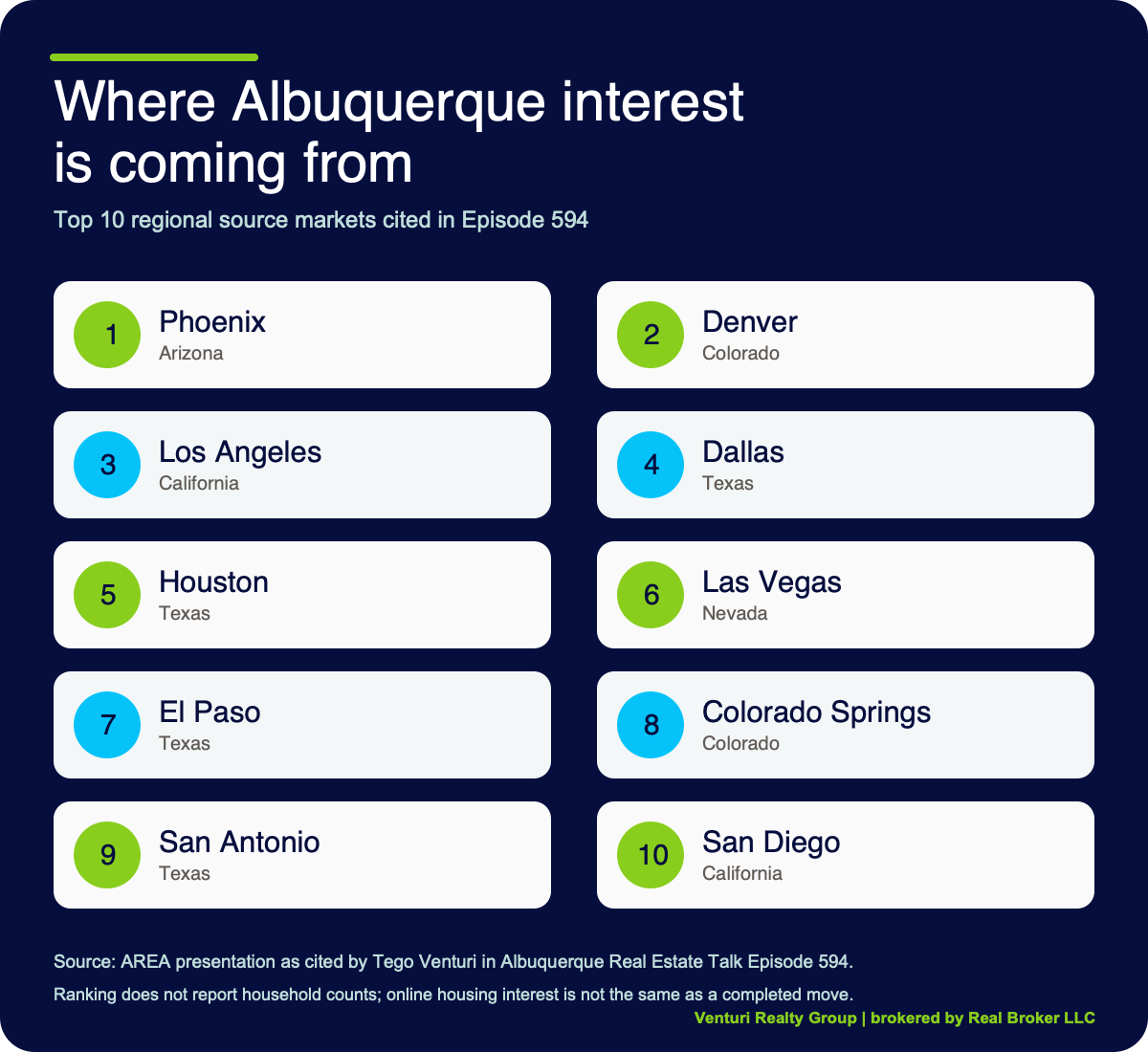
What the graphic can—and cannot—tell us: It identifies the metros AREA highlighted as sources of Albuquerque interest. It does not show how many households moved, whether they bought or rented, or when a move occurred.
Tego compared that list with Realtor.com’s cross-market demand view. In the episode, he reported that roughly 20% of Albuquerque’s out-of-market listing views came from the Phoenix metro and 16% from Denver, followed by Santa Fe, Dallas and Los Angeles. Realtor.com’s research methodology treats cross-market demand as online traffic to active listings. It is a measure of attention, not completed migration.
That difference is easy to lose in a relocation headline. A person can browse Albuquerque homes for months and never move. A household can relocate and rent before buying. Someone in Santa Fe may search Albuquerque while staying inside New Mexico. Search traffic is best understood as an early signal of consideration.
Why Albuquerque works as a regional destination
Price is part of Albuquerque’s appeal, but it is not the whole explanation—and it is not permanent. Housing costs, mortgage rates, insurance and taxes change. A more durable advantage is the combination Albuquerque offers: a metro-scale housing market, an international airport, two interstate corridors, a major research-and-defense ecosystem and access to communities from Rio Rancho to Los Lunas and Santa Fe.
That geography allows one economic project to reach beyond its municipal boundary. A job at Mesa del Sol may shape housing decisions in South Albuquerque or Valencia County. A Sandoval County employer may affect Rio Rancho, Northwest Albuquerque and communities along the US 550 corridor. A new hire may prioritize a short commute; another may choose an established neighborhood and accept more drive time. The housing effect follows real household choices, not a line on a jurisdiction map.
Episode 594 offered a telling example. Tego described someone who had expected to retire in Arizona but ultimately chose Santa Fe after weighing weather, taxes, culture, healthcare access and sense of place together. It was one person’s decision, not market data, but it captures how destination choices are actually made: as a package of tradeoffs rather than a single cost comparison.
What economic growth could change in the housing market
New employers can support housing demand, but there is no straight line from a company announcement to higher home prices. The sequence matters.
- Projects have to become operating facilities. Construction work has a temporary housing effect; permanent operations create a longer demand cycle.
- Hiring can come from inside or outside the metro. A local worker changing jobs does not create the same net housing demand as a household relocating from Denver or Phoenix.
- Wages have to support the full housing payment. Mortgage rates, insurance, taxes, utilities and maintenance can matter as much as the sale price.
- Location determines where demand is felt. Mesa del Sol, Los Lunas and western Sandoval County connect to different commute patterns and housing inventories.
- Supply determines how much pressure builds. More resale listings and new construction can absorb job growth. Tight supply can intensify competition.
This is why Tego returned to housing supply during the episode. Economic stability is healthy, but Central New Mexico also needs enough homes for the people already here and for those who may arrive. Readers can follow changing inventory and pricing through Venturi Realty Group’s Albuquerque housing market tracker and REABQ local market data.
The signals that will show whether the trend is taking hold
The strongest evidence will arrive gradually. Four indicators will tell the story better than any single announcement.
Facilities opening and jobs being filled
Track construction milestones, operating dates, job postings and permanent headcount—not only projected totals.
Housing activity near job corridors
Compare listings, new construction, contract activity and commute choices around Mesa del Sol, Los Lunas, Rio Rancho and Sandoval County.
Search interest turning into households
Online views show curiosity. Closed purchases, leases, address changes and population estimates provide later evidence of actual moves.
Housing supply keeping pace
Employment growth is easier to absorb when buyers and renters have enough choices in the places they need them.
For buyers and homeowners, the practical response is not to race an economic-development headline. It is to follow the evidence, compare locations and keep the household budget grounded in current conditions. For sellers, a regional growth story can support confidence, but current comparable sales, property condition and competing inventory still determine market position.
Albuquerque’s economic direction looks more promising when its pieces are viewed together: industries that fit the region, tangible private investment and sustained attention from nearby major metros. The next chapter will be written by execution—open facilities, durable jobs and enough housing to support the people those opportunities bring.
Questions people ask about Albuquerque’s economic growth
Is Albuquerque’s economy growing in 2026?
Albuquerque has a significant pipeline of advanced-industry investment, but the latest available broad employment data were mixed. June 2026 metro nonfarm employment was estimated 0.3% below a year earlier. It is more accurate to describe the region as building future growth capacity than experiencing a broad current boom.
Which industries are expanding in Albuquerque?
Current regional development efforts emphasize aerospace and defense, advanced manufacturing and technology, advanced energy and bioscience. Those industries connect to Central New Mexico’s laboratories, military research, university, engineering workforce and established contractors.
Where is Albuquerque attracting housing interest from?
The AREA source-market ranking cited in Episode 594 included Phoenix, Denver, Los Angeles, Dallas, Houston, Las Vegas, El Paso, Colorado Springs, San Antonio and San Diego. Realtor.com listing traffic discussed in the episode also showed especially strong attention from Phoenix and Denver. These are interest signals, not counts of completed moves.
Will the new projects increase Albuquerque home prices?
No single project determines metro home prices. The effect depends on permanent hiring, the share of workers relocating, wages, mortgage rates, existing inventory, rental supply and new construction. Stronger employment can support demand, while adequate housing supply can reduce pressure.
Which parts of the metro could feel the growth first?
Location matters. Pacific Fusion’s plans connect Mesa del Sol with a Los Lunas build center, while Project Ranger is west of Rio Rancho in Sandoval County. Housing effects will follow where employees work, available transportation and the homes households choose rather than city boundaries alone.
Sources and further reading
- Albuquerque Real Estate Talk Episode 594 — primary episode source, published August 13, 2026.
- Albuquerque Regional Economic Alliance aerospace profile — regional workforce and industry concentration.
- Pacific Fusion’s New Mexico project page — investment, locations and expected jobs.
- New Mexico Economic Development Department Project Ranger announcement — investment, acreage and projected employment.
- U.S. Bureau of Labor Statistics: Albuquerque Economy at a Glance — June 2026 employment snapshot extracted August 13, 2026.
- Realtor.com research reports — cross-market housing-search methodology.
Make the regional story specific to your move
Venturi Realty Group can help you compare Albuquerque-area locations, commute tradeoffs, available homes and current market conditions without treating an economic headline as a one-size-fits-all forecast.
Economic-development projections and housing-market conditions can change. This article is educational and does not provide investment, tax, lending or legal advice. Confirm current employment figures, project details and market data before making a real estate decision.