

By Venturi Realty Group
Albuquerque Real Estate Talk, Ep. 582: What’s in an Albuquerque Street Name? Builders, History & ABQ Home Values
In Albuquerque, street names do more than tell you where to turn. They mark the layers of history that shaped the city long before many current neighborhoods were built. Names like Atrisco, Candelaria, Griegos, Menaul, Central, and Corrales carry traces of land grants, farming villages, railroad expansion, schools, churches, and the postwar growth that pushed Albuquerque east into the Heights and outward across the metro.
That is part of what makes New Mexico street names so distinctive. In many cities, street names can feel generic or interchangeable. In Albuquerque, Rio Rancho, and Corrales, they often preserve something older and more specific: a family name, a community identity, a religious landmark, a topographic feature, or a chapter in the region’s development. The map is not just functional. It is historical.
"Some of the most familiar street names in Albuquerque are really place-history hiding in plain sight."
Understanding those names gives you a better understanding of the metro itself. A road like Atrisco points back to one of the area’s most important historic communities. Central Avenue reflects Albuquerque’s transformation from railroad town to commercial corridor. Menaul preserves the legacy of an institution that helped shape the city. In Corrales, road names still reflect the agricultural and village landscape that defines the area. And in the Northeast Heights, neighborhood and street identity often overlap with the builders who helped create modern Albuquerque.
This guide takes a closer look at those naming patterns and what they reveal about the history, geography, and neighborhood character of the Albuquerque area today.
The Four Ways Albuquerque-Area Streets Got Their Names
The best way to understand street names in Albuquerque, Rio Rancho, and Corrales is to stop treating them as one big category. They come from different naming traditions layered over different eras of growth. Some roads preserve much older village and land-grant history. Others reflect nineteenth-century urban ambition. Others were named for schools, civic figures, or institutions. And many of the more modern corridor names belong to the era of suburban expansion and planned growth.
The oldest layer is the colonial and village-based one. On the west side and in the South Valley, names like Atrisco are tied to the historic Atrisco Land Grant and community, not to a modern developer’s branding exercise. In the Valley, names like Griegos and Candelaria preserve older plaza communities, family geography, chapels, and irrigated settlement patterns that existed long before the postwar city. In Corrales, the naming language still feels unmistakably village-based because it is: Corrales itself points to an agricultural identity, Church Road reflects the church-centered structure of the settlement, and Loma Larga reads as descriptive Spanish topography rather than a commemorative modern street name.
The second layer is railroad and booster-era Albuquerque. Central Avenue is the clearest example. What is now Albuquerque’s best-known east-west corridor began as Railroad Avenue in the 1880 New Town grid and was renamed Central Avenue in 1907. That change matters because it shows a city redefining itself. Railroad Avenue described function. Central Avenue claimed importance. The corridor had become more than a trackside route; it was becoming the city’s spine. Readers who want more on that evolution can dig into Albuquerque’s Route 66 story through the Albuquerque Museum’s Route 66 history exhibit.
The third layer is institutional and commemorative naming. Menaul Boulevard is one of the strongest examples because it was formerly Menaul School Road, named for Menaul School, which was named for Rev. James A. Menaul. That makes Menaul different from a family-name road or a generic directional corridor. It is a road shaped by the presence and legacy of an institution. The same general logic helps explain later commemorative renamings in Albuquerque, where streets sometimes shift from practical names to names that foreground civic memory, public identity, or cultural significance.
The fourth layer is suburban and metropolitan. This is where Rio Rancho feels especially different from older Albuquerque. Much of Rio Rancho’s naming belongs to the post-1961 development era tied to Rio Rancho Estates and the city’s later expansion. Names like Northern and Southern are part of that newer suburban vocabulary. Corridors like Unser Boulevard, Pat D’Arco Highway, and Paseo del Volcán sound different because they come from a different stage of metro growth. They reflect commemoration, regional planning, and large-scale roadway development more than village-era settlement.
Tracy captures the instinct many locals have when they first start asking these questions: “I assumed some of them were from families and probably, you know, people who were very influential in the development of the Albuquerque metro area.” Sometimes that is true. But just as often, the name points to a school, a chapel community, a land grant, a railroad corridor, or an era of growth. That is what makes the subject so rich. The street sign is often telling you not just who mattered, but what kind of place this was before the subdivision arrived.
"Every major street name belongs to a different chapter of metro Albuquerque history."
That is also why some names feel immediately legible while others remain partly unresolved. A name like Atrisco is anchored in documented land-grant history. A name like Menaul has a strong institutional trail. But several familiar Northeast Heights arterials still invite deeper archival work through plats, planning files, and newspaper records. A smart evergreen guide does not pretend every story is equally settled. It explains what is well documented, what is locally understood, and where the historical trail is still worth following.
Quick Guide to Albuquerque Street Name Origins
- Some of Albuquerque’s oldest street names come from land grants and colonial communities
Names like Atrisco preserve the history of the Atrisco Land Grant and the long-standing west side and South Valley community that existed long before modern suburban Albuquerque. - Valley street names often preserve plaza, chapel, and farming geography
Candelaria reflects the older Los Candelarias community, showing how roads in the Valley often carry forward the names of plazas, chapels, and irrigated settlement patterns rather than later developer branding. - Central Avenue is one of Albuquerque’s clearest documented renames
The corridor began as Railroad Avenue in New Town Albuquerque in 1880 and was renamed Central Avenue in 1907, marking the shift from a rail-oriented corridor to the city’s main commercial spine. - Menaul is a strong example of an institution shaping the city map
Menaul Boulevard was originally Menaul School Road, named for Menaul School and ultimately Rev. James A. Menaul, making it one of the clearest institutional street-name stories in Albuquerque. - Old Town naming preserves Albuquerque’s earliest religious and civic identity
Names connected to San Felipe de Neri and the original town core reflect the colonial-era pattern of ecclesiastical naming and the city’s earliest community framework. - Some major Albuquerque roads reflect later civic renaming
Dr. Martin Luther King Jr. Avenue was formerly Grand Avenue, while Avenida César Chávez is documented as the later name for the former Stadium Boulevard corridor. - Modern regional roads can still carry older local identity
Atrisco Vista Boulevard shows how newer transportation corridors sometimes adopt historic place names, with the Albuquerque segment replacing the earlier Paseo del Volcán label to better reflect local landscape identity. - Street names reveal different eras of city growth
Albuquerque’s map combines colonial place names, railroad-era corridors, institution-based names, and late-twentieth-century civic renamings, which is why one part of the city can feel historically very different from another. - Not every famous street-name origin is fully settled yet
The research is strongest for names like Atrisco, Central, Menaul, Candelaria, and MLK Jr. Avenue, but several major Northeast Heights arterials still need deeper archival confirmation rather than easy assumptions. This is because some street names are so old, the origin has been lost, or that there are multiple folklores about where the street got its name!
Why Street Names Matter to Neighborhood History and Real Estate
Street names matter because they are often the shortest route into a neighborhood’s backstory. In Albuquerque, a road name can tell you whether you are looking at an older Valley landscape, a railroad-era corridor, a postwar subdivision, or a later suburban growth pattern. That makes this subject more than local trivia. It helps explain why different parts of the metro feel so different from each other, and why buyers often connect so strongly to certain neighborhoods once they understand the history behind them.
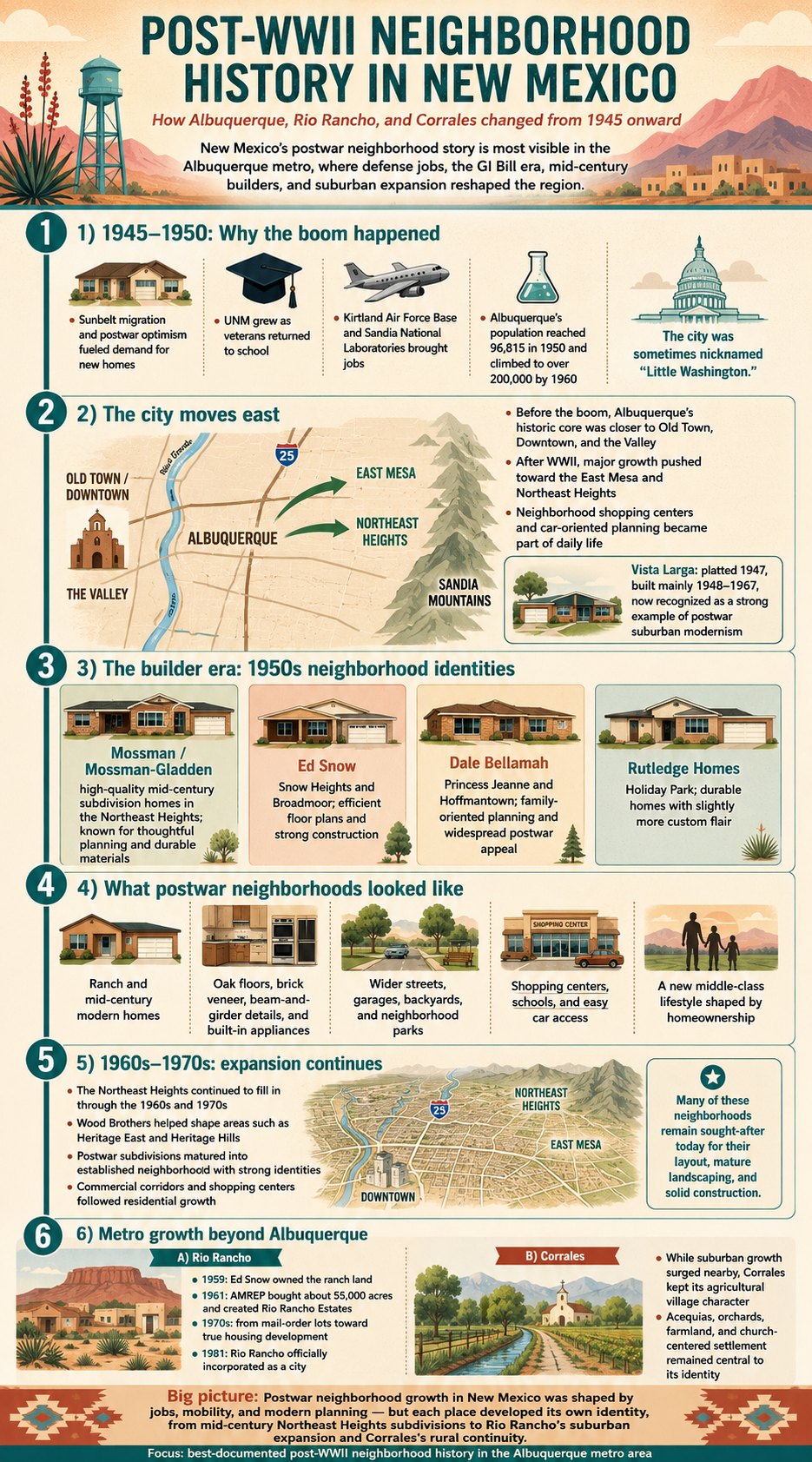
The transcript makes that connection clear when the conversation shifts from street names to builders. Tracy explains, “Post-World War II there was a massive shift towards the East Mesa and Northeast Heights because really downtown is where we started, and we started migrating east as Albuquerque grew.” That line matters because it places the Northeast Heights not just on the map, but in the timeline of Albuquerque. The postwar building boom did not just create more houses. It created new neighborhood identities, new planning patterns, and new names that still shape how locals talk about the city today.
That is where builder history and street-name history begin to overlap. Fred Mossman and Mossman Gladden became associated with thoughtful neighborhood planning, oak flooring, durable materials, and mid-century quality. Ed Snow became inseparable from Snow Heights and Broadmoor. Dale Bellamah became central to Princess Jeanne and Hoffmantown. Rutledge became linked to Holiday Park. Wood Brothers became part of the Heritage conversation. Richland Homes built its own reputation in postwar Albuquerque. These are not just construction names. They are neighborhood signals. They tell locals what era a home belongs to, what kind of planning went into the area, and what kind of reputation those houses still carry.
"Some street names tell you who built the neighborhood. Others tell you what existed there long before the neighborhood."
Tracy says of that generation of planners and builders, “And they kind of made, created Albuquerque. They laid out the grid, some of them, like the streets and the organization and parks in them, and just very forward-thinking.” That quote gets to the heart of why this topic belongs in a real estate blog. A neighborhood is never just a collection of addresses. It is a layout, a set of roads, a pattern of parks and schools, and a story about what kind of city people were trying to build. When a name like Snow Heights or Princess Jeanne survives for decades, it becomes part of the area’s identity in the resale market as well as in local memory.
That same logic helps explain why Albuquerque, Corrales, and Rio Rancho feel so different. In Corrales, the roads still sound like a village because the place still carries that village structure. Names connect naturally to agriculture, topography, and church-centered settlement. Readers who want more on that backdrop can start with the Village of Corrales history and agriculture page. In Albuquerque, the map layers colonial names, railroad names, institutional names, and postwar subdivision names on top of each other. In Rio Rancho, the dominant naming language is newer and more metropolitan, shaped by later planning and regional growth corridors.
That is why a road like Atrisco feels fundamentally different from Central Avenue, and why Central feels different from Menaul, and why Menaul feels different from a later corridor like Paseo del Volcán. Each belongs to a different chapter of local development. The names are doing historical work even when drivers barely notice them. They mark what kind of landscape came first: land grant, village, railroad grid, institutional corridor, or suburban expansion belt.
For buyers and homeowners, that context is useful in practical ways. It can help explain why a neighborhood has a certain lot pattern, why streets run the way they do, why a house style clusters in one area, or why some parts of town still feel connected to much older settlement patterns than others. It also helps explain why some neighborhood names carry so much weight in the market. A Mossman home, a Bellamah neighborhood, or a Snow Heights address does not exist in a vacuum. Those labels are part construction history, part planning history, and part local brand.
And finally, it is worth saying that not every street-name story is equally settled. Some are strongly documented through land-grant history, institutional records, or long-established local history sources. Others deserve more archival digging. That is not a weakness in the story. It is part of what makes this such a strong evergreen topic. New Mexico street names are not just a list to memorize. They are a living way to understand how place, culture, and growth are layered together across the Albuquerque metro.
Frequently Asked Questions
What does Atrisco mean in Albuquerque place names?
In this context, Atrisco is best understood as the name of a historic land grant and long-standing west side and South Valley community. That is why the name carries much more weight than a modern neighborhood label.
Why was Central Avenue once called Railroad Avenue?
Because the corridor began in Albuquerque’s New Town as a rail-oriented street. Its later rename to Central Avenue reflects the city’s growth into a broader commercial and civic center rather than just a railroad stop.
Is Menaul Boulevard named after a person or a school?
Both. The road was formerly Menaul School Road, and the school itself was named for Rev. James A. Menaul. That gives the boulevard a strong institutional origin story.
Why do Corrales street names feel different from Rio Rancho street names?
Corrales retains a more village-based and agricultural naming pattern, while Rio Rancho reflects a newer suburban and metropolitan growth era. The naming styles come from very different development histories.
Why do builder names still matter in Albuquerque neighborhoods?
Because builders like Mossman, Bellamah, Snow, Rutledge, and others shaped not just the houses, but the planning identity of entire neighborhoods. Their names still help buyers recognize era, style, and reputation.
Have questions about Albuquerque real estate?
If you are thinking about buying or selling, or just want to understand how the current market affects your plans, our team is here to be a resource.
Call or text: (505) 448-8888
Email: [email protected]
Website: WelcomeHomeABQ.com
Venturi Realty Group of Real Broker, LLC