
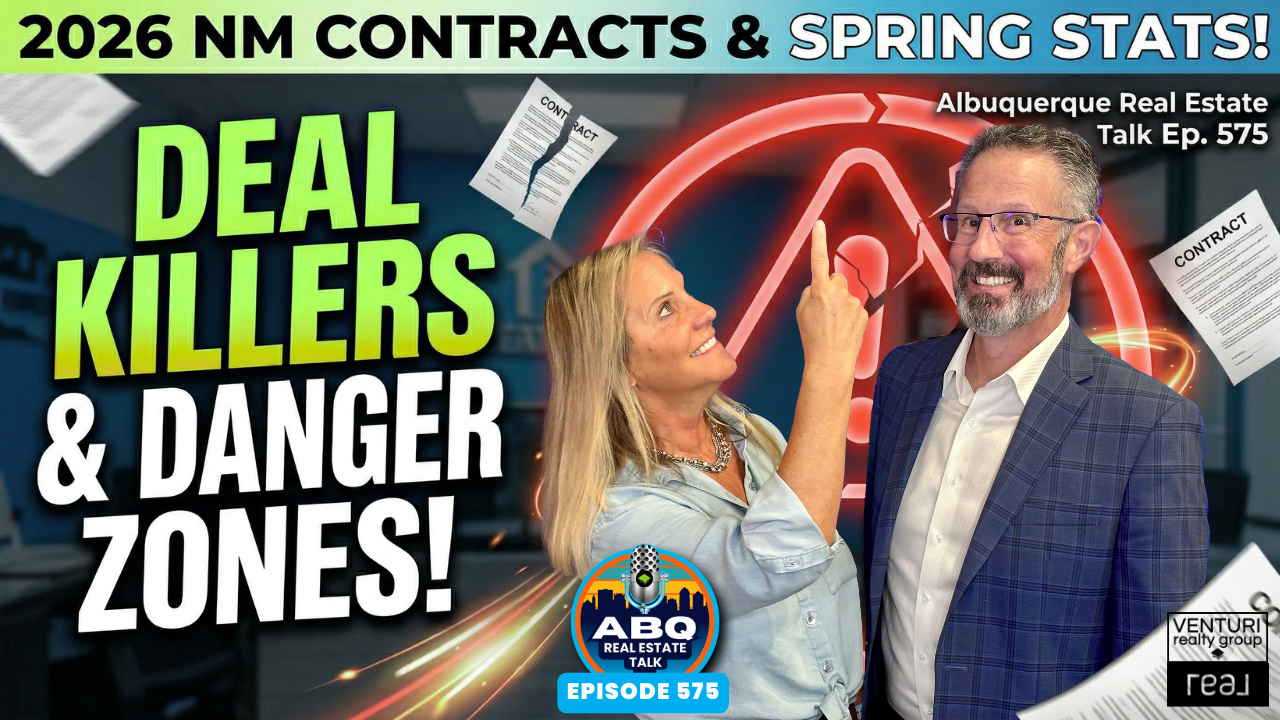
2026 NM Real Estate Contract Danger Zones and Obscure Spring Market Stats in Albuquerque
By Venturi Realty Group
Albuquerque Real Estate Talk, Episode 575 | Early April 2026
Spring in Albuquerque brings the usual burst of real estate energy: longer daylight, more listings, more buyers thinking about summer moves, and a market that feels active even when the numbers are more balanced than dramatic. In this episode of Albuquerque Real Estate Talk, Tego and Tracy Venturi move from light seasonal conversation into a serious look at the 2026 New Mexico purchase agreement and the small mistakes that can derail a deal.
Their central message is practical and timely for anyone buying or selling in Albuquerque, Rio Rancho, or the surrounding market. The new contract used by most Realtors in New Mexico has more structure, more deadlines, and more potential consequences if buyers, sellers, or even brokers miss a step. What looks like an innocent oversight can become a terminated contract, lost earnest money, or a closing delayed by federal compliance issues. Readers who want a general consumer guide to the closing process can also review the Consumer Financial Protection Bureau’s closing guidance.
"There's a lot of big changes in this agreement, and there's some things in there that can really bite somebody if they're not paying attention."
Along the way, the episode also offers a snapshot of the early spring Albuquerque housing market. Tego describes prices as essentially flat overall, with some mixed signals beneath the surface: median sale price down slightly year over year, price per square foot basically unchanged, pending sales appearing stronger, and several lesser-known indicators that paint a more nuanced picture than any headline number alone. For broader long-term context on how home values are tracked, the Federal Housing Finance Agency House Price Index is one of the standard public benchmarks.
The New 2026 New Mexico Purchase Agreement: Where Deals Can Quietly Go Wrong
The first major topic in this episode is the 2026 New Mexico purchase agreement, the form used in most residential transactions across the state. Tego emphasizes that the danger is not just in obvious disputes. It is in deadlines, documentation, and obligations that can be missed while everyone is busy with inspections, financing, title work, moving plans, and everyday life. As he explains, once a buyer and seller are under contract, there are “so many deadlines” and commitments that one missed step can seriously hurt the process.
One of the biggest changes is mandatory independent consideration, which Tego compares to option money. It is now a required payment from buyer to seller, and it is non-refundable. More importantly, the contract gives the buyer only three days to deliver it and the seller to acknowledge receipt. That short clock makes it one of the clearest danger zones in the new agreement. On the consumer side, this fits the broader reality that buyers need to submit documents and answer requests from lenders and settlement professionals promptly as closing approaches.
As Tego puts it, “The deal doesn't exist anymore.” That is how blunt the consequence can be if the independent consideration is not delivered and acknowledged in time. There is no casual reset and, as they explain, the seller could simply move on to another buyer without even needing a termination form.
"If they don't get it in three days and acknowledge it, termination."
The episode then shifts to what Tracy calls the “too much information trap” around inspections. Buyers may receive a long inspection report and understandably want to send everything over when asking for repairs or credits. But the contract rule they discuss is clear: do not send the entire inspection report unless the seller specifically requests it. If that full report is sent without that request and the transaction later terminates, the buyer could lose earnest money. On the seller side, receiving that full report may create new disclosure obligations if the deal falls apart and the home goes back on the market.
Tego sums up that issue in a way that every New Mexico buyer and seller should remember: don’t share the whole report unless the seller asks for it, and sellers should not ask for it casually without understanding the consequences. In a spring market where people are moving fast, these are exactly the kinds of technical mistakes that can turn a manageable transaction into a legal and financial headache. For readers newer to the process, HUD’s home-buying overview is a useful consumer resource on offers, inspections, financing, and settlement.
Key 2026 Contract Danger Zones Buyers and Sellers Need to Watch
- Independent consideration now has a hard three-day deadline: The buyer's failure to pay or deliver the Independent Consideration by the deadline renders the agreement invalid and automatically terminated.
- Neighborhood Vetting Expansion: The 2026 contract expands the inspection period to explicitly include a "thorough investigation of the neighborhood and surrounding areas". Buyers can walk away if they discover things they dislike about the area.
- The "I'll Pay the Appraiser Later" Trap: The 2026 contract explicitly requires that the appraisal must be both ordered and paid for by the appraisal deadline. If a buyer drags their feet on paying the invoice, they risk defaulting on the appraisal contingency
- Sending the full inspection report can create a breach problem: If a buyer sends the entire report without the seller specifically requesting it, the buyer could lose earnest money if the deal later terminates.
- Sellers can create new disclosure duties by receiving inspection details: Once a seller has the full report, material facts in that report may have to be disclosed to future buyers if the first deal falls through.
- Loan denial timing matters under the financing contingency: If financing falls apart too close to closing and the required denial letter is not delivered in time, the buyer risks forfeiting earnest money.
- Buyers can waive objections by missing review deadlines: Documents related to title, HOA information, permits, surveys, and inspections all have review windows, and missing them can mean losing the right to object.
- FIRPTA documentation has to be handled before closing: Sellers must document that they are not a foreign person with the title company before signing or proceeds may be withheld for taxes under federal rules explained by the IRS FIRPTA guidance and related Form 8288 instructions.
What the Early Spring 2026 Albuquerque Market Is Really Showing
Before digging into the contract language, the episode also offers a useful early-April read on the Albuquerque market. Tego cautions listeners not to overreact to single-month headlines. The median sale price for single-family detached homes was running at $365,000, which he says was down 2.7% from a year ago, but he quickly adds that a one-month snapshot can be misleading. When smoothed over a longer period, he describes the market as essentially flat rather than falling.
His plainest summary is also the most important: “There's nothing in our market that indicates, you know, prices are gonna drop substantially. It is just flat.” That is a notable message for buyers waiting for a crash and sellers worried that the market is slipping away. In his view, Albuquerque is not showing signs of dramatic deterioration. It is showing balance. For readers who want a broader frame of reference, FHFA explains that its House Price Index is a national measure of single-family house-price movement, and its summary tables and calculator can help consumers understand long-run price trends.
"This is what a balanced market looks like."
He supports that with several specific observations. Price per square foot was almost identical to last year at roughly $214 versus $213. In the $400,000 to $600,000 range, price per square foot was actually up about 3.5% year over year, while the $600,000-and-above segment showed a modest decline. He also notes that sales appear likely to be slightly higher than last year, pending sales appear up, and new listings may be down, which is why he describes the market as full of mixed signals rather than moving in one obvious direction.
The later portion of the show adds more obscure but revealing stats. Tego says 36% of homes that closed had some sort of seller concession, which he notes is much higher than in 2022. He also says 15.7% of March 2026 closings were above list price, a reminder that desirable homes in strong areas can still attract multiple offers even in a more balanced market. Cash sales came in at 12%, which he describes as relatively normal and actually on the low end historically. And for pending transactions that fall out and come back on market, he says the fallout rate is 18%—below the urban-legend numbers people often throw around, but still meaningful enough to show why contract management matters. Buyers moving through that process should also review the Consumer Financial Protection Bureau home-buying resources and carefully review documents before signing.
Tracy brings the discussion back to homeowners by noting that every neighborhood and every price point behaves differently. For anyone thinking about selling this spring, their advice is to look beyond broad metro headlines and focus on what relevant sales in that specific area show the market will bear. That local approach fits the rest of the episode: broad awareness matters, but details decide outcomes.
"There's not a huge surge in supply. There's not a huge surge in demand. We're just kind of steady."
Frequently Asked Questions
What is independent consideration in the new 2026 New Mexico purchase agreement?
In this episode, Tego describes independent consideration as option money: a non-refundable payment from the buyer to the seller so the home is taken off the market while the buyer performs due diligence. It is one of the most important new contract items discussed because it now has a specific timing requirement that can affect whether the agreement stays in force.
What happens if independent consideration is not delivered within three days?
According to the discussion, if the buyer does not deliver the money and the seller does not acknowledge receipt within the three-day deadline, the transaction can terminate and the seller may move on to another buyer. That is why this step is not just paperwork. It is a real contract deadline with real consequences.
Can a buyer send the full inspection report to the seller?
Not unless the seller specifically requests it. The episode warns that sending the whole report without that request can create a breach issue and may cause the buyer to lose earnest money if the deal later falls apart. Buyers should work closely with their broker so repair requests are handled correctly and strategically.
Why would a seller avoid asking for the full inspection report?
Because once the seller receives that report, any material facts in it may have to be disclosed to future buyers if the current contract terminates. What seems like a simple request for more information can create a broader disclosure obligation later if the home goes back on the market.
What happens if a buyer’s loan is denied right before closing?
The episode explains that timing matters. If financing fails too close to closing and the required denial letter is not delivered by the contract deadline, the buyer may risk losing earnest money. It is one more reason the Venturi team emphasizes staying in close contact with the lender throughout the transaction.
Why do local lenders matter in a transaction like this?
Tego and Tracy point out that communication is a major part of keeping deals together. They prefer local lenders because it is usually easier to get updates, address underwriting issues quickly, and spot red flags before they turn into closing-day problems. In a contract full of tight deadlines, responsiveness matters.
What kinds of deadlines can buyers accidentally miss besides financing?
Buyers may have deadlines tied to title review, HOA documents, surveys, permits, inspections, and other due diligence items. If those deadlines pass without an objection, the buyer may waive certain rights under the contract. That is why opening emails, reviewing documents quickly, and staying engaged is so important.
What is FIRPTA and why does it matter at closing?
FIRPTA is the federal tax law that can require withholding when U.S. real property is sold by a foreign person. The IRS explains the rule and the related filing requirements in its FIRPTA guidance and Form 8288 reporting instructions. In the episode, Tego explains that sellers need to provide the required documentation to the title company ahead of closing so money is not unnecessarily withheld.
What did the episode say about the Albuquerque spring 2026 market?
Tego described the market as balanced and mostly flat. He said prices were not showing signs of a substantial drop, price per square foot was basically in line with last year, and several stats such as concessions, above-list closings, cash sales, and fallout rates showed a market with mixed but steady signals. For broader context, FHFA publishes public house-price data and summary tables tracking longer-term trends.
Are homes still selling above list price in Albuquerque?
Yes, some are. Tego shared that 15.7% of March 2026 closings sold above list price, which shows that well-priced homes in desirable areas can still attract strong demand and even multiple offers. At the same time, that does not mean every listing will behave the same way, which is why pricing and neighborhood-level analysis still matter.
How common are concessions and contract fallout right now?
The episode notes that 36% of homes that closed had some form of concession and that the fallout rate for pending homes was 18%. Those numbers help show why buyers and sellers need careful guidance from contract to closing. Even in a steadier market, a meaningful share of deals still need credits, adjustments, or recover from potential derailments.
What is the main takeaway for buyers and sellers from this episode?
The biggest takeaway is that the easy part is often getting under contract. The harder part is managing the transaction all the way to the closing table. In the 2026 New Mexico contract, small mistakes involving timing, paperwork, communication, or disclosures can create serious problems, so having a trusted real estate advisor is more important than ever.

Have questions about Albuquerque real estate?
If you are thinking about buying or selling, or just want to understand how the current market affects your plans, our team is here to be a resource.
Call or text: (505) 448-8888
Email: [email protected]
Website: WelcomeHomeABQ.com
Venturi Realty Group of Real Broker, LLC