
New FinCEN Reporting Rules for Real Estate: What Buyers and Sellers Actually Need to Know
If you’ve heard people talking about “new federal reporting rules” for real estate, you’re not alone. There’s been a lot of confusion — and honestly, a lot of unnecessary fear — about what the FinCEN Residential Real Estate Reporting Rule means for everyday buyers and sellers.
The goal of this article is simple: clear up the myths, explain when the rule may apply, and help you understand what information could be required during a transaction.
To make it easier, I’ve also built a step-by-step FinCEN Reporting Wizard that you can use to quickly screen a sale and see how the rule might apply. You’ll find it embedded below.
First — What Is the FinCEN Reporting Rule?
FinCEN is a federal agency focused on financial transparency and anti-money-laundering efforts. The new residential real estate reporting rule is designed to bring more visibility to certain property transfers — particularly transactions where ownership structures make it difficult to identify who is really behind the purchase.
This rule is not aimed at the average homeowner buying a house with a normal mortgage. Instead, it focuses primarily on higher-risk transaction types.
When Does FinCEN Reporting Usually Apply?
Most traditional home purchases will never trigger this rule.
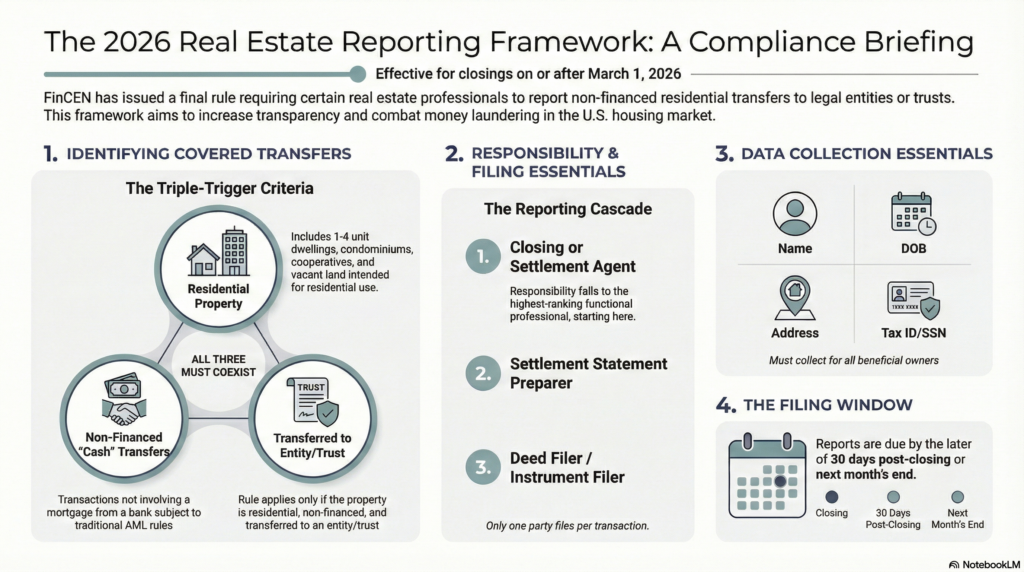
In general, a transaction is more likely to fall under FinCEN reporting when it involves:
- Non-financed or privately financed purchases (all-cash, seller financing, hard money, or private lending)
- Buyers using legal entities such as LLCs, corporations, or certain trusts
- Residential properties in the United States designed for 1–4 families
That doesn’t automatically mean reporting is required — but it raises the likelihood that the settlement agent will need to review the transaction more closely.
When the Rule Usually Does NOT Apply
Many everyday transactions are typically outside the scope, including:
- Purchases financed through a regulated bank or credit union
- Individuals buying property directly in their own names
- Certain court-ordered or supervised transfers
That said, every transaction is unique. The final determination is made by the reporting person or settlement professional, not by a checklist alone.
What Information Might Buyers Need to Provide?
If a transaction falls into a reportable category, buyers may be asked for additional details during closing. This often includes:
- Legal name and address of the purchasing entity or trust
- Identification information for individuals who own or control the entity
- Details about the person signing documents on behalf of the entity
- Payment and funding information
For individual buyers, the requirements are generally lighter — but settlement agents may still verify identity information.
What Sellers May Be Asked For
Seller reporting requirements are typically more straightforward. Depending on the structure of ownership, sellers may need to provide:
- Legal name and address
- Identification type and number
- Trustee details if the property is owned in a trust
These requests usually come from the title company or settlement professional handling the closing.
Why This Rule Exists
Real estate has historically been one of the few major asset classes where ownership structures could sometimes obscure who was behind a purchase. The FinCEN rule aims to bring consistency to reporting and reduce the risk of financial crimes — while still allowing normal transactions to move forward smoothly.
The key takeaway is this: the rule is not designed to slow down legitimate buyers and sellers. It simply adds another layer of transparency in certain situations.
Use the FinCEN Reporting Wizard
Because the rule can feel complicated, I built an interactive screening tool to help break it down into plain language.
Use the FinCEN Reporting Wizard below to see how a specific transaction may be categorized.
Final Thoughts
New regulations always bring questions, and this one is no different. The most important thing to remember is that most traditional home purchases will not be affected. For transactions that do fall within the rule, the process is usually handled behind the scenes by settlement professionals.
If you’re unsure how a specific situation fits, start with the wizard, then talk with your real estate professional, attorney, or title company for guidance.
Clarity beats confusion — and understanding the process ahead of time makes closing day much smoother for everyone involved.